
UK shares science expertise to enable ASEAN to deliver its AI and climate goals
By Valeryn Liaw
As ASEAN’s AI ambitions drive demand for data centres and power, the UK is offering its science and experience to help the region grow without missing its climate targets. Her Excellency Helen Fazey, UK ambassador to ASEAN, shares more.
-1794292645817.jpg)
Her Excellency Helen Fazey is the UK ambassadr to ASEAN. Image: ASEAN
Floods, droughts, and heatwaves are putting climate resilience at the top of the agenda across Southeast Asia.
Creating tension at the heart of this effort is the growing number of data centres to power the region’s artificial intelligence (AI) ambitions, which consumes significant natural resources.
The UK, which is further along in managing this tension, wants to share evidence from its urban climate adaptation work to support ASEAN’s strategic planning as the region pursues AI while working towards its sustainability targets.
“Whether in Southeast Asia or the UK, we all face a need to rapidly reduce our emissions and scale up adaptation for vulnerable communities,” says Her Excellency Helen Fazey, UK Ambassador to ASEAN, to GovInsider.
Through its capacity building work in the region, the UK government is looking to put technology to work as a tool to address climate challenges around AI development.
Focus on climate resilience and cleaner energy
Fazey says as AI grows, making the infrastructure behind it more efficient and increasingly powered by clean energy will be key to keeping that growth sustainable.
The ASEAN’s Guide for Sustainable Data Centre Development acknowledges the challenge of AI’s environmental footprint, calling for digital expansion to be balanced with environmental sustainability and resource security.
“Regional frameworks and partnerships are important for setting direction, but implementation depends on translating those priorities into national and local policies, budgets, institutional responsibilities, technical capability, and investment decisions," Fazey notes.
To understand what capacities the region needs, the ASEAN-UK Science, Technology, and Innovation Dialogue focuses on identifying these priorities for the cross-border cooperation.
“We are working together to increase ASEAN’s capability to adopt and scale technological solutions to regional challenges, such as promoting engineering biology for sustainable growth in ASEAN.”
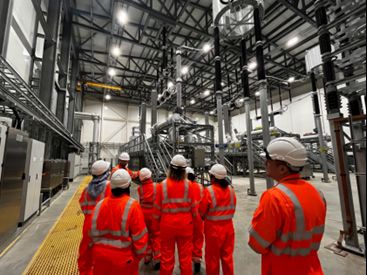
Engineering biology combines insights from biotechnology with engineering principles to harness biological processes to create new products and services.
Fazey also facilitates cross-border exchanges between ASEAN and the UK to learn more about how electricity grids connection can strengthen resilience and bring more renewables into the network.
AI used to assess energy supply and demand
“We should look at how AI can improve forecasting, grid management and system efficiency, making it part of the solution to energy resilience, not just a source of demand,” Fazey says.
Additionally, the UK’s Foreign, Commonwealth and Development Office (FCDO) also commissioned the AI for Sustainable Development in ASEAN study, which identified high upfront costs and limited access to renewable energy as barriers to greener data centres.
“There is no single answer on how to navigate the trade-offs because the energy and environmental systems, digital infrastructure and regulatory conditions differ across ASEAN,” Fazey says.
To her, useful cooperation would include shared evidence, transparent measurement, stronger efficiency practices and investment in cleaner and more resilient systems.
The UK also supports community-level climate work through SustFridge, an FCDO-funded initiative developing solar-powered refrigerators for communities with limited access to electricity.
The project aims to cut food and medicine spoilage and improve energy efficiency, using phase change materials to make the cooling more efficient.
The collaboration has since built a digital twin for remote monitoring and formed local partnerships, including with rural clinics and communities in Malaysia.
Balancing capacity building with sovereignty
Fazey believes that greater regional coherence, alongside strengthened capacities, enable ASEAN member states to implement priorities in ways that reflect their own unique circumstances.
To strengthen national capacity, she says countries should:
-
Invest in capable public institutions, technical skills and reliable climate and digital data.
-
Integrate climate resilience into infrastructure, urban planning, public services and budgets.
-
Connect government, researchers, businesses and investors to commercialise and scale locally developed solutions.
The ASEAN-UK Plan of Action 2027-2031 has set out the shared ambitions to strengthen responsible AI governance, technical capability and AI for development.
“The focus is to translate existing principles into practical implementation, while recognising Member States’ differing needs, priorities and levels of readiness,” Fazey says.
As AI technologies and applications evolve, the common goal is to pursue technological ambitions and clean power together.
Institutional capability needs to go beyond accessing the latest technology, she says.
"ASEAN institutions need the xpertise to assess where AI adds value, understand and manage its risks, establish appropriate governance, and translate evidence into policy and implementation,” she highlights.
This requires diverse stakeholders to move from the technological research and early testing into practical uses.
“Regional and international partners may provide evidence, expertise and finance, but this will not substitute the importance of sustained national leadership, domestic investment and accountable institutions.”