
Video: Humility helps governments solve real-world problems in the AI era
Governments do not need a “silver bullet” to navigate the artificial intelligence (AI) era. Instead, they need the humility to learn from different sectors and remain focused on solving real-world problems, according to UNDP’s Juan Kanggrawan.
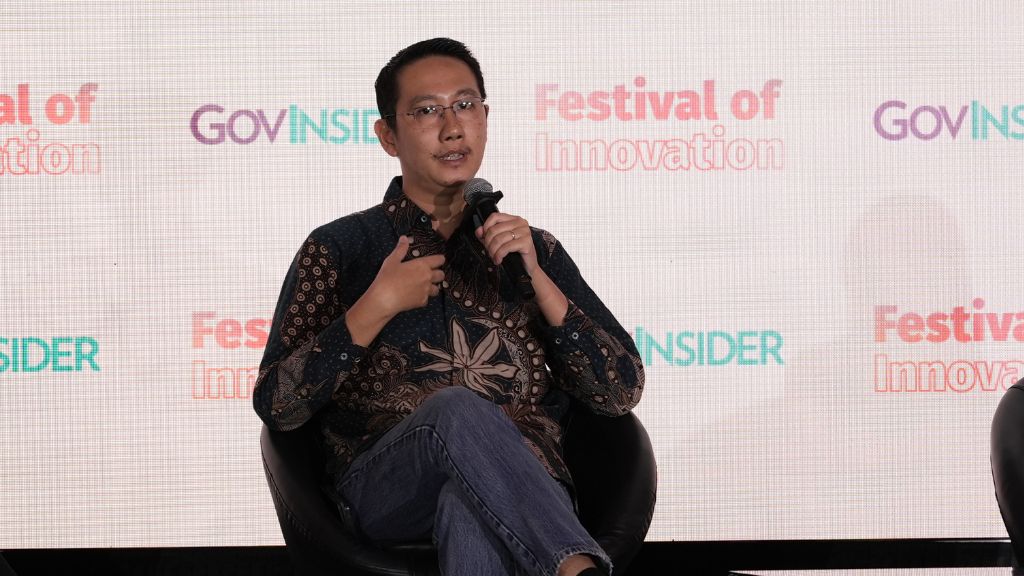
UNDP's Regional Digital and AI Expert, Juan Kanggrawan, reflects on his experience in both government and the private sector at the GovInsider's Festival of Innovation 2026. Image: GovInsider
As governments accelerate their artificial intelligence (AI) transformation efforts, the biggest challenge lies not in the technology itself, but whether institutions can embrace cross-sector collaboration and maintain the humility to keep learning.
“Many people think there's a silver bullet. You're in an AI tech startup, you can solve everything. You're in the government, you can do all the policy. I don't think so,” said UNDP’s Regional Digital and AI Expert, Juan Kanggrawan.
Speaking to Civic Punks’ podcast host, Derek Alton, on the sidelines of GovInsider’s Festival of Innovation (FOI) in Singapore, in March this year, Kanggrawan shared what he learned from his time in government.
“First is humility. Don't think you are the best. You know everything. Try to learn and work with people from multiple perspectives,” he said.
The second is the ability to solve problems. Referencing former US President Barack Obama, Kanggrawan said the most valuable people in any organisation are those who can execute and deliver results.
“I need people who can do, get the things done. Problem solver,” he said, adding that the principle applies to anyone working in a startup, government, university, or international organisation.
From unicorns to public impact
Before joining UNDP, Kanggrawan spent years working in Southeast Asia’s private sector, including unicorn companies and smart city initiatives.
His journey into government and international development began through volunteer work between Singapore and Indonesia, where he became involved in public sector projects and social initiatives.
What attracted him was the opportunity to connect technology with policymaking and tangible impact.
“I find it very satisfying, whereby I can blend technology, policy to actual impact,” he said.
The experience also shaped his belief that innovation cannot be developed in isolation, and that every sector brings valuable perspectives to the table.
Rethinking pilot projects in government
Drawing on his experience working with governments, Kanggrawan noted that public institutions often struggle to move quickly due to procurement processes, regulations, and bureaucratic complexity.
Pilot projects, he said, can provide a practical way to experiment rapidly while managing risk.
“Pilot is for low-hanging fruits. It means low to medium complexity and medium to high impact,” he said.
However, he cautioned against assuming that every pilot should automatically be scaled nationwide.
A pilot that succeeds in one province or city may not necessarily be suitable for every region, particularly in countries with diverse social, economic, and administrative contexts.
“Maybe three to five or maybe ten provinces are good enough, depending on the needs and how far you want to scale, and how many resources that you have,” he added.
Rather than viewing pilots solely as proof-of-concepts (POCs) before large-scale implementation, Kanggrawan believes governments should also see them as mechanisms for learning — including learning how to deal with failure.
“In startup, it's normal. You fail, don't hide it, admit it, learn from that and improve moving forward,” he said.
Kanggrawan noted that public institutions often find it harder to acknowledge unsuccessful programmes because of political and reputational pressures.
Yet, without experimentation and without accepting that some initiatives will fail, innovation becomes difficult.
Bringing regional lessons to new contexts
Looking ahead, Kanggrawan hoped lessons from more mature digital ecosystems such as Singapore could be adapted effectively across other countries and cities in Asia-Pacific.
However, he emphasised that success does not come from simply copying existing models, but from understanding local contexts and needs.
His long-term focus is ensuring that digital transformation reaches smaller cities and rural communities, rather than remaining concentrated in major urban centres.
“I hope by the blend of this experience, it can be useful for several replications, several implementations to some cities and countries in Asia-Pacific,” he said.
You can watch the full video below: