
Villages are the real frontline to protect migrant workers
Field research in a West Java village reveals that migration is driven as much by aspiration as by necessity, and that protecting migrant workers starts not in the capital city, but at the village level.

The prospect of working in developed countries is often a career aspiration for people living in rural communities. Village leaders and migrant workers who are already in destination countries play an important role in providing prospective migrant workers with trusted information. Image: Canva
This article is based on findings from "Program Desa Aman Migrasi," a collaboration between Universitas Padjadjaran, Indonesia, and Universiti Malaya, Malaysia, funded by the Indonesian Endowment Fund for Education (LPDP) under the EQUITY Program.
Every year, thousands of Indonesian young people, particularly in West Java Province, leave for jobs in Japan, Taiwan, and South Korea.
In Kuningan Regency, labour migration is nothing new. This has passed down from one generation to the next.
Yet when we ask, "what is the village's role in protecting these prospective migrant workers?", the answer is often silence. Not because villages don't care, but because they don't know where to begin.
For years, the conversation about migrant worker protection has mostly happened at the national level: new laws, bilateral agreements, and digital campaigns run by the central government.
Villages, the very places where migration decisions are made and where migrants eventually return, are rarely treated as policy actors in their own right.
But our field research in April 2026, Babakan Mulya Village, tells a different story.
It shows that villages, through the trusted figures within them, are exactly where migration decisions get made, checked, and finally trusted.
Migration is about aspiration, not just necessity
The old story about labour migration usually starts with one assumption: people migrate because they have limited job opportunities and have no other choice.
That is not entirely wrong, but it no longer fully explains today's generation of migrants.
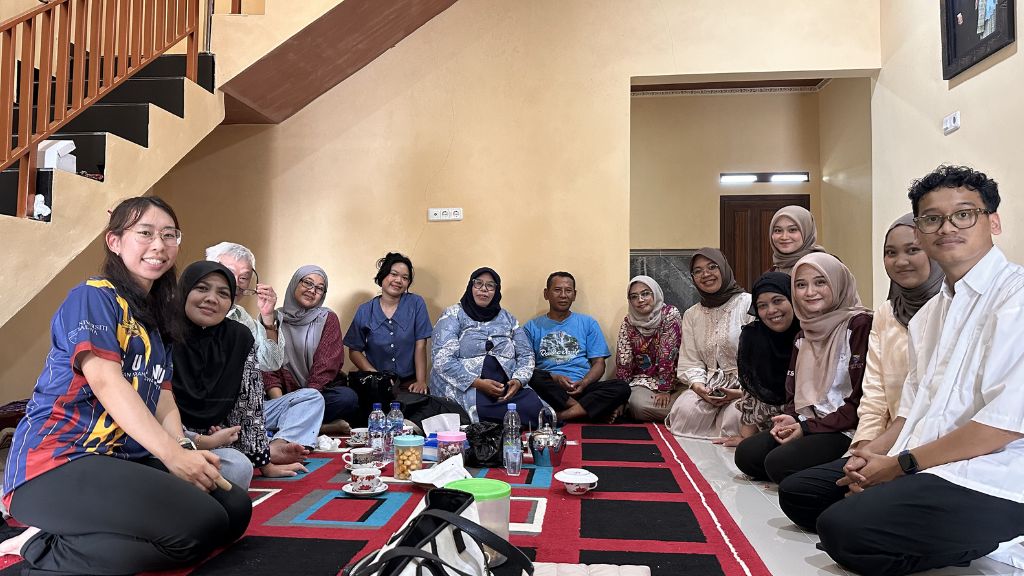
In our research with twenty-one people, prospective migrant workers and staff at the local Vocational Training Centre (BLK), a different pattern emerged.
Young people in the village choose to migrate not simply because they lack options, but because migration has become something they want.
Short videos about life and work in Japan, salaries that look impressive, and admiration for advanced technology, including stories about automated machines in factories, smart tools for elderly care — these all make migration feel like a path to a better, more modern version of oneself.
One young participant put it simply: he wants to go to Japan not just for the money, but because "the technology there is so advanced, I want to experience it myself."
This is where the BLK or the vocational training centre in villages plays a role that hasn't been given enough attention. It is not just a place for Japanese-language classes or technical training. It works as an institutional bridge between aspirations sparked by social media and a migration process that is actually safe and legal.
Instructors at the BLK, referred to by participants as sensei, act as trusted checkpoints: information about job openings, updates on which sectors are hiring, and even rumours circulating online all pass through them before young people believe it.
This finding matters because it points to both a gap and an opportunity. Social media is clearly good at sparking interest in migration, but trust still flows through local networks and institutions like the BLK.
That gives village governments a strong reason to treat the BLK and other trusted local figures as their main policy partners, not just as technical training providers.
Selective skepticism: An opportunity and a blind spot
Our research also found that prospective migrant workers in the village are actually quite critical of the information they see online, but only in certain areas.
Claims about salary, contracts, and working conditions are almost always double-checked with family, friends already working abroad, or a sensei at the BLK.
Claims about how advanced or modern life is in the destination country, however, are rarely questioned at all. For many young people, that part is simply taken as a fact.
This has clear policy implications. Generic digital literacy campaigns won't work well if they don't target the specific areas where verification isn't happening.
This is exactly where villages, through the BLK and existing social networks, can be far more effective than top-down digital campaigns run by government social media accounts, which, according to our findings, are rarely trusted sources of information for village residents anyway.
Rural women: Layers of vulnerability
While the findings above show how villages can become hubs of trust, the IOM fact sheet on rural women and migration reminds us of something else that policy at the village level often overlooks: rural women face layered vulnerabilities that village-based policy rarely addresses.
Women in remote areas often lack access to identity documents, safe migration information, and networks strong enough to verify job offers.
At the same time, they are also the ones most at risk of scams, trafficking, or exploitative contracts once they step outside the safety of family support.
Notably, the same report also points out that returning women migrants often face stigma back home, and are blamed for an "indulgent lifestyle" rather than recognised as victims of a system that failed to protect them.
This means the village's role isn't only about preventing risky departures. It's also about how villages welcome migrant women home and support their reintegration, without piling on more stigma.
These two findings, young people driven by technological aspirations and the specific vulnerabilities facing rural women, point to the same conclusion.
Villages are not passive places that migrants simply leave behind. They are active hubs where risks can be prevented from the very start, as long as they have the capacity and clear policy direction to do so.
So where should villages start?
Villages' confusion about "where to begin" can actually be answered fairly concretely, if we treat the findings above as a roadmap:
First, villages don't need to build a new digital information system from scratch.
What matters more is strengthening the verification role already trusted by residents — the BLK, community leaders, and networks of returned migrants — so they have access to accurate, up-to-date official information about job sectors, worker rights, and current scam patterns.

Second, villages need a dedicated mechanism for women migrant candidates: gender-sensitive pre-departure information sessions, help accessing travel documents, and a clear channel for reporting exploitation, rather than relying solely on national programmes that rarely reach the village level.
Third, villages need to rethink how they see returned migrants, not just as "people who once left," but as a knowledge asset.
They are the most trusted source of verification for the next generation of migrants, and they can also play a role in reintegration programmes that don't stigmatise.
Fourth, instead of focusing mainly on digital campaigns, villages need to recognise that effective digital literacy actually needs to be delivered through trusted, face-to-face figures, because that is where migration decisions are really weighed and finalised.
Migrant worker protection is often imagined as a big project handed down from the capital or negotiated between states.
Having said that, the decisions that matter most in a migrant's journey — which information to trust, whether to come home safely — almost all happen at the village level.It's time migration protection policy stops treating villages as passive recipients of policy and starts treating them as the strategic point where protection can actually begin.
-----------------------------------------------------------------------------------------
The author is a lecturer at Indonesian public university, Universitas Padjadjaran. She was previously the Head of Implementation and Tribe Lead of Citizen Engagement and Services at Jabar Digital Service, a GovTech delivery unit under the West Java Provincial Office of Communication and Informatics.