
What it means to weave empowerment into Singapore’s active ageing strategy
By Sol Gonzalez
Duke-NUS Medical School’s inaugural Singapore Conference on Ageing and Health highlighted findings that may help to inform how Singapore designs policies that enable people to age well in place.
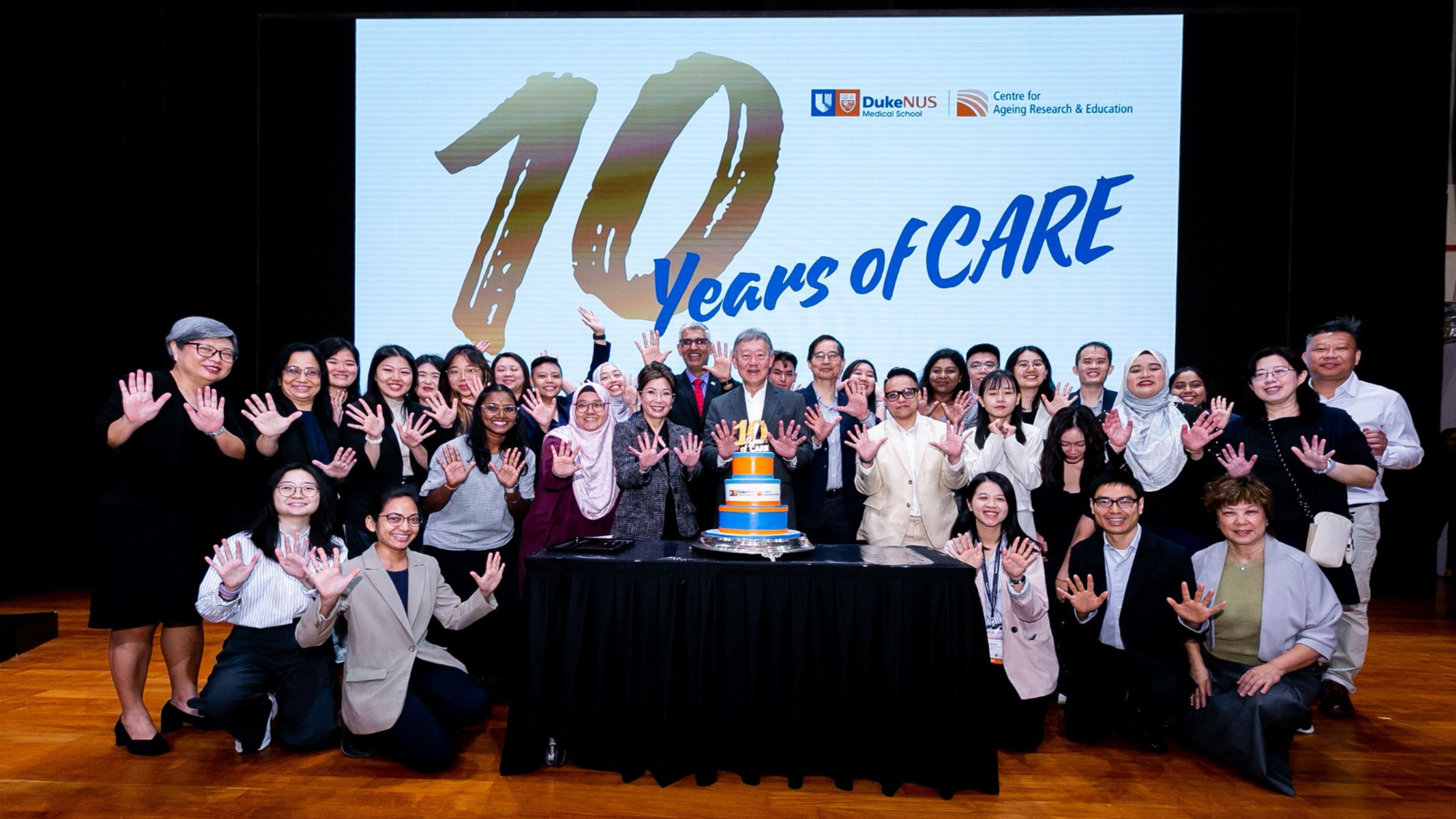
The Singapore Conference on Ageing and Health 2026 also saw Duke-NUS' Centre for Ageing Research & Education celebrate its 10th anniversary. Centre, with cake: Guest-of-Honour Goh Yew Lin, with Executive Director Assoc Prof Rahul Malhotra and Senior Advisor Assoc Prof Angelique Chan on his right, and Dean of Duke-NUS, Prof Patrick Tan, on his left, posing with the CARE team. Image: Duke-NUS Medical School.
A rapidly ageing population is not just a demographic shift, but a systemic challenge.
This was one of the core messages underpinning the inaugural Singapore Conference on Ageing and Health organised by Duke-NUS Medical School on February 2 and 3.
Researchers, policymakers, healthcare professionals and community organisations convened to examine issues that the ageing societies face, and how to better design communities that support them.
“Ageing reshapes how we think about health, how we organise care, how communities function, and how societies sustain themselves over time.
“Addressing it meaningfully requires evidence, integration, and translation at scale,” noted Duke-NUS' Dean, Professor Patrick Tan, in his opening address.
He highlighted the role of Duke-NUS’ Centre for Ageing Research & Education (CARE) in translating research into policy implementation to support national initiatives like Age Well SG.
The conference also saw CARE researchers presenting findings on how to better design programmes that align with older persons’ routines and interests, and strategies to better mitigate social isolation and loneliness.
Designing meaningful ageing initiatives
Older adults formed stronger social connections when they were encouraged to co-create programmes.
This was a key finding from a Duke-NUS' study conducted between 2023 and 2025 to assess the implementation of Active Ageing Centres (AAC) service model in Singapore.
“The larger objectives were to understand the context and mechanisms of operationalising the AAC and understanding what works for whom, speaking to older persons, frontline staff, and senior management personnel,” said CARE’s Researcher, Atiqah Lee.
Older adults also prioritised comfort and familiarity when socialising, such as going to a hawker centre or void deck to connect with friends instead of “making an effort” to go to new environments like AACs.
“Literature is telling us that as people age, they look for social networks that are aligned with their evolving priorities, emphasising on emotional fulfilment,” explained Lee.
The study recommended AACs to design activities around the older adult’s existing routines and aspirations, as this “would save older adults from the social cost of having to recalibrate themselves in new, unfamiliar settings”.
Another recommendation was for AACs to explore curating programmes that are intentional in fostering mutual trust and deeper connections, as this group enjoy therapeutic conversations where they could address sensitive topics in a safe space.
The overarching goal was to strengthen weak social ties and embed connections within broader community networks, maintaining low barriers to participation, and “meeting older persons where they are”.
With these findings, community-based ageing initiatives can improve their structures to better meet older persons’ social and emotional needs.
“Beyond extending lifespans, we need [active ageing] models that support social connection, psychological well-being and a sense of purpose, so older persons can age with dignity and meaning,” said CARE’s Executive Director, Associate Professor Rahul Malhotra.
GovInsider previously explored the strategies that Singapore has put in place to support elderly people, from social initiatives to preventative care.

Enhancing care in medical settings
With a rapidly ageing population comes an increase in chronic diseases, which requires effective communication between doctors and elderly patients at a higher rate, noted SingHealth Duke-NUS Global Health Institute’s Taufique Joarder.
He was behind the study that examined the perceptions of elderly people regarding respectful, responsive, and dignified care, aiming to assess their needs to inform better healthcare.
The study found that elderly people want clear information about their conditions and prefer to be involved in decision-making more actively, which was challenging due to diverse linguistic needs.
To improve this, the study recommended integrating respectful care standards and mandating language support in healthcare facilities, promoting advanced care planning and creating incentives for more time allocation for patient engagement.
“Many of the questions in ageing are about trajectories: how health changes across the life course, how care is coordinated, and how systems either support or fail people as needs get more complex,” noted Duke-NUS' Governing Board Chair, Goh Yew Lin.
“As populations age, the responsible choice is not short-term fixes, but steady investment in research that builds knowledge over time and improves how care is actually delivered,” he concluded.