
What Ukraine's digital resilience taught Estonia about building an agentic AI state
By Valeryn Liaw
“The most important measure of resilience is your adaptive capacity,” Luukas Ilves, the AI advisor at the Estonian Government Office, shares.
-1790041585045.jpg)
Having once advised Ukraine on AI, Estonian Government Office's AI advisor Luukas llves is now bringing Ukraine's digital resilience lessons back to Estonia to help build its agentic AI state. Image: Canva
In the military, commanders give their soldiers a clear objective instead of prescribing them with instructions for every possible scenario that may happen on the battlefield.
When the battlefield changes, soldiers should be able to adapt and make decisions without waiting for new orders.
The principle, known as Commander’s Intent, offers a useful way to think about the Ukraine’s resilience to keep the state running even during times of crisis.

Since Russia's invasion in 2022, the Ukrainian government continued delivering public services while dealing with cyberattacks, physical destruction and the displacement of citizens.
“The most important measure of resilience is your adaptive capacity,” Luukas Ilves, the AI advisor at the Estonian Government Office, shares with GovInsider.
“And the simple reason for this is that we cannot game through every possible scenario and every risk.”
For two years, Ilves was an advisor to Ukraine's Ministry of Digital Transformation and deputy Prime Minister Mykhailo Fedorov.
Having once advised Ukraine on AI, he is bringing Ukraine's digital resilience lessons back to Estonia to help build its agentic AI state.
Building the readiness before the crisis
Ilves noted that Ukraine’s adaptability did not emerge during wartime, but they had spent years building its digital government, drawing on Estonia’s experience from 2014 and accelerating that work after 2019.
Having worked closely with Ukraine’s digital team, Ilves saw first-hand how Estonia’s experience in building digital government has been adapted to Ukraine.
“A lot of the service architectures were inspired and copied from Estonia. The legislation for digital identity, the data exchange platform that Ukraine set up, a lot of sectoral reforms were patterned on what Estonia's already done,” he adds.
The agile development allowed Ukraine to scale up the digital work during the Covid-19 pandemic, subsequently giving them the the capability to move quickly in wartime.
As the first state in the world to introduce legally recognised digital passports, Ukraine has demonstrated rapid innovations, as reflected in Diia, by adopting a mobile-first approach to drive widespread adoption of public services.
The superapp has been supporting more than 150 digital services and has now incorporated Diia.AI to complete the service requests.
“The capacity and success from peacetime became the launching pad for a lot of what has happened in defence,” Ilves says.
Ukraine was able to deploy new classes and services within weeks, including services for reporting war crimes, documenting damage, notifying authorities about enemy movements, and applying for refugee status and benefits.
Ukraine also challenged conventional assumptions about digital sovereignty.
Before the invasion, Ukrainian government systems and backups were moved outside the country and onto commercial cloud infrastructure, allowing the government to protect the operations against physical destruction.
“In wartime, sovereignty may not follow geography in the same way it does in peacetime,” Ilves says.
As what Ilves shares, “governments should assume they may have to rebuild, rebase, and rearchitect their systems overnight.”
Building a reserve of talent capacity
The country's earlier digital transformation helped create public confidence while reducing the time to assemble technical resources.
“It's a combination of the long-standing civil service expertise with an understanding both at a technical and operational level of how things work in fast-paced commercial services,” llves notes.
Estonia is no stranger to building cyber resilience.
When Estonia faced the 2007 cyberattacks, the government subsequently built reserves of IT specialists inside government and technology talent through its volunteer force known as the Defence League (Küberkaitseliit).
The advance arrangements allow the government to react immediately, instead of having to identify and vet people when a crisis hits.
Treating resilience as an everyday capability
While Ukraine's war presents an extreme circumstance, the same capability is important for other crises, such as natural disasters, political changes and cyberattacks.
When the infrastructure becomes unavailable and the data centre goes offline, do we have the right tools and people to rebuild it?
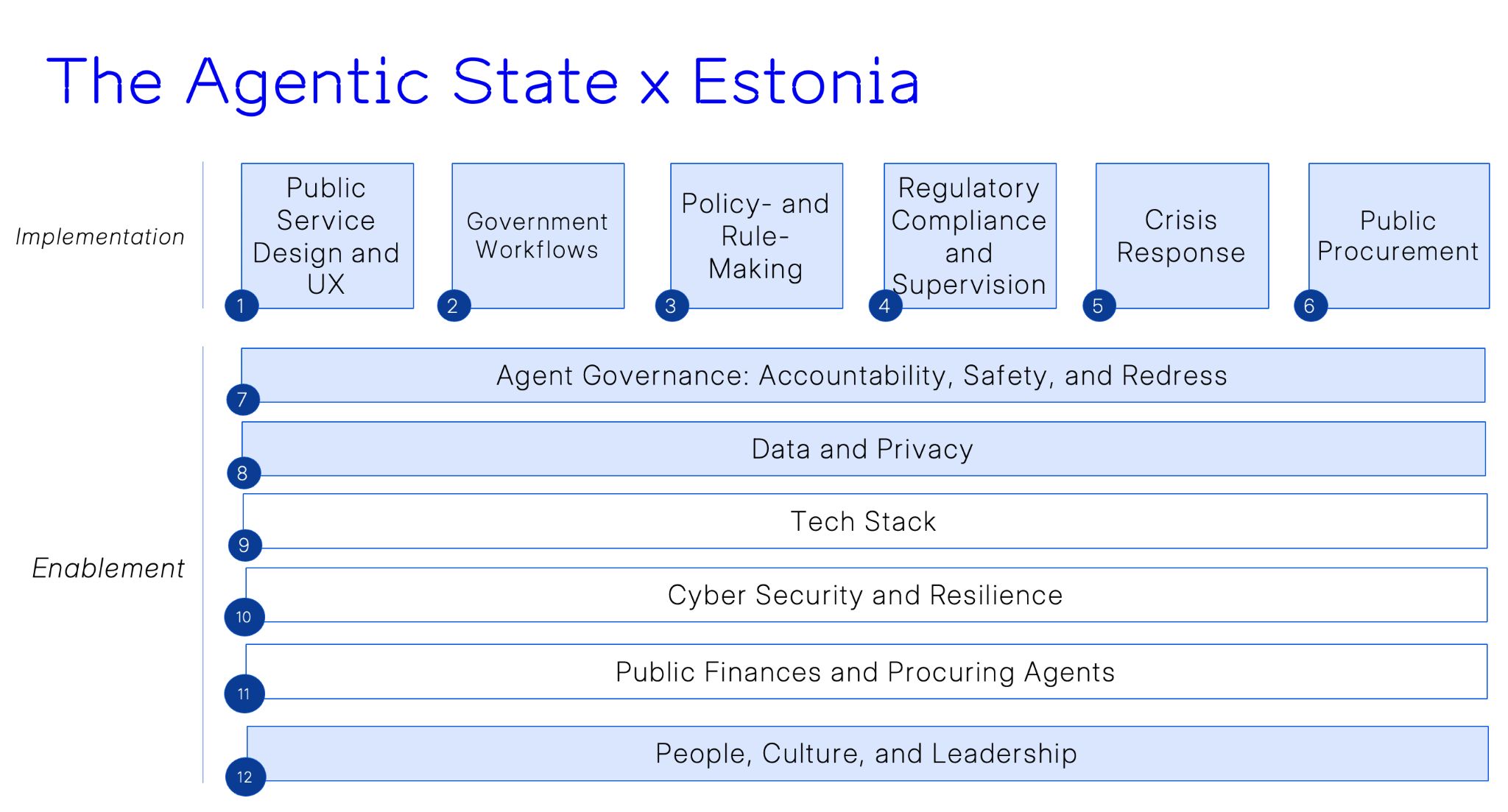
Estonia is now applying the same principle as it develops towards an “Agentic State”, a vision for how government operates in a world of ubiquitous AI agents, both using agents itself and interacting with agents used by citizens, businesses and other organisations.
Countries still developing AI capabilities can start with relatively simple steps, such as making documents machine-readable and experimenting with lower-risk agents.
“You can start with lower risk use cases, by having humans in the loop,” Ilves shares. “The practical know-how of how you build ethical systems that are accountable comes from getting your hands dirty, experimenting and piloting.”
The views expressed in this article are those of the interviewee and do not reflect the official views of the Government Office, Estonia.