
Why Italy’s DPI doesn’t feel like infrastructure
The real question is not whether Italy can build digital systems, but whether its institutions can maintain the stability of digital public infrastructure.
-1779424916535.jpg)
The question is not only whether Italy’s digital systems function. It is whether they are governed as strategic public assets designed to generate sustained public value. Image: Canva
Italy has built a digital state. It just does not feel like one.
SPID, Italy’s national ID system, now serves over 40 million citizens. PagoPA, the national platform for digital payments to public administrations, processes millions of public payments every month. The National Registry of the Resident Population (ANPR) has consolidated thousands of municipal databases.
Interoperability platforms such as PDND (Digital National Data Platform) enable structured data exchange across public administrations.
Billions of euros from the National Recovery and Resilience Plan (PNRR) have been allocated to digital transformation.
By most technical measures, the building blocks of digital public infrastructure (DPI) are in place.
Yet, interacting with the Italian state online rarely feels seamless or inevitable. It feels fragmented, uneven across territories, and dependent across administrations.
The problem is not that Italy cannot build digital systems. The problem is that what it has built has not fully matured into infrastructure.
Infrastructure is supposed to disappear
We often use the word “infrastructure” loosely. But infrastructure is not simply technology at scale.
It is technology that has reached institutional settlement.
Electricity continues to evolve. Water systems are upgraded. Transport networks are modernised.
Infrastructure is not static. But its governance stabilises it.
Its presence becomes predictable. It is not renegotiated at every political turn. It does not need to be reintroduced to citizens every few years.
Infrastructure is invisible not because it never changes, but because it is no longer experienced as a policy initiative.
Italy’s digital systems remain visible. SPID is periodically redesigned and politically debated. PagoPA integration varies across municipalities.
Digital services are reorganised under new ministerial portfolios. Each reform cycle reopens questions of governance, coordination, and responsibility.
While these systems work, they are still managed as phases of transformation rather than as elements of a stable architecture.
Transformation implies movement and visibility. Infrastructure implies continuity and embeddedness.
What separates the two is not technical sophistication, but institutional settlement.
From innovation to commodity
To understand this distinction more precisely, it helps to think in evolutionary terms.
Wardley Mapping describes how technologies evolve: from genesis (novel and experimental) to custom-built solutions, to productised offerings, and eventually to commodity utilities.
Infrastructure occupies the rightmost stage of this evolution: standardised, industrialised, and taken for granted.
Working technology is not the same as commodified technology.
Figure 1 maps Italy’s DPI using this lens.
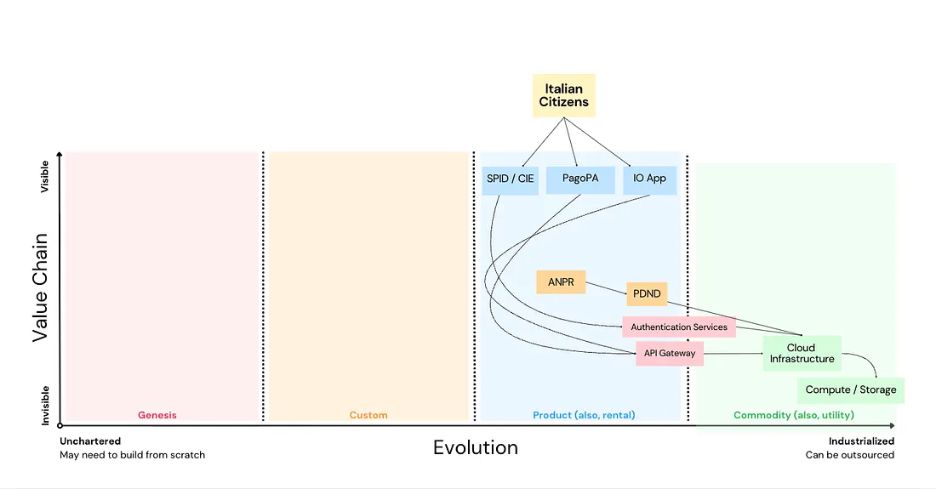
At the bottom of the value chain, cloud infrastructure, compute, and storage are fully commodified. They operate as utilities. No citizen questions whether cloud computing will exist next year.
Higher up the stack, however, citizen-facing services such as SPID, PagoPA, IO App remain positioned in the “Product” stage.
While they are functional and standardised in principle, they are still managed as active policy instruments.
Platform components such as ANPR and PDND sit in a similar position: technically mature, but institutionally unsettled.
The asymmetry is revealing. Technical standardisation has advanced more rapidly than institutional stabilisation.
The institutional evolution gap
The infrastructure layer behaves like infrastructure. The platform layer behaves like a product.
Take SPID. Technically, it works. Millions authenticate daily across services. Yet, it operates through multiple private identity providers (see Figure 2 below), each with different interfaces, reliability levels, and governance arrangements.
This model reflects deliberate policy choices about market competition and public–private collaboration.
But it also ensures that digital ID remains visible and differentiated rather than uniform and invisible.

PagoPA presents a similar dynamic. The platform itself is centralised and technologically robust.
Yet, its implementation across nearly eight thousand municipalities and numerous public bodies produces variability in user experience.
Some administrations integrate it seamlessly. Others maintain parallel processes. The result is inconsistency at the point of contact.
ANPR successfully unified population registries being a major achievement in a historically fragmented administrative system. PDND facilitates interoperability.
But data exchange still depends on institutional coordination that remains politically and administratively autonomous.
These are not technological weaknesses. They are governance conditions.
Italy’s digital platforms are technically capable of behaving as commodity infrastructure. But they remain framed, managed, and contested as products.
The box is institutional
In reform discourse, we often hear that governments must “think outside the box.” If services are confusing, redesign them. If processes are fragmented, innovate more boldly.
But in Italy’s case, creativity is not the primary constraint. The box is institutional architecture.
Authority is distributed across national ministries, twenty regions, and thousands of municipalities. Regional autonomy is constitutionally embedded.
Municipalities retain operational discretion. Coalition governments are frequent. Administrative leadership changes regularly. Procurement and implementation responsibilities are layered.
This pluralism reflects democratic history and territorial governance. Italy’s institutional architecture was not designed with platform logic in mind.
Digital infrastructure, however, demands standardisation. It requires components to stop being politically differentiated. It requires governance arrangements that prioritise continuity.
Infrastructure requires convergence. Italy’s institutional design protects divergence.
The resulting misalignment is structural, not accidental.
In other words, infrastructure maturity requires administrative capacity and digital leadership, not merely technical capability.
Visibility, credit, and political incentives
There is also a political economy dimension to this gap.
Digital platforms, when framed as reforms, are visible achievements. Ministers can announce adoption figures. Agencies can claim success. New versions can be launched and branded.
Infrastructure is designed to endure and generate long-term public value. Its effectiveness is measured in stability, not attention.
If digital systems remain framed as reform initiatives rather than as public utilities embedded within a broader public purpose, they remain politically visible.
And visibility prevents institutional settlement.
This does not mean infrastructure should not evolve. On the contrary, mission-oriented governance requires continuous adaptation.
It means its evolution should be governed within stable institutional arrangements. But adaptation must occur within stable institutional arrangements oriented toward long-term value creation, not short-term symbolic wins.
The question is not only whether Italy’s digital systems function. It is whether they are governed as strategic public assets designed to generate sustained public value.
Italy’s digital systems have not yet achieved that insulation as well as an alignment with a long-term public purpose.
What can we learn from others?
If Italy’s challenge is not building digital tools but turning them into infrastructure, then looking at countries that have achieved that transition becomes a powerful resource.
Estonia’s trajectory indicates that infrastructural maturity is less a technological breakthrough than an institutional settlement.
Beginning in the early 2000s, the country constructed a layered digital architecture composed of a secure data exchange backbone (X-Road), a universal digital identity system (eID), and a service layer accessible through a central state portal.
These elements were not introduced as isolated reform initiatives but established as foundational state infrastructure, underpinned by enabling legislation, central coordination, and sustained political leadership.
As Prime Minister Taavi Rõivas explained, Estonia made a “very conscious choice to build shared platforms […] rather than allow diverse development,” while ensuring common standards and procedures so that innovations remained secure and interoperable.
The outcome is not merely widespread digital adoption, but institutional consolidation: digital ID, data exchange, and service delivery function as embedded utilities of the state rather than recurring reform agendas.

Why this matters now
Italy is entering a new phase of digital transformation.
Artificial intelligence, digital health records, predictive analytics, and advanced data governance frameworks are being layered onto existing systems.
These innovations depend on foundational components: identity, payments, registries, interoperability.
If those foundations are not institutionally stabilised, additional layers increase complexity without increasing coherence.
Infrastructure creates predictability. Predictability creates trust. Trust enables innovation on top of the base layer.
Without infrastructural settlement, digital transformation risks becoming a succession of reforms rather than a structural shift.
From functioning to inevitable
Italy’s digital platforms are not failures. They are incomplete successes.
They have moved beyond experimentation. They have achieved scale. They have integrated systems across a historically fragmented state. These achievements should not be underestimated.
But they have not yet crossed the threshold into inevitability.
Figure 1 does not show technological lag. It shows institutional lag.
The cloud layer is commodified. The platform layer is productised. The citizen layer experiences variability. The gap lies in governance, coordination, and political insulation.
Italy’s digital governance will continue to feel provisional, until identity, payments, and data exchange are treated as shared national utilities, standardised across territories, governed for continuity, and insulated from short-term oscillation.
Infrastructure does not mean immobility. It means stability within change.
The real question is not whether Italy can build digital systems. It clearly can. The question is whether its institutions are prepared to let those systems become “boring” enough to last.
And in digital government, the real achievement lies not in innovation alone, but in making systems stable enough to disappear into routine.
The article was originally published on Porcellini’s Medium page here, and edited.
----------------------
The author is a Master of Public Administration candidate at the UCL Institute for Innovation and Public Purpose (IIPP). Her work explores digital government, public value creation, public sector innovation and the institutional conditions that shape successful digital transformation.