Indonesia eyes its next leap in digital ID development through global best practices
Oleh Mochamad Azhar
At the recent panel in Jakarta, global experts shared how digital identity serves as a foundation of Digital Public Infrastructure, delivering tangible impacts for citizens.
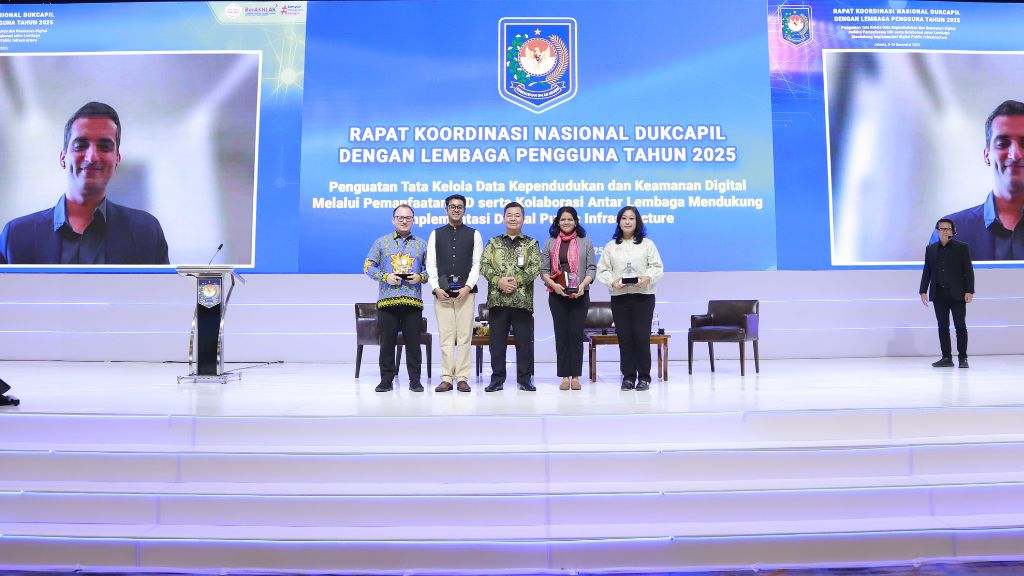
Global experts shared best practices on digital ID at the recent Digital Identity Forum in Jakarta. Photo: Directorate General of Population and Civil Registration, Ministry of Home Affairs.
As Indonesia advances the development of its digital identity, Identitas Kependudukan Digital (IKD), as a foundation for its Digital Public Infrastructure (DPI), the country is increasingly turning to global lessons to shape the next phase of implementation.
As part of this effort, the Directorate General of Population and Civil Registration (Dukcapil) at the Ministry of Home Affairs, organised the Digital Identity Forum panel in Jakarta on December 10, bringing together global experts to share international experiences and best practices in digital ID development.
Kickstarting the panel was Gates Foundation’s Senior Programme Officer of DPI, Swetha Kolluri, who explained how digital identity has become the foundation of DPI because it provides reusable building blocks that ultimately deliver concrete public benefits.
She cited India’s experience with Aadhar, which does not only serve as a digital identity system, but also drives economic efficiency.
“About US$2.2 billion (S$2.9 billion) has been invested in Aadhaar so far, and more than US$42 billion has been saved,” she said.
These savings, she added, come from preventing duplication, enhanced transaction transparency, and the ability to accurately assign unique identities.
Kolluri emphasised that the impact of digital ID can only be achieved when the entire ecosystem moves together, rather than having each ministry or agency work in silos.
“If something is going to take a whole-of-society impact, then it requires a whole-of-society approach to curate the system.”
Digital identity needs use cases
Co-Develop's Investment Associate, Sourav Das, stressed that digital ID is only as valuable as its real-world use cases.
“A digital ID without use cases is not very useful,” he said, adding that Co-Develop works with many countries not only to implement DPI but to ensure that use cases are developed on top of it.
He again referenced India, explaining how the Aadhaar-enabled payment bridge has improved the accuracy of gas subsidy distributions.
“Before Aadhaar, there were many duplicates and leakages. With Aadhaar authentication, benefits can be sent directly to the beneficiary’s bank account,” he added.
The ability to use Aadhar to open bank accounts via e-KYC has also accelerated financial inclusion in India, reducing onboarding costs to an average of US$0.27.
He provided further international examples, pointing to Nigeria, where digital identity facilitates access to hundreds of public and private services, and to Estonia, where digital identity is used across nearly all sectors.
“The most important principle of digital ID is e-authentication, where a single identity can deliver multiple benefits.”
Das added that digital identity also helps in disaster response, referring to the recent floods in Sumatra. Digital authentication can help affected residents access emergency funds when their physical documents are damaged by the floods.
However, he noted that cross-border identity recognition remains a significant challenge, citing the case of African citizens migrating to South Africa, whose identities are not automatically recognised upon arrival in the destination country.
“If I have an Indonesian identity and migrate to Malaysia, why can’t I access services in Malaysia using my identity?” he asked, noting that Brazil, Uruguay, and Argentina have already integrated their digital identity systems through formal agreements.
This challenge could be turned into an opportunity for regional cooperation, including for Indonesia which is increasingly active in ASEAN discussions around digital identity standards.
Finding the right model for Indonesia
World Bank’s Senior Digital Specialist, Jonathan Marskell, outlined how different countries design their digital identity ecosystems and how these models can be adapted for Indonesia’s needs.
Marskell grouped them into three main models: centralised, federated, and decentralised.
The centralised model, which is adopted by Indonesia, allows a single identity provider to manage verification for every transaction. Its advantage is simplicity, but it limits innovation.
The federated model allows a wider ecosystem of identity providers to develop systems that are supervised and certified by the state, as seen in Thailand, Australia, and France.
The decentralised model allows data issuers to create digital credentials containing verified information, which are stored in citizens’ digital wallets and integrated with other documents.
“With verification happening against data stored on the user’s device, this model removes the burden of millions of transactions from central servers. Its scalability is much higher,” he said.
The World Bank sees global trends moving towards decentralised, wallet-based models, such as in the European Union, South Korea, the UK, and several ASEAN initiatives, he added.
When discussing the ideal model for Indonesia, Marskell said that due to the nation’s large size, complexity and unique characteristics, no foreign model can be copied wholesale.
“A centralised model can still be a starting foundation, but in the long term the decentralised model will become key part of Indonesia’s digital economy,” he added.
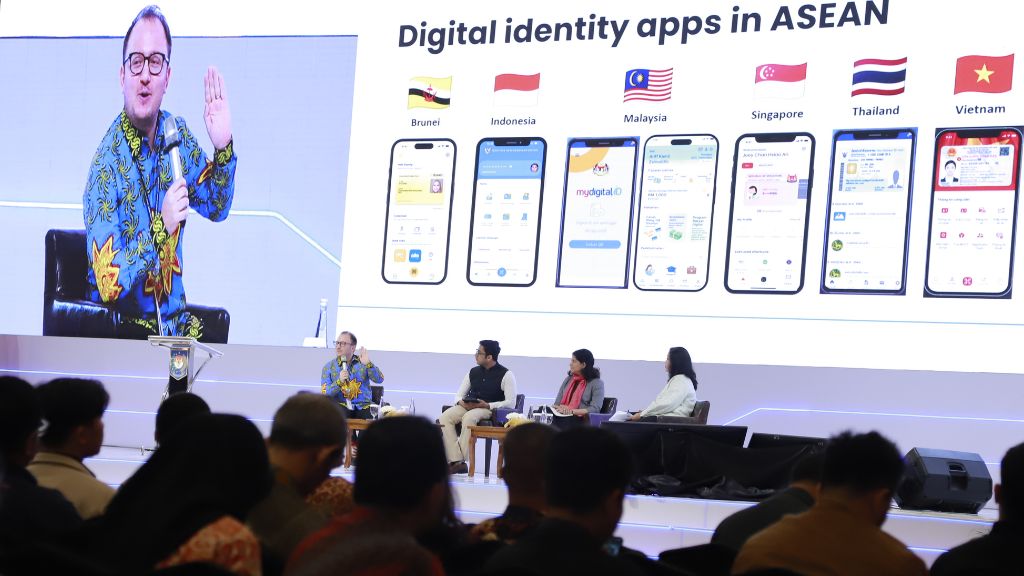
He also touched on ASEAN’s digital identity landscape, noting that Singapore is the most mature with SingPass covering almost the entire population. Indonesia’s IKD has reached 17 million users, while Malaysia’s MyDigital ID has 3 million, Thailand’s ThaID at 23 million. Vietnam leads in growth with 62 million users.
Marskell noted that in most ASEAN countries, digital identities function as a natural extension of physical cards, displaying the card's face on the main screen.
Indonesia and Malaysia, however, have not yet adopted this design.
“One of the primary uses of digital ID is entering buildings or boarding flights. Familiarity is crucial for building trust,” he said.
Interoperability is key
Joining the session virtually, Centre for Digital Public Infrastructure’s (CDPI) Head of Country and Programme, Vineet Bhandari, said that Indonesia has a unique advantage because it already has a strong identity database.
The challenge now is ensuring that digital identity does not merely replace physical cards but enables public service interoperability.
“The real value emerges when digital identity connects seamlessly with health services, social assistance, education, and payments,” he said.
Bhandari highlighted the importance of implementing interoperability by design, so that IKD truly becomes a connector between systems rather than adding complexity.
Equally important is data minimisation: digital identity should act as a key, not a vault.
“Finally, we need shared rules that govern how public and private institutions use data, because this relates to the trust framework that should last for the next 10 to 20 years.”
Indonesia’s digital ID development’s direction
-1765701136041.jpg)
During his remarks, Dukcapil’s Director General, Teguh Setyabudi, emphasised that the IKD will continue to be enhanced with biometrics, face recognition, and liveness detection.
“We will continue to strengthen security while also simplifying verification processes so they can be integrated into a wider range of public services.”
The government would also expand IKD’s use cases for public and private services by working with ministries, local governments, and non-government service providers.
On use cases, Setyabudi highlighted the pilot project on digitalising social assistance (Perlinsos) in Banyuwangi Regency, which uses IKD. The programme demonstrated how IKD can improve targeting accuracy, minimise administrative hurdles, and accelerate service delivery.
“This pilot has been successfully implemented and can be scaled up in other regions and extended to other strategic government policies,” he said.
Setyabudi also expressed Indonesia’s readiness to host the upcoming Global DPI Summit, an international forum that discusses the development and implementation of DPI from around the world.
He called on all stakeholders to strive and work hard so that Indonesia can showcase successful DPI use cases at the important event.