What changes when government services are designed with human experience in mind
By Kitsoft
GovStack’s Women in GovTech 2026 challenge saw more than 200 women from 85 countries having created prototypes of digital public services in just six weeks on a low-code platform.
-1778227259421.jpg)
The Ukranian govtech company Kitsoft provides both the low-code platform and mentorship for GovStack's Women in GovTech 2026 participants to build real-world digital service prototypes. Image: Kitsoft
GovStack Women in GovTech Challenge is a global initiative by GovStack, implemented in partnership with the World Bank, the United Nations Development Programme (UNDP), the UN Office for Digital and Emerging Technologies (UN ODET), and University College London (UCL).
The programme brought together women working in digital transformation and enabled them to create their own GovTech solutions.
2026 marked the third cohort and the largest one to date. Participants worked in international teams and went through the full service development cycle — from problem definition and user research to business analysis, process modelling, and building prototypes.
At the end of the programme, they presented their work to experts.
“The challenge served as a platform for collaboration among specialists who would not work together, while Liquio, a low-code platform, enabled them to co-create and prototype real services using a shared, accessible tool tested in practice,” said Helen Uvarenko, tutor of the Liquio platform in the challenge.
What solutions teams developed
Service development started with research rather than predefined ideas.
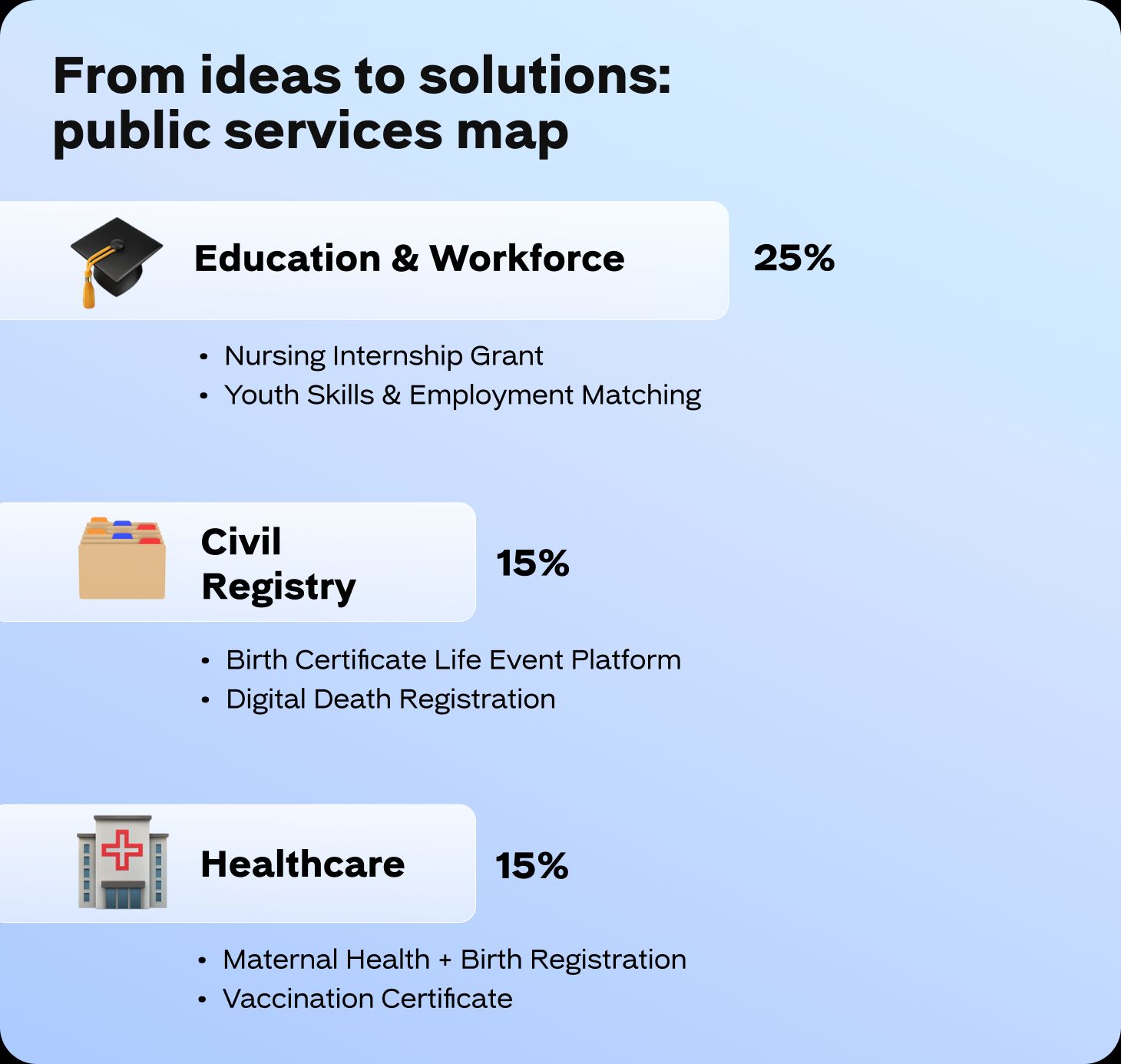
Thirty-three teams analysed real problems across different countries, studied user experiences, and only then formulated solutions that could work in specific contexts.
Participants then selected ideas and turned them into prototypes.
The solutions included youth employment platforms, digital academic certificates, birth and death registration services, maternal health services, and business registration and licensing platforms.
The largest share of projects focused on education and workforce (around 25 per cent). Civil registration and healthcare each made up about 15 per cent.
Teams also worked on services in social protection and business services (approximately 10 per cent each). Some teams additionally explored solutions in mobility, agriculture, and urban infrastructure.
Despite different contexts, participants encountered similar challenges.
We might all be from different parts of the world, but the problems are universal. Government agencies still struggle to talk to each other digitally... A simple problem can become complex. Once you start considering policies and how people will adapt, what seemed straightforward becomes a layered challenge.
- Amina Ramallan, digital inclusion advocate focused on empowering women and youth and building a secure and resilient internet ecosystem in Nigeria, mentee in the challenge
Where services break
According to Liquio's Uvarenko, public services often face a structural problem: while each institution handles its own part of the process, no one is responsible for connecting them.
A child is born. The hospital records it. The civil registry does not. The parents leave without a birth certificate. Access to healthcare, education, and social services is delayed. The systems are already in place, but they don’t operate together - Helen Uvarenko, tutor of the Liquio platform in the challenge
Across countries, public services are built as separate processes — for registration, benefits, identity. Each works on its own terms. For citizens, they appear as a sequence, but failures occur where institutions are expected to connect.
Drawing on her experience from the challenge, Helen Uvarenko points to how this pattern appears in practice.
One team focused on birth registration. What initially seemed like a straightforward digitisation task expanded once mapped fully.
Hospitals, registries, ID systems, and local authorities all played a role — each with its own logic, timing, and data requirements.
Another team looked at death registration. The act of registering a death was not the issue — what followed was. Records needed to be updated, payments stopped, agencies notified.
In practice, these steps rarely moved together, and families often carried information from one institution to another at the most difficult moment.
A third case explored access to child benefits. Eligibility depended on data that already existed — income, residency, family status — but was not connected. As a result, people were asked to prove what governments already knew.
Despite the differences, the same structural issues appeared across all cases.
What changes when services are designed end-to-end
Rather than working on isolated features, participants of GovStack Women in GovTech Challenge 2026 were asked to build complete service flows.
This required them to follow the process from start to finish, tracing how each step connects to the next.
Once the full picture was mapped, the work began to shift. Teams moved away from improving individual steps and started reconsidering how the service was structured.
This made gaps visible much earlier and forced teams to rethink how services are structured as a whole.
The role of low-code in this process
The teams developed services on Liquio, a low-code platform, created by the Ukrainian GovTech company Kitsoft.
This allowed teams to move quickly from ideas to working solutions, test process logic, and make changes without complex development.
Participants began with no-code tools, directly converting their understanding of real administrative processes into structured workflows.
Instead of abstract descriptions, they worked with concrete elements — steps, events, and conditions.
This changed the pace of work. Instead of defining requirements and waiting for implementation, teams built and adjusted flows themselves.
They could immediately see how one step affected another, where the logic broke, and what needed to be changed.
This reduced the distance between understanding a process and shaping it.
Across teams, there was a consistent focus on how services are experienced in practice — not in ideal scenarios, but in real conditions, with incomplete information, limited connectivity, and multiple institutions involved.
In trying to develop a system that is usable, we have to think of all categories of citizens who should have access to that platform — and then, of course, interoperability: ensuring it interacts with every other government service provided online. - Dr Ibiso Kingsley-George, an expert in digital policy and public administration in Nigeria and a mentor of the challenge
From prototypes to real services
These solutions provide a working model of how services can function across institutions.
By the end of the process, the logic has been tested, dependencies are clear, and the sequence of actions fits together. That shifts the starting point for further work.
Rather than developing an abstract concept, teams build on something that already operates as a functioning service model.
“If a prototype proves its value by solving a concrete problem, it can serve as the starting point for a production system.
"With a platform like Liquio, the transition from prototype to real service can be relatively smooth, as the same architecture and components can scale," said Oleksandr Iefremov, CEO at Kitsoft.
------------------------------------------------
Kitsoft is a Ukrainian GovTech company that specialises in developing digital solutions, online public services, and IT infrastructure for government agencies and businesses. It is widely recognised for building the technical foundation of Ukraine's digital state ecosystem, including the Diia (Digital State) portal.