
Activist-turned-public servant turns debt holiday into labour activation
Being a public servant should be seen as a powerful tool of change, says the Lithuanian Ministry of Social Security and Labour’s Senior Policy Advisor Rokas Keršys.
-1776232659011.jpg)
“Being a public servant should be understood as a powerful tool of change. It’s only fulfilling if you take it as a tool and you know what you want to use it for,” says civil service activist and Lithuania’s Ministry of Social Security and Labour Senior Policy Advisor, Rokas Keršys. Image: Creative Bureaucracy Festival
Good ideas alone are not enough. You need to know the right people and have enough influence to make change happen.
This is the survival guide for civil service activist and Lithuania’s Ministry of Social Security and Labour's Senior Policy Advisor, Rokas Keršys.
“Being a public servant should be understood as a powerful tool of change. It’s only fulfilling if you take it as a tool and you know what you want to use it for,” he says to GovInsider.
A former union activist and protest organiser, Keršys transitioned from the streets to the statehouse with a “double dose of idealism and the will for change”, determined to prove that government can solve wicked problems.
His launchpad into the government was in September 2022 through the Create Lithuania, a programme designed to bring individuals with international experience to work in the country’s public sector.
Given a short six months to a year period, he took up the challenge to find a solution to break the vicious cycles of debt with the ministry he currently works for – and stayed on ever since October 2023.
Solving a wicked problem from different sides
Prior to joining the Create Lithuania programme, Keršys was already advocating for debt reforms as a citizen activist, having made hundreds of calls to the Parliament but still not moving the needle.
“I thought maybe [Create Lithuania] could be a good opportunity to see if it's possible to do anything better if you're part of the government," he says.
The programme, he notes, has equipped him to be a project manager – a role that previously didn’t exist in the public sector – focusing on big picture thinking and collaborative problem solving across departments.
About half a decade has passed since he worked on this wicked problem from inside the government.
Keršys says that this year, his ministry will finalise and put into practice the “three punch strategy” that he has been working on.
The strategy aims to reframe the over indebtedness issue from a moral failure to a labour market priority, ensuring that borrowers are employed and can sustain their employment.
The “three punch strategy” entails changing the laws to reduce income deduction, putting in place a debt vacation to pause debt collection for six months for borrowers who started work, providing debt consultancy services to support borrowers.
Early results show the promise of enabling policies to encourage borrowers to remain in the workforce.
Since its implementation, the country’s labour market reintegration rate for unemployed individuals with debt issues jumped from 2.6 per cent in 2023 to 34 per cent in 2025, impacting around 30,000 individuals, he shares.
Specific to the debt vacation, 548 people have taken it up, with 80.1 per cent (439) of them currently employed.
Notably, six months after the debt vacation ends, 42 per cent of them continue to remain in the workforce, with the percentage swinging between 40 to 60 per cent, he says.
He shares that the full results of the implementation will be released sometime in late-2028.
“This underpins a wider paradigm shift in debt politics, from deterring to enabling policies,” he notes.
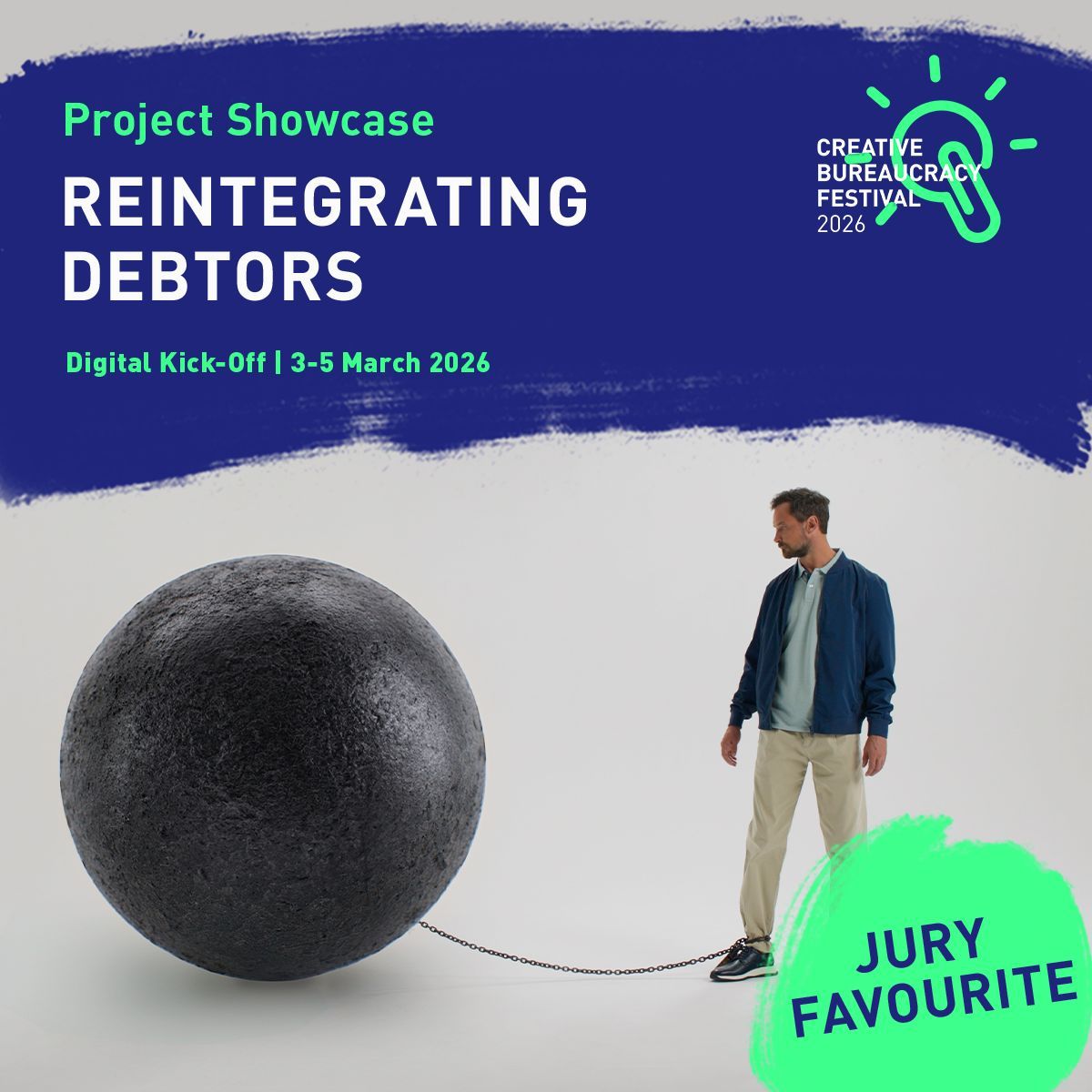
Keršys’ work in reintegrating the over indebted into the labour market saw the Ministry clinching one of the three Jury Favourites from the Creative Bureaucracy Festival (CBF)’s project showcase.
One government data platform as the turning point
Keršys highlights how the State Data Lake, a centralised data platform for the whole-of-government, has been key for his team to move from what he calls a “hunch-based policymaking” to a systemic intervention.
Before the platform, data remained in departmental silos.
By connecting three specific databases, he could create a national data map of the overindebted crisis.
These three databases are the bailiff database to track the scale and nature of debts, social insurance fund (Sodra) database for the incomes, pensions and employment history, and national registry to overlay the demographic data.
According to him, this data helped achieve three aims:
- Dismantle the moralistic narrative that debt is a result of poor personal choices, proving instead that it is largely driven by unexpected life events.
-
Quantify the impact of over indebtedness at both micro and macro levels, turning private struggles into a public crisis for the state to intervene.
-
Prove that his ministry had the duty to intervene, by mapping the correlation between unemployment and debt.
The map allows his team to pinpoint the typical borrower, which is a middle-aged male in rural Lithuania, making the problem visible and geographically targeted for the first time.
“This gave us an explosion of knowledge to work with and so many better arguments to make,” he shares, highlighting that the data also has the power to “completely reshape the message and scope of their project.”
Friction as a proof of impact
If a policy doesn’t meet resistance, it likely isn't changing the status quo, says Keršys.
Within less than 10 days of the debt vacation policy rollout in December 2024, his team faced a sustained campaign of resistance, including over 40 articles talking about the policy’s failure and even a Constitutional Court challenge.
At that point, only one person took up the debt vacation, he shares, which did not provide enough data to prove the policy’s efficacy.
Keršys shares how the main friction for Lithuania’s debt reforms came from the private bailiff lobby, which has significant interest to maintain the previous system.
His new policy essentially threatens the financial model of an entrenched industry.
“I think the moment that we're not going to get attacked - and that the bailiffs are going to be fine with what we're doing - is the moment that I'll have to revisit whatever we're doing... we're probably doing something wrong,” he says, proving that friction is the first sign of progress in the business of systemic change.
Within the government, the friction has been compounded by territorial guards between the ministries.
For example, the Justice Ministry which traditionally oversaw the debt collection system was initially skeptical of this intervention that appeared to be led by a social policy approach.

Informal allies inside the government matter
In our conversation, Keršys addresses the “invisible labour” of policymaking, which is the the ability to navigate the complex human networks within the government.
Keršys emphasises that success requires the underground work of cultivating strategic connections and navigating the informal "who you know" network to bypass the bureaucratic roadblocks.
“Having friends at the ministerial level, be it vice ministers or heads of departments, that's super crucial to get anything done,” he says.
In another example, he shared the influence of parliamentary staffers rather than high-profile politicians.
By tapping into the networks of those who set the daily schedules and deciding committees, his team ensures they place the right advocates in the room and that their proposals stayed on the agenda.
It can feel isolating especially when one works on highly-politicised projects like over indebtedness,” so finding other people who also believe in your ideas and also share the same worldview is incredibly important,” he says.
Beyond data, Keršys notes that navigating complex policy demands strong relationships with those working on the frontlines, be it the public servants, civic organisations, or the citizens.
Having revisited a problem that defeated him as an outsider years ago – now as an insider, his story highlights how the machinery of government, often said to be slow and unresponsive, can be calibrated for social justice to serve the most vulnerable people.
Keršys will be presenting about the project at the Creative Bureaucracy Festival happening in Berlin, Germany, on June 11, 2026. You can find out more about the event here.