
Agentic AI in government starts with a permissions question
By Zoho
Agents are only as useful as the data they can reach, and public sector data is one that agencies cannot afford to lose. Zoho’s Managing Director for APAC, Gibu Mathew, explains how Zia Agents are built to resolve that tension.
-1791786888950.jpg)
The public sector can also leverage agentic AI capabilities when security and privacy guardrails are embedded into the models, ensuring the agents access only the data they are allowed to see. Image: Canva.
Public sector agencies want agentic artificial intelligence (AI) to deliver faster, more seamless and personalised services.
But they also need to know what agents can touch.
Zoho’s stance is that every agent can reach only the data that a given user is already allowed to see.
“Whatever information I have access to, that's the only information my agents can also access,” says Gibu Mathew, managing director for APAC at Zoho.
“There's already a clear guardrail of what I can see.”
That design also builds in accountability, with each agent attached to an individual and the agent’s actions traced.
This agentic capability is different from what earlier AI-powered chatbots and automation can do before, Mathew notes.
The latter follows fixed conversation paths and runs on predefined rules. Changing those rules can take weeks or months.
Agents add two more capabilities, by understanding intent in real time, and working towards a goal by reasoning through steps.
“The agents can only be as good as the data they have. Without organisation-specific data, an AI model returns answers that the whole world knows,” he adds.
One platform, not a patchwork
That model works because of how Zoho is built, Mathew shares.
Zia Agents are the agentic solution that enables organisations to enhance their digital workforce.
These agents sit inside a suite of more than 60 business applications running on a common, underlying platform.
Governance and guardrails live in that platform layer, so every product starts from the same security and privacy baseline, explains Mathew.
This means fewer connections to secure for the agency, as well as fewer places where citizen data can slip out of view.
Integration “is not an afterthought. You have the ability to integrate on day one,” says Mathew.
With AI built into the suite, data stays under one set of access rules instead of passing through a new integration for each use case.
Guardrails agencies set themselves
Security and privacy concerns take utmost priority for public sector data. “Customers' data belongs to the customer, and we felt that we shouldn't be using it for any form of activity.

“We are very clear that privacy is as critical as security for customers, so we do not use our customers' information for training itself either,” says Mathew.
This protective posture extends to agentic capabilities, he says, as a government agency can allow staff, including non-specialists, to customise agents through low-code tools, within defined boundaries.
Zoho also owns the hardware in its own data centres, which lets it meet the security and privacy requirements of large and government customers while keeping costs in check, he shares.
“Let's say a government organisation buys a Zoho service. The guardrails are set. They can allow innovation in their organisation within the framework what Zoho provides, so that basic levels of security and privacy are ensured without violating what is not acceptable within that organisation,” explains Mathew.
For organisations that connect to public large language models (LLMs), he recommends an enterprise bring-your-own-key arrangement.
This dedicates the model access to one customer and carries over that provider's compliance practices.
The company is developing its own LLM as well.
Mathew notes that the model does not yet match leading public ones, but the aim is a medium-to-long-term roadmap in which customers are not dependent on rationed or expensive external models.
“We were quite clear about how LLMs or how technology would evolve. We wanted to own that,” he says, adding that the objective is to become a “technology partner for the long term”.
Built like a new hire
Mathew highlights that non-technical public servants can also leverage agentic capabilities.
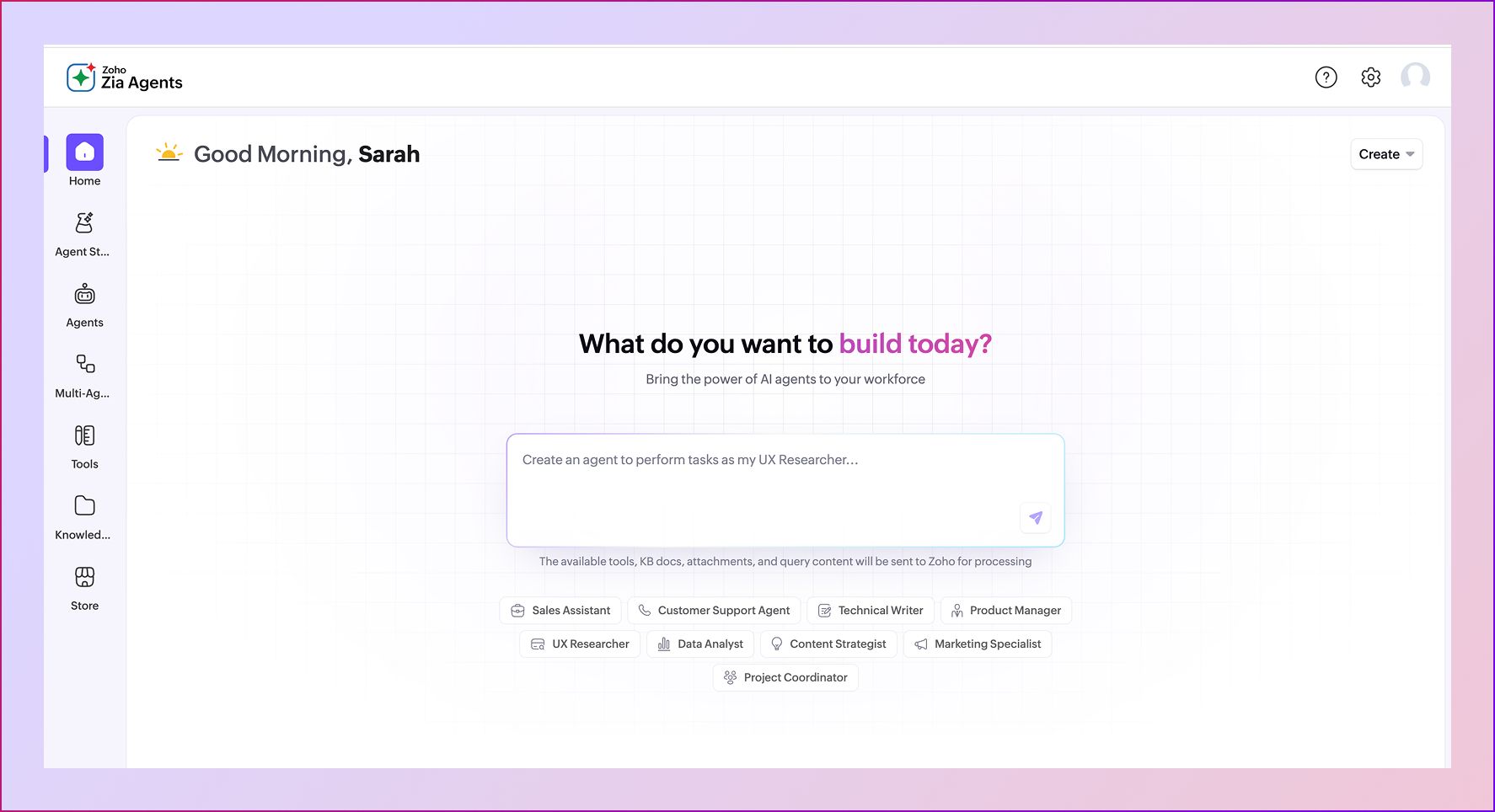
Agents can be built with low-code in the Zia Agents Studio, where users select tools, assign skills, and connect applications, inside or outside the Zoho ecosystem.
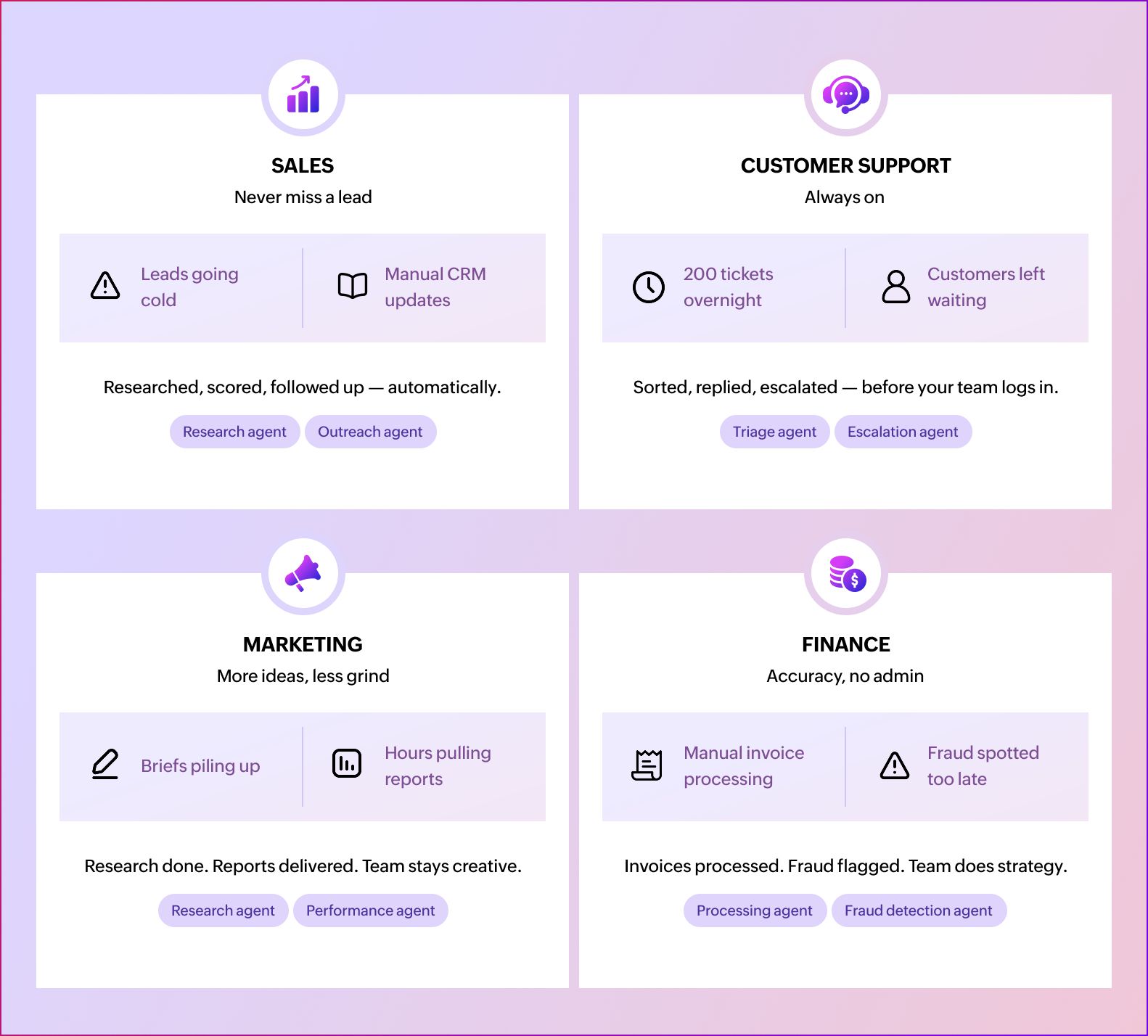
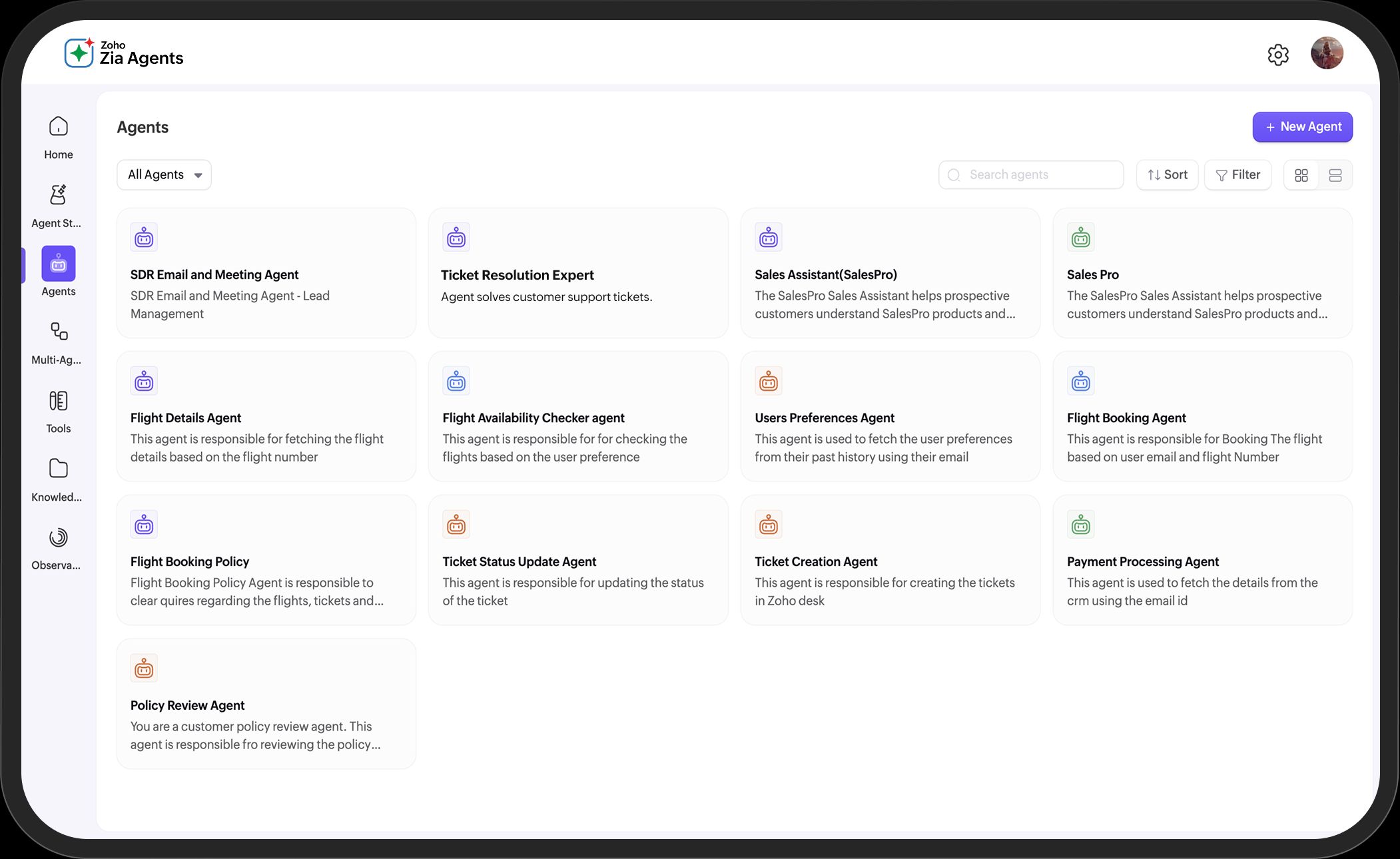
Organisations can also adopt or modify from over 100 pre-built agents, which include sales development agents to junk lead detection agents, according to their needs and processes.
Customising these agents resembles onboarding a new team member, says Mathew.
“Each organisation has nuances, and those go to the agent as plain-English instructions that are passed on to the underlying model. So the model is only as good as how you have trained it," he says.
On whether agents will replace jobs, Mathew draws on Zoho's own experience; its roughly 20,000 staff use AI extensively for code generation.
Output rises, but the bottleneck shifts.
“Still humans have to make the final call,” he says. Instead of seeing it as replacement, using emerging technologies like agentic AI drive reskilling for staff and redesigning of roles.
While it may affect most roles, it also enables people to do more, as citizen expectations will rise with the tools, which may create new work in different areas and a need to reskill.
Singapore government's emphasis on adoption and learning of AI agents, for instance, is “the right posture” for this shift, he says.
A strategic technology
Mathew also sees AI becoming a matter of national capability across APAC.
Restrictions on access to some powerful models have shown that the technology “can be rationed,” he says, and governments are responding by investing in supply chains such as chip manufacturing.
The question for agencies is no longer only where data sits, but who controls the stack beneath it.
The region is also seeing the launch of new solutions, such as the Zia Chat, which brings Zoho’s application data and large language models (LLMs) into a single interface across several channels, including voice.
“The impact of bringing it all together with increasing number of channels and capabilities is what makes this stand out,” says Mathew.
Start within six months
For agencies still deciding where to begin, Mathew offers a clear advice: choose one specific use case, allow three to six months, expect trial and error.
Meanwhile, teach staff to adjust agent instructions regularly, he says.
“Remember that your agents, and your new employee, are only going to be good enough as how you have trained them. That is an important aspect for success in this agentic era,” he concludes.