
Complaining, ‘good kaypoh people’ and rest — what it takes to transform the workforce
By Hanna Kum
At the CHI INNOVATE 2026 event, perspectives from healthcare’s human resource, finance and education departments were brought together to discuss workforce transformation strategies.
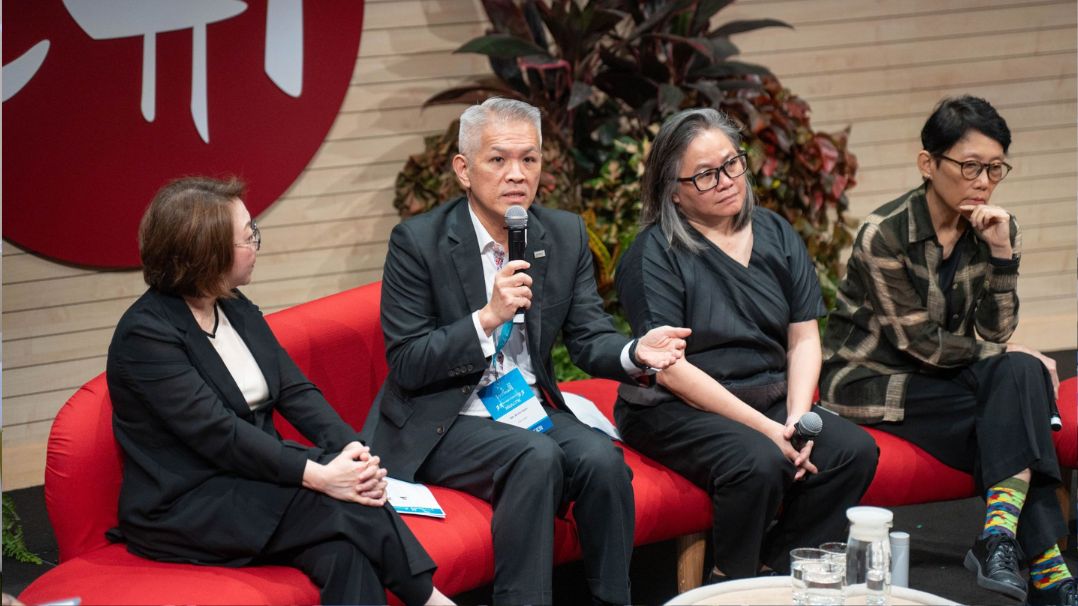
Picture of speakers at the panel, "Turning Pillars of Workforce Transformation into Enablers". Image: Centre of Healthcare Innovation
Change does not happen in a vacuum. It happens when the current system isn’t performing at an optimal level and when people think of ways to make things better.
“We complain a lot and actually, that's a driver for change,” said NHG Health’s Chief Education Officer, Michelle Jong.
Jong was speaking in the “Turning Pillars of Workforce Transformation into Enablers” panel at the CHI INNOVATE 2026 event on July 3, alongside speakers from finance, human resources, and education.
But it’s not always that straightforward, and sometimes the process might just stop at complaining, instead of taking it further to actual change.
Much like how multiple factors drive innovation, innovation is also constrained by various elements. For example, depending on the workplace environment, employees might be encouraged or discouraged from innovating.
“How much is at risk when I push for something new? If this doesn’t turn out well and it’s my responsibility, maybe we should just continue with the current workflow.” This might be the mindset of someone in a work environment that doesn’t support innovation, or even their growth.
Singapore Human Resources Institute (SHRI)’s Chief Executive Officer, Alvin Goh, pushed for creating an environment that focused on nurturing the workforce’s people and abilities.
“When we train someone, we must give them the opportunity to practice their craft, and when they make the first mistake, don’t punish, don't fault. Coach, mentor. And say, “try again”,” Goh said.
This takes an intentional effort to create an environment that can support this sort of communication — an environment that doesn’t only focus on results, but also the process.
The speakers discussed the structural tensions that stand in the way of turning employees into enablers that transform the workforce.
Being open to change
“There are no sacred tasks that cannot be touched,” Goh shared. One cannot simply be doing things the same way as 20 years ago.
And the people carrying out the tasks are the key to changing these tasks.
Since they work on the ground, they not only have the firsthand experience of the frustrations, but can also suggest more specific and practical changes to be made.
Similarly, even the most deeply ingrained principles should be questioned to see if they really hold water. One good example of this was about “rest”, which was brought up by NHG Health’s Chief HR Officer, Khoo Swee Lan.
“Rest is not the enemy of care, and neither is it saying you lack commitment,” Khoo said.
Khoo was advocating rest into the system, where people were not “shy to take” either moments of rest in the day, or leave when possible.
Instead of seeing rest as a lack of commitment, Khoo reframed it as a way to “sustain commitment in providing the care that [was] expected of [them].”
After all, a workforce that doesn’t allow their workers to rest is one that is unsustainable in the long run — contradicting the goal of finding a better and more efficient way to work.
Genuine, honest dialogue to get the wheels of change turning
Whereas grumbling and complaining are commonly seen as negative, the panel showed how it could be the start of something new, if appropriate subsequent action was taken.
“Complaining is actually a key asset, because we are unhappy with the status quo,” Jong had mentioned.
But the next steps are what matter.
“There are the really good kaypoh [nosey] people, and then there are those that are just kaypoh,” Goh quipped.
By ‘good kaypoh people’, he referred to those who can pinpoint exact problems and work on solving them, rather than indiscriminately work on general feedback that might not necessarily improve things.
These people also have to frequently take a step back to consider the bigger picture and whether things were working out as intended, or have morphed into something else.
“A simple instruction can become very complicated [when it translates] into systems, and you have a part to play to stop that when you see it happen,” Khoo noted.
If the programme just continued without any real purpose or end goal because no one took the initiative to stop it, this would only waste the already-limited time and resources.
Leaders, not managers
In creating a space for people to safely innovate and try new things, Goh shared three qualities that a leader must have.
A leader must want to lead rather than manage, have the competencies to do so, and lastly, be reliable to walk the talk — so that the employees can trust them to have their backs.
With leaders helming workforce transformation this way, the whole culture of the organisation shifts to one that is nurturing and sustainable.
And in coming up with practical ways to speed things up and improve processes, employees become the very enablers of workforce transformation.