
Darren Lim, Principal Engineer (Software Engineering), Enterprise Digital Services, Defence Science Technology Agency, Singapore
Meet the young public sector officials in the inaugural Young & Official Report 2026.
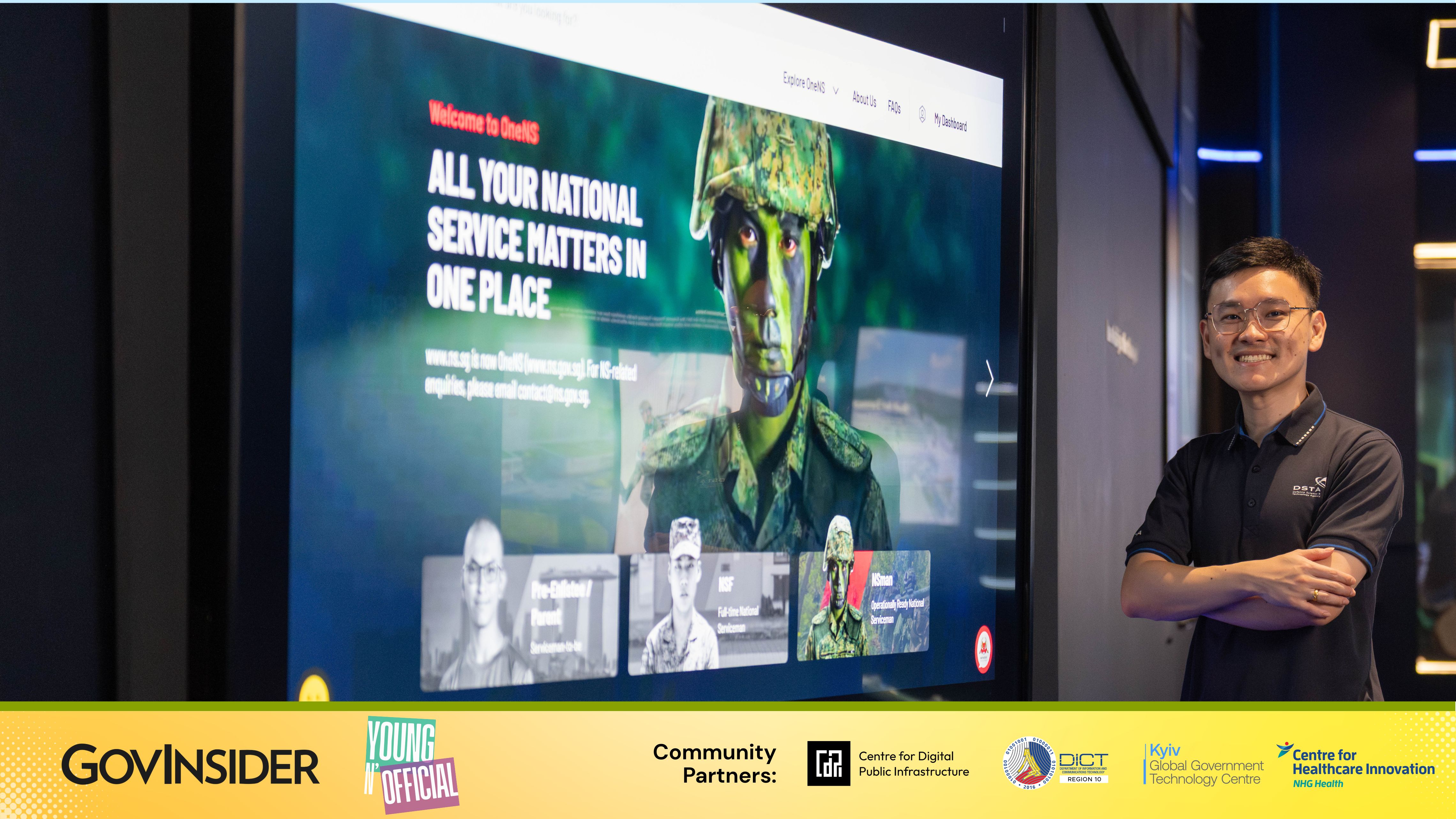
Darren Lim, Principal Engineer (Software Engineering), Enterprise Digital Services, Defence Science Technology Agency Singapore. Image: DSTA.
1) What does public service mean to you? Can you share more about your role in the public sector?
Public service is about applying technology in ways that create a meaningful impact for
Singapore, both today and for future generations, including my own children. It is fulfilling to
know that the systems and solutions we build contribute directly to national outcomes.
As a Principal Engineer from Enterprise Digital Services in Defence Science Technology Agency Singapore (DSTA), I work on delivering digital and systems solutions that help Singapore's Ministry of Defence/Singapore Armed Forces (MINDEF/SAF) maintain their technological edge, which is critical to Singapore’s defence and deterrence capabilities to preserve peace.
2) Tell us about projects you championed. What impact did it have on the community?
I was part of the team behind OneNS, a large-scale digital platform that transformed the National Service (NS) experience for NSmen.
The challenge was bold: Consolidating over 20 legacy systems into a single modern platform that thousands of NSmen rely on daily.
Working across multiple departments in DSTA, whole-of-government partners, global multinationals and local small and medium enterprises (SMEs), we collectively designed the overall system architecture, driving the migration of these legacy systems into the new OneNS platform, with scalability and maintainability at its core.
A key part of my role was ensuring that the many interconnected systems could integrate and operate reliably at scale, while maintaining enterprise alignment in technology choices, design patterns and development standards.
The impact was transformative.
Manual processes that once took significant coordination were replaced with digital workflows, enabling faster mobilisation and communication for our NSmen.
Through a single touchpoint on the app or web, NSmen could now seamlessly access critical services and information anytime, anywhere. Overall, OneNS has improved operational efficiency and responsiveness of our NSmen and MINDEF/SAF has benefited from a more digitally ready force.
3) As a young professional, how has your unique background or perspective allowed you to identify a solution that others in your organisations might have overlooked?
Coming from a software engineering background, I tend to approach problems by understanding not just how things are done, but why they are done that way in the first place.
In a large organisation like DSTA, processes are often well-established for a good reason, built up over years of operational experience and knowledge. As a young engineer, what my background allowed me to bring was a complementary lens: the willingness to question processes rather than assume they had to remain unchanged.
This meant engaging relevant stakeholders to understand the original intent behind existing workflows before proposing changes. These conversations surfaced nuances that documentation rarely captured and helped build the trust needed to explore a more transformative approach together.
The combination of curiosity about the why, paired with respect for existing expertise, is what helped uncover solutions that might otherwise have been overlooked.
4) What is your personal strategy for maintaining your creative energy when faced with bureaucracy?
I focus on understanding the intent behind policies instead of viewing them purely as constraints.
Being given the opportunity in DSTA to work on problems of genuine scale and complexity – where systems must be secure and resilient with little to no margin for error – taught me that once the purpose behind a policy is clear, it becomes easier to design solutions that are both compliant and innovative.
This strategy helps me stay creative while still working effectively within the realities of large organisations and governance structures.
5) If you had just one area to invest in to accelerate transformation in the public sector (regulation, technology, talent, etc.), which one would you choose and why?
I would invest in talent retention, as strong and stable teams are often the foundation behind successful transformation efforts.
Experienced officers who understand both technology and the public sector operating environment are extremely valuable and not easily replaced.
While attracting new talent is important, retaining experienced people preserves institutional knowledge, reduces the cost of retraining, and allows organisations to move faster and make better decisions.
My time in DSTA reinforced this belief.
I benefited from seniors who invested time in mentoring juniors (myself included), sharing lessons on navigating complex systems, making sound tradeoffs and thinking at scale. Much of this knowledge cannot be captured in documentation; it’s passed on through experience and relationships. Losing these officers does not just create a vacancy; it creates a gap that takes years to rebuild.
6) What is your greatest ambition as you grow in your public service career?
My ambition is to lead multiple teams that bring together different complex systems and projects to deliver stronger, more meaningful outcomes as a whole.
Having worked on projects that required coordination across many stakeholders, systems and operational needs, I developed a strong appreciation for the importance of balancing trade-offs beyond the needs of a single project.
At the system level, solutions are often shaped by the immediate business needs. At a broader organisational level, there is a greater opportunity to shape outcomes more holistically across interconnected systems across domains.
I hope to grow into a role where I can better integrate capabilities across teams, make organisation-level technology and engineering decisions, and contribute towards stronger and more effective defence outcomes at scale.
7) What is a “universal value” that connects everyone in your department – from interns to directors – and how do you use that to drive collaboration?
A strong shared sense of purpose connects everyone in the organisation.
Many of my colleagues understand that much of our work supports Singapore’s defence. In many ways, success means the work does what it is supposed to do, even if it goes unseen by the public.
That shared understanding creates alignment across all levels because everyone recognises the importance of contributing towards a common mission.
One example was during a product requirements workshop involving both the delivery team and business stakeholders.
Regardless of appointment or seniority, every input was heard and carefully considered if it created value for the end user. During moments where discussions became challenging or stalled, returning to the shared objective of delivering the best outcome helped the team align and move forward together.
8) What is the best piece of advice you’ve got for the next generation of public servants?
Design solutions that are resilient, scalable, and adaptable because priorities and circumstances will always evolve. Be prepared to pivot when needed, and look for opportunities to create an edge, even if it takes longer to implement.
Public service work often requires balancing speed with long-term sustainability, and both are equally important to delivering meaningful outcomes.
9) What is a myth you wish to debunk about young public servants?
A common misconception is that young public servants simply follow processes without challenging existing ways of doing things.
In reality, many young officers are willing to take ownership, propose new ideas, and drive improvements.
I’m fortunate to work in an environment at DSTA where my seniors and management welcome new ideas, so long as they are backed by proper thought, due diligence, and a clear understanding of the risks and trade-offs involved.
We also have systems put in place to develop ideas in a safe, nurturing environment – where every failure is treated as a learning opportunity.
My current work in leading a team across different DSTA domains to develop an Agentic AI innovation procurement product was made possible through this culture of encouraging experimentation and innovation.
10) Write a letter to your future self in 2035. Please keep it within 200 words.
Dear Darren in 2035,
I hope you have stayed grounded in the reasons you chose public service in the first place: to use technology meaningfully and contribute towards something larger than yourself.
Remember that impact is not just measured by scale, but by how well things work when it matters most. Continue to invest in people because strong teams will always outperform individual effort.
Stay adaptable. Technology will evolve, but principles like integrity, clarity of thought, and accountability will remain constant.
And finally, do not forget the people you are doing this for: your family and the generations that come after.
If your work continues to contribute, in some way, to a safer and stronger Singapore, you are on the right path.