
Darryl Juan Wen Kai, Assistant Manager, Department of Diagnostic Imaging, National University Hospital, Singapore
Meet the young public sector officials in the inaugural Young & Official Report 2026.
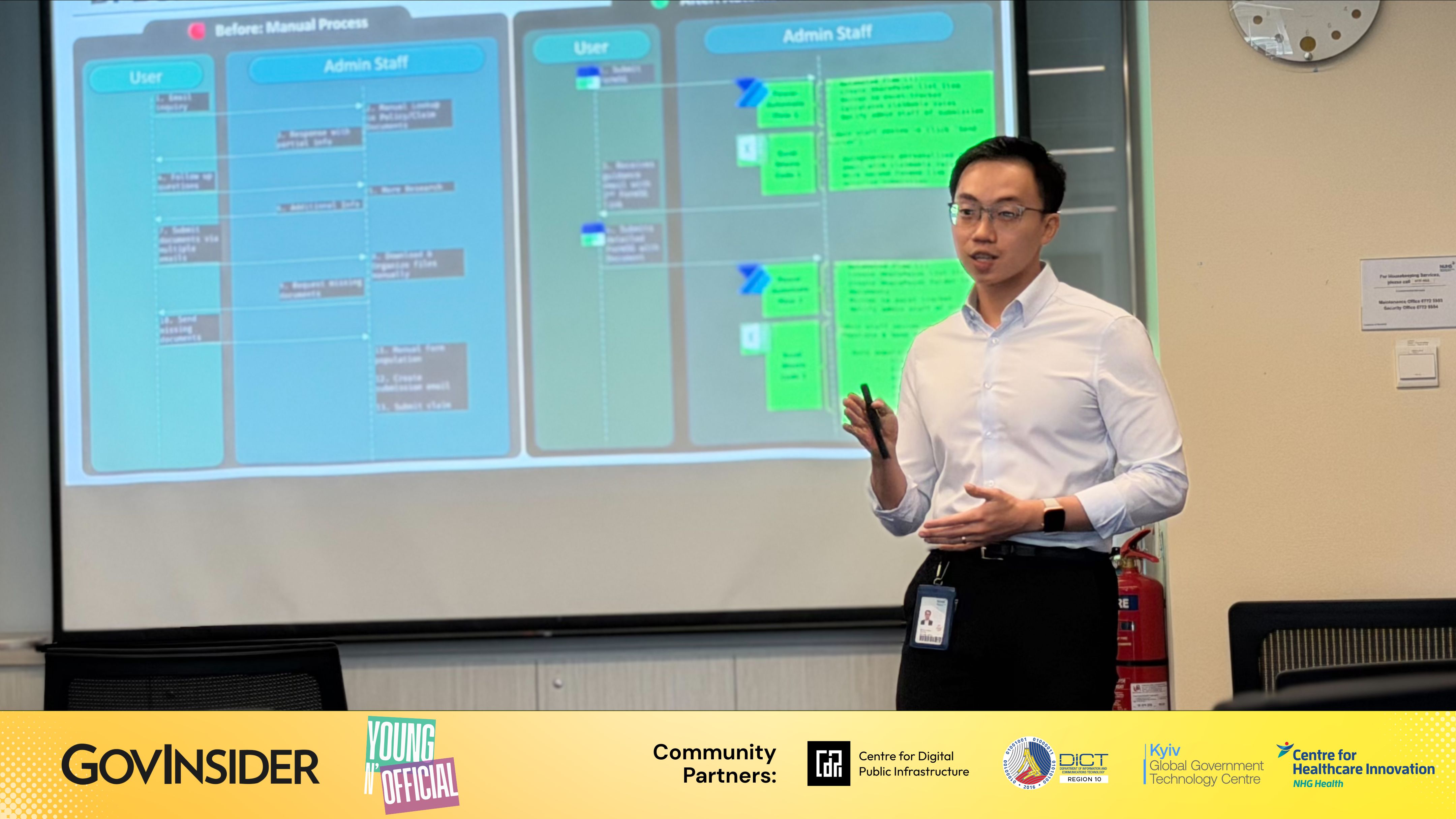
Darryl Juan Wen Kai, Assistant Manager, Department of Diagnostic Imaging, National University Hospital, Singapore. Image NUHS
1) What does public service mean to you? Can you share more about your role in the public sector?
Public service, to me, is the privilege of doing meaningful work; work that touches real lives, often in moments that matter most.
I serve as an Operations Assistant Manager in the Department of Diagnostic Imaging at the National University Hospital Singapore, where I oversee operations and administration, develop and drive the adoption of automation and artificial intelligence (AI) technologies to manage resources, optimise care and improve service delivery.
But beyond the title, a big part of my role is to manage, optimise and expand the resources available to us - because ultimately, how well we steward those resources determines how accessible our care can be for the patients who need it.
I deeply believe that feeling the weight of that responsibility is not a burden — it is a privilege. As Billie Jean King once said, "Pressure is a privilege."
When there is pressure, it means the work matters. It means people are counting on you. And that, to me, is the highest honour of public service.
2) Tell us about a project you championed. What impact did it have on the community?
One of the projects I am most proud of is RadiBOT, a Retrieval-Augmented Generation (RAG) chatbot I built to solve a persistent, quietly costly problem in our department.
DDI-specific information - scan pricing, modality workflows, scheduling information, system code mappings — was scattered across multiple documents and intranet pages.
Staff had to hunt manually through silos, which slowed them down, introduced errors, and ultimately affected patient experience.
The RadiBOT changed that. It gives staff instant, natural-language access to the information they need - pricing codes, workflows, contacts, clinical guides - in seconds, without needing to know exact terminology. It is used hospital-wide today. The impact is not just speed; it is confidence.
When a frontliner can answer a patient's question accurately and quickly, it changes how that interaction feels for everyone.
3) How has your perspective as a young professional allowed you to identify solutions others might have overlooked?
Growing up in an era of digital tools has shaped how I instinctively see problems: not as fixed constraints, but as processes waiting to be reimagined.
When I looked at our department's claims processing for doctors - a manual, fragmented workflow spanning multiple systems - I saw not just inefficiency, but unnecessary friction that was draining people's time and confidence.
That led me to build ACPODs (Automated Claims Processing and Organising Digital System), a fully automated pipeline using Power Automate and Excel Macros.
It eliminated guesswork over claimable rates, reduced back-and-forth communications, and consolidated fragmented steps into a single, guided flow.
What I think defines our generation is not an inherent advantage, but the fortune of having been shaped and moulded by these tools from early on. The relevance now lies in how agile we are in applying them - we bring not just the know-how, but a deep-seated optimism that almost any process has the capacity to be reimagined and done differently.
4) What is your personal strategy for maintaining your creative energy when faced with bureaucracy?
I love to play tennis in my free time.
Not just the game, but the values and culture behind the sport. It taught me something that translates directly to work: "Victory belongs to the most tenacious" - words etched at Roland Garros's centre court, Philippe Chatrier.
Because the truth is, the distance between a good idea and real impact is rarely short. Ideation to implementation takes time; it winds through alignment, resourcing, iteration, and setbacks. My strategy is to stay anchored on the why.
When momentum slows, I remind myself of the patient whose wait time we are trying to cut, or the frontliner whose day we are trying to make a little less stressful. That clarity of purpose keeps the creative engine running. I also find that small wins matter enormously — demonstrating impact early builds the trust and momentum needed to tackle larger change.
5) If you had just one area to invest in to accelerate transformation in the public sector (regulation, technology, talent, etc.), which one would you choose and why?
Talent — specifically, investing in the people closest to the work.
Technology is powerful, but it is only as effective as the people who use and champion it. In our hospital, I have seen colleagues — many of whom do not come from technical backgrounds — grow into confident users and advocates of the tools we build together.
When you bring people along on the journey, rather than just deploying solutions at them, you unlock something far more valuable than efficiency: you unlock ownership. And ownership drives sustained transformation in ways that no technology alone can.
6) What is your greatest ambition as you grow in your public service career?
To build systems - and teams - that outlast me.
My ambition is not to be the one who always has the answer, but to create the conditions where my team can find better answers than I ever could.
In the long run, I hope to help shape a model of operations in healthcare that genuinely demonstrates you can do more with less — not by cutting corners, but through thoughtful innovation and genuine care for the people doing the work.
7) What is a “universal value” that connects everyone in your department – from interns to directors – and how do you use that to drive collaboration?
A shared mission to do things right, and to do them better.
Whether you are a radiographer, an admin executive, or a department head, everyone in Diagnostic Imaging is ultimately working towards the same end: delivering the best possible care for our patients.
I use that common ground to bridge gaps when priorities diverge. When I introduce a new system or process, I try to frame it not as a technology project but as a step towards that shared mission - how does this help us serve patients better? How does this raise the standard of what we do together?
That reframing cuts through silos and creates alignment across every level of the team, because regardless of role, the goal is the same.
8) What is the best piece of advice you’ve got for the next generation of public servants?
Seize your opportunities fully. Nobody owes you an opportunity; they are rare, and they do not wait.
When one comes, do not just meet the moment - exceed it.
Bring your whole self, your curiosity, your creativity, and your grit. And never underestimate the impact you can have from wherever you are sitting. You do not need a grand title to drive meaningful change. Start with the problem in front of you, step up and show your worth!
9) What is a myth you wish to debunk about young public servants?
That we are impatient and only interested in flashy innovation. In my experience, the young public servants I know are deeply mission-driven.
Yes, we challenge conventions - but it comes from a sincere desire to serve better, not to disrupt for disruption's sake. And when given a seat at the table, we do not just show up as task executors - we think deeply, we ask the harder questions, and we align ourselves to the bigger common goal.
The most rewarding moments for me have not been personal milestones, but watching a frontline staff member grow in confidence, or seeing a solution we built together genuinely change how a patient experiences care.
10) Write a letter to your future self in 2035. Please keep it within 200 words.
Hey Darryl, it must not have been easy these past few years.
But I sure hope that you have stayed true to what drives you — not the accolades, but the moments. The staff member who finally felt confident. The process that used to frustrate everyone now just works.
I hope you have kept the tennis mindset: that pressure is still a privilege, and that you have leaned into every difficult rally rather than backing away. That you have remained tenacious — not stubbornly, but purposefully.
I hope the teams you have built are thriving, not because they depend on you, but because you gave them the tools, the trust, and the belief to lead themselves.
And I hope you still remember what this all felt like at the beginning - the urgency, the optimism, the hunger, that this work, wherever you are, can be a place of genuine joy and innovation.
Keep at it. Remember to keep that sparkle alive in you.
Darryl, 2025