
Digital Public Infrastructure is changing how the Indonesian government works
By implementing DPI in its social protection programme, the Indonesian government is improving the way it delivers public services.
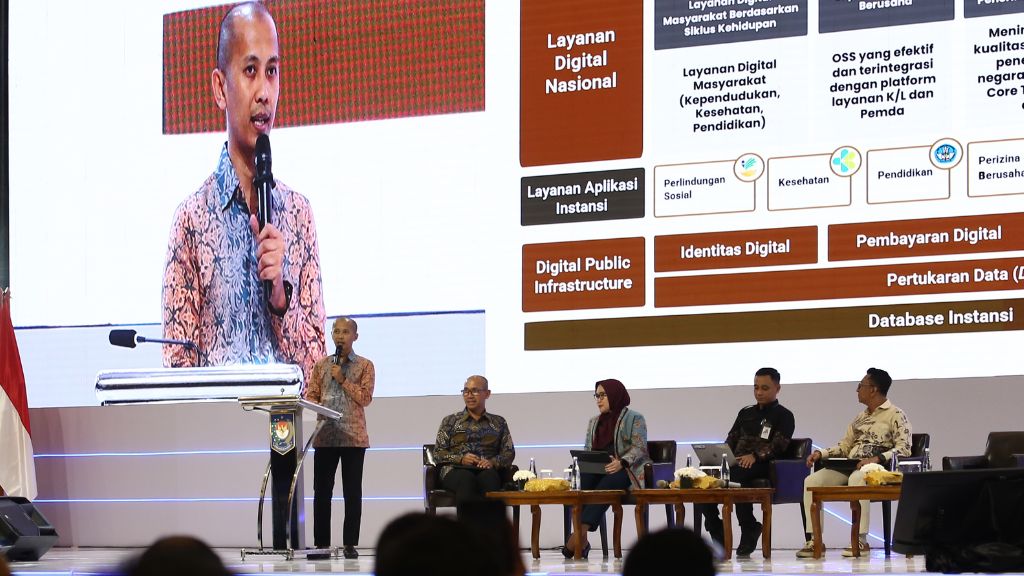
For Indonesia National Economic Council's Principal Expert, Rahmat Danu Andika, DPI is not merely about technology but about the courage to change how the state serves its citizens. Image: Directorate General of Population and Civil Registration.
Digital transformation is often understood as the effort to move legacy services onto new platforms.
Its essence lies in changing mindsets and ways of working enabled by strong digital infrastructure, said National Economic Council’s Principal Expert, Rahmat Danu Andika.
Speaking at the Digital Identity Forum 2025 event organised by the Directorate General of Population and Civil Registration (Dukcapil), Ministry of Home Affairs, in Jakarta on December 10, Andika explained that this paradigm shift is now being tested through the application of Indonesia’s national Digital Public Infrastructure (DPI) in social protection programme (Perlinsos).
“DPI is not merely about technology, but about the courage to change how the state serves its citizens.
“If DPI exists but our ways of working do not change, then we have not truly transformed,” he said.
Andika explained the DPI using a simple analogy: the GPS. Beyond making navigation easier, the GPS also gave rise to new innovations.
“After GPS existed, people could think of the unthinkable: building ride-hailing apps, logistics platforms, or other GPS-based services,” he explained.
The same logic applies to the DPI, he said. DPI is not just a collection of digital systems, but a shared foundation that enables the state to build public services that are more effective, secure, and citizen-centric.
From portals to shared infrastructure
Andika noted that Indonesia already has a wide array of digital services, ranging from government portals, public service apps to online forms across different economic sectors.
“What we do not yet have effectively as a shared asset is DPI, which includes digital identity, data exchange platforms, and digital payment systems.
“The absence of this foundation means many digital processes still replicate old ways of working,” he added.
He pointed to the civil servant recruitment system, which still requires applicants to upload images of their diplomas to ministry and agency portals.
What is needed is the assurance that an applicant is genuinely a university graduate, and not just another copy of the diploma.
With DPI, such verification can be carried out through direct data exchange with the institution that serves as the single source of truth, which is the Ministry of Higher Education, Science and Technology, in this case.
The old way of collecting document copies in multiple locations only increases the risk of data breaches and makes security more difficult to manage, he added.
To subscribe to the GovInsider bulletin, click here.
Perlinsos as a DPI pilot
Andika underlined that efforts to develop DPI in Indonesia have in fact been under way for many years. However, these advances have progressed in silos.
“This prompted the government to develop a new approach, starting with a single, concrete use case [like] the Perlinsos,” he said.
According to him, Indonesia has allocated more than IDR500 trillion (S$38.6 million) each year to various social assistance programmes. Yet, multiple studies indicate that this budget is potentially misdirected.
“With a population of around 280 million and the limitations of today’s systems, accurate targeting is indeed very challenging.”
In the specific Perlinsos pilot in Banyuwangi, East Java, the government is applying a DPI approach in its cash assistance programme, Family Hope Programme (PKH) and food assistance schemes.
Registration is conducted through biometric authentication by leveraging population and identity data already held by Dukcapil as the basis for verification.
Beyond targeting, another key aspect being tested is transparency.
With the applicant’s consent, administrative data held by various agencies – ranging from Dukcapil and BPJS Health to the State Electricity Company’s (PLN) billing and banks – can be accessed to assess eligibility for assistance.
“This data is verified because people are applying for assistance … There is a clear cause-and-effect relationship, and it is based on consent.”
This approach will address a long-standing question frequently raised by the public: why does one person receive assistance while another does not?
Going forward, every decision will be accompanied by clear reasons, as well as an online appeal mechanism, he said.
Foundation to scale
The Perlinsos pilot in Banyuwangi has shown encouraging early results and provides a foundation for scaling up.
“In less than one month, around 359,000 families registered, equivalent to more than half of Banyuwangi’s population. The process also reached residents without digital devices, through the support of thousands of field agents,” Andika said.
However, he stressed that the pilot should not be judged on perception alone. Its success will be measured scientifically by comparing targeting error rates before and after implementing DPI and using the National Economic Census data as a benchmark.
“A pilot is an experiment. It may succeed or it may fail. What matters is that we know, in measurable terms, what has changed.”
If the results show improvement, the government plans to expand the model to at least 32 cities in 2026, before rolling it out nationally and extending it to other subsidy programmes.