
Dr Sarah Chua, Consultant, Division of Endodontics, National University Centre for Oral Health, Singapore (NUCOHS)
Meet the young public sector officials in the inaugural Young & Official Report 2026.
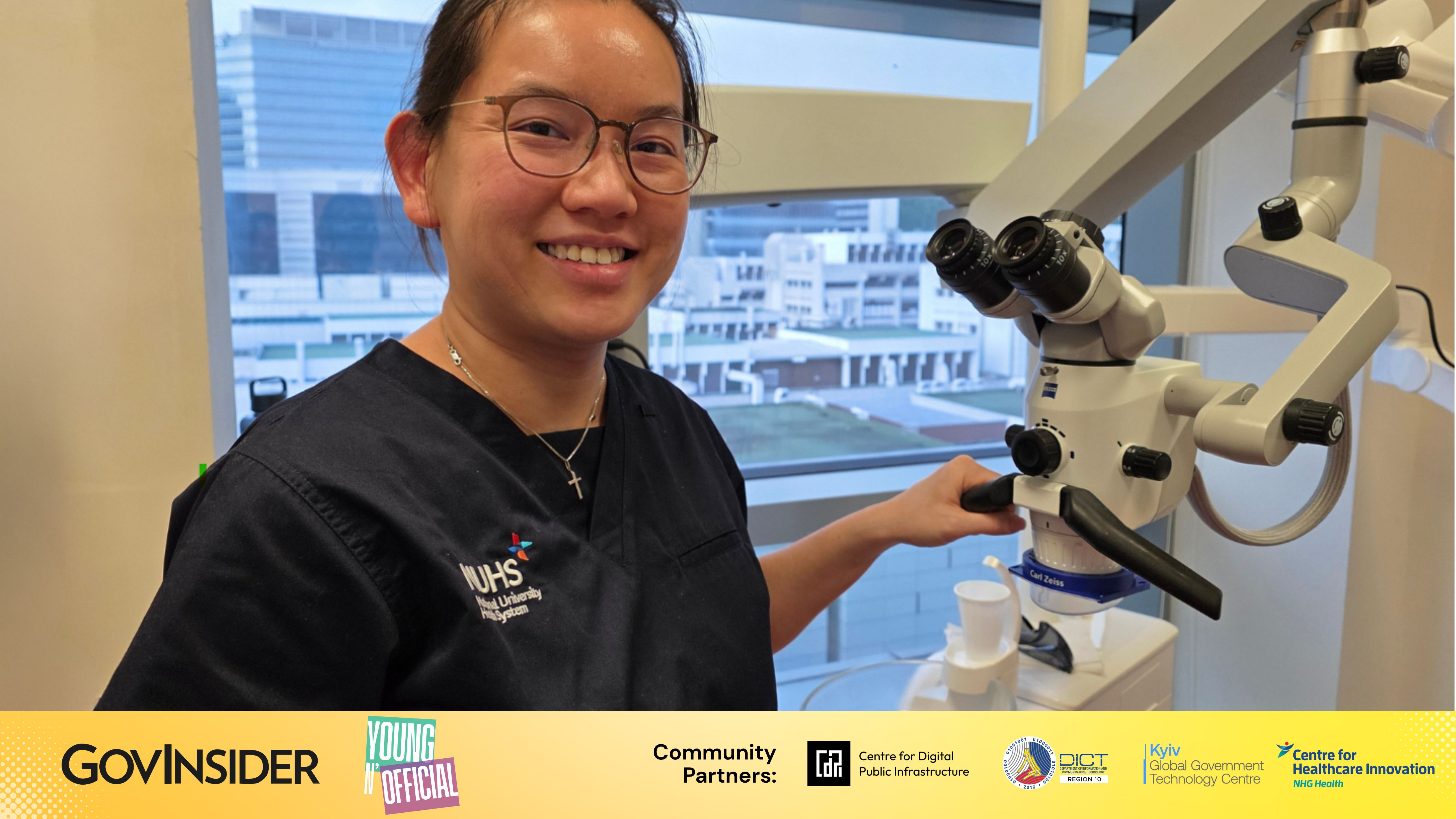
Dr Sarah Chua, Consultant, Division of Endodontics, National University Centre for Oral Health, Singapore (NUCOHS). Image: NUHS
1) What does public service mean to you? Can you share more about your role in the public sector?
In 2024, the World Health Organisation (WHO) declared that there is “no health without oral health.”
As a dentist, public service thus means treating oral health as a foundational requirement for a healthy society. It is a commitment to improving the health of the entire population, regardless of their socio-economic status, both through the provision of high-quality dental treatment and the prevention of oral diseases.
As an endodontist (root canal specialist) working in the public healthcare system at the National University Centre for Oral Health, Singapore (NUCOHS), my primary role is in treating patients from all walks of life with diseases involving the pulp (nerve and blood vessels) of the tooth, which are usually caused by decay or trauma.
I see a mixture of private and government-subsidised patients. As an adjunct faculty member of the Faculty of Dentistry, National University of Singapore (NUS Dentistry), I am also involved in the didactic and clinical teaching and training of aspiring dentists.
2) Tell us about a project you championed. What impact did it have on the community?
Together with a group of like-minded colleagues, I championed a project for “Appropriate Care” for patients requiring dental optimisation before medical therapy.
We focused on a subgroup of patients who were planned for bone-strengthening medications for osteoporosis and radiotherapy for head-and-neck cancers.
These patients need their dental conditions optimised before medical therapy to avoid oral complications like jawbone death.
We harnessed the new Next Generation Electronic Medical Records (NGEMR) system, EPIC, as well as enhanced interdepartmental communication systems like Microsoft Teams, to develop a more streamlined patient care journey for these patients, thereby reducing the time taken to achieve dental optimisation and reducing delays to medical therapy.
This is an ongoing project, and we hope to further improve patients’ experience with dental optimisation before medical therapy, as well as to improve follow-up preventative care post-medical therapy.
3) As a young professional, how has your unique background or perspective allowed you to identify a solution that others in your organisations might have overlooked?
As a younger, more tech-savvy individual, I was particularly excited when my healthcare cluster moved to using the Next Generation Electronic Medical Record (NGEMR) (developed by EPIC Systems Corporation) in 2022, and I was immediately able to see great potential for it in multiple avenues, including improving documentation quality and standardisation of clinical protocols in alignment with clinical guidelines.
I signed up as a “SuperUser” to help train and help colleagues in the transition to EPIC and spent a few evenings after work tinkering with EPIC to customise it for my own workflow.
I later attended the EPIC Physician Builder course to learn how to code and configure the EPIC software, which allowed me to understand the EPIC ecosystem on a deeper level and gave me the technical jargon to communicate more “fluently” with the Builders when developing system-wide enhancements.
4) What is your personal strategy for maintaining your creative energy when faced with bureaucracy?
I remind myself of the bigger picture and the greater goal that we are trying to achieve, and consult with colleagues so that we can use each other as sounding boards to refine our approaches and ideas, and simply to remind ourselves that we are not alone on this journey.
5) If you had just one area to invest in to accelerate transformation in the public sector (regulation, technology, talent, etc.), which one would you choose and why?
In my opinion, talent is the most critical factor because the public sector, and especially public healthcare, is inherently human-centric.
Even the most advanced technology and the most effective regulations require the human touch of critical thinking, emotional intelligence, and passion to drive them.
When it comes to talent in the public healthcare sector, one area I think can be invested in is giving young clinicians protected time in the workweek to expand beyond their clinical scope into administrative, research, and education roles.
This would allow them to bring their transformative energy to these important aspects of public healthcare, without impacting their clinical service or forcing them to burn the candle at both ends to do so.
6) What is your greatest ambition as you grow in your public service career?
The idea of “Appropriate” and “Value-driven” care, going beyond just quality contemporary clinical care or good bedside manners, is something that I hope we can expand on in NUCOHS.
I believe that we can leverage the powerful combination of clinical and research expertise within NUCOHS and NUS Dentistry and the NGEMR EPIC ecosystem to develop data- and research-driven programmes to ensure that patients receive the most appropriate and valuable care for their individual conditions.
This concept should also be taught to our NUS Dentistry students so that it can benefit even more Singaporeans in the years to come.
7) What is a “universal value” that connects everyone in your department – from interns to directors – and how do you use that to drive collaboration?
The desire to provide world-class patient care and experience is the heartbeat of my department.
At the same time, it is also important to keep an open mind and communicate so that everyone can be individually convinced of how any new change can bring us a step closer to our common goal, so we can strive together to achieve it.
8) What is the best piece of advice you’ve got for the next generation of public servants?
Communication and collaboration are key. You may be passionate about change, but you cannot do it alone.
It is important to work within the system to engender change, and the first step usually includes speaking to seniors to better understand the bigger picture and possible legacy issues and barriers that may need to first be overcome. This way, everyone can collaborate towards meaningful change.
9) What is a myth you wish to debunk about young public servants?
Younger staff are often seen as upstarts who do not respect the chain of command or who try to disrupt established protocols.
However, the truth is that this “disruption” reflects a desire to improve workflows that they believe can be further refined despite having served their purpose for many years.
Both senior and junior staff should keep an open mind and seek to collaborate to ensure the department remains resilient and adaptable amidst an ever-changing landscape. The possibilities are endless if we can meld the steady experience of senior staff with the dynamic creativity of junior staff.
10) Write a letter to your future self in 2035. Please keep it within 200 words.
Dear me, I hope you still remember the passion of those first few years as a dentist in the public healthcare system: that desire to contribute to society by providing dental care that is not only of high quality, but also holistic and cost-effective.
Never forget the importance of listening to patients and empowering them to improve their oral health through effective preventive care. I hope that your spark has not been extinguished by bureaucracy or routine.
When the days grow long, remember not to become weary in doing good, for in due time you will reap a harvest if you do not give up. Cling to your calling to do justly, to love mercy, and to walk humbly.