
Energy, connectivity and cybersecurity as foundations of Indonesia's digital economy
Government leaders at the Digital Transformation Indonesia Conference & Expo (DTI-CX) 2026 emphasised a broader shift in the government’s thinking, framing digital transformation as a primary driver of the nation’s economic development.
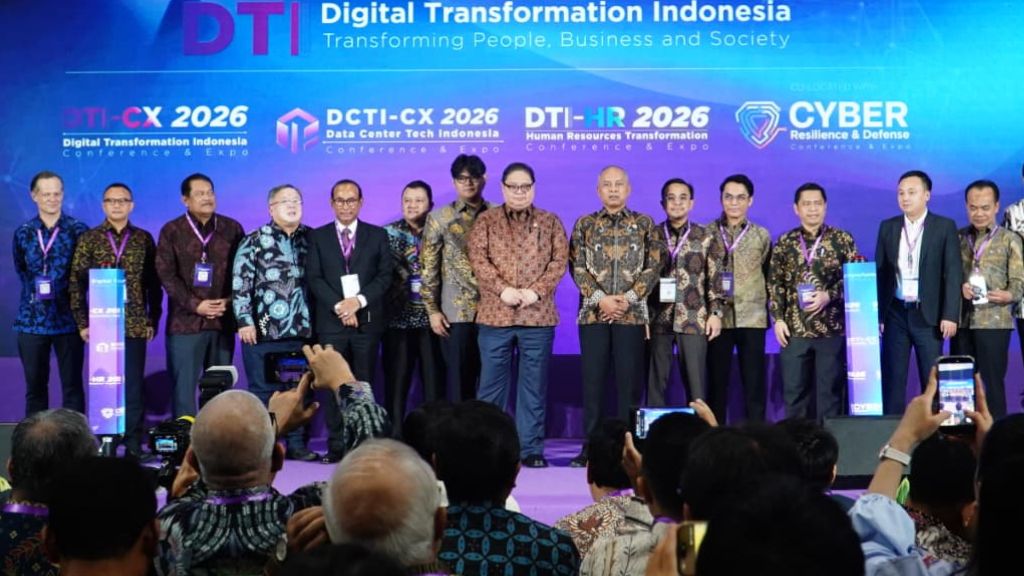
Government and industry leaders gathered at the opening of Digital Transformation Indonesia Conference and Expo (DTI-CX) 2026 in Jakarta, August 5. The event aimed to unlock new economic opportunities through digital transformation. Image: Indonesia's Coordinating Ministry for Economic Affairs.
With the ASEAN Digital Economy Framework Agreement (DEFA) now agreed, opportunities for digital trade and technology investment across Southeast Asia are expected to expand significantly.
But how prepared is Indonesia to seize this opportunity?
That question ran throughout the Digital Transformation Indonesia Conference & Expo (DTI-CX) 2026 held in Jakarta on August 5-6.
Bringing together government leaders, technology providers and industry players, the event featured 138 speakers, 500 exhibitors, and thousands of visitors.
Three government officials, in their opening addresses, highlighted three foundations that Indonesia needs to have to build a thriving digital economy. They were a strong energy foundation, a digital ecosystem capable of generating economic value, and cybersecurity as the basis of public trust.
This reflected a broader shift in the government's thinking, which is viewing digital transformation not as a technology agenda, but as a key driver of national economic development.
A digital economy begins with energy
Coordinating Minister for Economic Affairs, Airlangga Hartarto, said discussions around AI, data centres and the digital economy often overlook their most fundamental requirement: energy.
According to him, the entire digital infrastructure depends on the availability of reliable electricity.
"A digital economy can only exist if the energy infrastructure is in place."
Hartarto noted that Indonesia holds a significant advantage through its domestic energy resources, including geothermal, hydropower and solar energy, to support the development of data centres, AI and quantum computing.
While fibre optic networks and subsea cables have rapidly boosted the country's digital connectivity, the next challenge was ensuring that developing islands’ energy networks keep pace with the rest.
"Investment opportunities in energy networks remain wide open for both domestic and international investors, as no single player has yet come to dominate the market," he added.
However, he emphasised that natural resources alone will not be enough.
Indonesia must also accelerate the development of digital talent if it is to remain competitive globally.
The government was therefore expanding collaboration with universities, industry and professional communities to produce more digital and AI talent, including by introducing coding and AI education from an early age.
According to Hartarto, combining digital talent, rich energy resources and a large domestic market is key to driving Indonesia’s next wave of tech startups, skilled professionals, and global innovations.
"This golden moment will not last. We have to seize it within the next three to four years," he noted.
Connectivity must create economic value
Another challenge was ensuring that Indonesia's digital networks genuinely improve productivity and create added economic value, said Edwin Hidayat Abdullah, Director General of Digital Ecosystem at the Ministry of Communication and Digital (Komdigi).
According to Abdullah, Indonesia has now moved beyond the stage of building basic connectivity.
The government's focus has shifted towards meaningful connectivity, which is defined as connectivity that improves productivity, creates jobs, and strengthens public services.
He compared the digital ecosystem to a building consisting with four interconnected layers: physical infrastructure, virtual infrastructure, digital platforms, and applications.
None of these layers, he argued, can be developed in isolation.
"If we only build physical infrastructure, it is like constructing a road with no traffic. On the other hand, if we build the upper layers first without preparing the underlying infrastructure, we will simply create congestion."
For that reason, the government wants to ensure that every layer of the digital ecosystem develops in parallel – from infrastructure, investment, talent and regulation to digital services - deliver tangible benefits for citizens.
One example is the Government Service Integration Platform (SPLP) - the government's API – which enables government data exchange to support Indonesia's social protection programme (Perlinsos).
To date, SPLP has processed more than 10 million data exchange transactions, accelerating verification, reducing duplicate records, and improving the accuracy of social assistance delivery.
"This enables citizens to access services without worrying about duplicate processes that waste their time and – more importantly – prevent them from losing access to government services."
Cybersecurity as a mandatory investment
As more public services become digital, ensuring that these systems remain secure and trustworthy becomes increasingly critical, said the Head of Indonesia's National Cyber and Crypto Agency (BSSN), Nugroho Sulistyo Budi.
With Indonesia's digital economy projected to reach more than US$340 billion by 2030, Budi warned that rising technology adoption will inevitably be accompanied by growing cyber risks.
"The only truly secure system is one that is switched off. As long as it remains connected to a network, there will always be threats," he said.
He highlighted that most cyber incidents originate from internal vulnerabilities, ranging from compromised credentials and malware to human error.
As a result, cybersecurity should not be treated as an additional layer only applied after systems have been built.
Instead, organisations should adopt a security by design approach, embedding security into technology from the outset, alongside resilience by architecture, ensuring systems can continue operating and recover quickly when incidents occur.
Budi also called on both government and industry to rethink cybersecurity investment, shifting it from a technical issue to a strategic decision made at the highest levels of leadership.
"Cybersecurity is no longer optional. It is a mandatory investment for the success of Indonesia's national digital transformation," he added.