
Every digital government wants to be Singapore and Estonia, but almost nobody can say what that takes
After making his name with the Agentic State whitepaper, Germany's Federal Ministry for Digital Transformation and Government Modernisation (BMDS)'s advisor, Manuel Kilian, goes back to basics in digital statecraft and the social contract it rests on.
-1788830448634.jpg)
Germany's Federal Ministry for Digital Transformation and Government Modernisation (BMDS)'s advisor, Manuel Kilian. Image: Kilian
While the US has some of the world's best tech systems, Manuel Kilian points out that it's far from the best at putting them to work inside the government.
Likewise for Germany, despite once pulling off the bureaucratic feat of merging two countries, it still struggles to get basic services online.
Estonia, on the other hand, had almost nothing going as a post-Soviet state, yet built one of the world's most digitised governments.
Singapore, meanwhile, has sustained a similar level of execution for more than a decade now.
Speaking to GovInsider, Kilian has heard the same aspiration from other governments to "become more like Singapore and Estonia", but almost none of them could explain what that takes.
He admits that it's a puzzle he has circled for his career in govtech, starting out as a researcher, founding a startup, and running the first govtech centre under the World Economic Forum (WEF).
Just four months ago, he joined Germany's youngest ministry, the Federal Ministry for Digital Transformation and Government Modernisation (BMDS), as an advisor.
In his new book "How Nations Digitise: The Ten Forces of Digital Statecraft," he attempts to give governments the shared vocabulary around the digital state.
A shared vocabulary for digital government
Asked what digital statecraft means, "it's the ability of the state to govern well in the technological era," Kilian says, linking it back to the social contract between the state and the citizens.
"The citizen gives up a certain degree of freedom, and in return, the state says: I provide for you. That provision has to be projected onto the digital space," he explains.

Kilian believes the digital state deserves the same rigour other disciplines of statecraft have already earned.
"The fact that we can talk about and understand diplomacy is because at some point Niccolò Machiavelli wrote down the fundamentals of what it is.
"The way we think about public finances goes back to John Maynard Keynes and Milton Friedman. I think we need the same thing for digital statecraft," he says.
In his book, he lays this vocabulary out in a framework of ten forces, which he groups into three tiers: foundations, capacity and execution.
The first three forces, namely agency, urgency and permanence, make up the foundations that make transformation possible at all.
The next four, namely iteration, legacy, procurement and culture, indicate the government's capacity to carry it out.
And the last three, namely user experience, adoption and boundaries, determine how well it gets executed.
The book draws on lessons in digital governance across different regions from Europe, Africa, the Americas, the Middle East and Asia.
While he has distilled the book down to ten forces, he stops short of prescribing a single model, saying that there is "no one and only right way to do it [master digital statecraft]."
"Rather, these examples show that digital statecraft is a universal challenge that surfaces across regions, political systems and stages of development," he shares.
The forces that stood out for Singapore
Where Singapore does feature in the book, Kilian highlights two forces that stand out, namely urgency and adoption.
On urgency, he points to the founding Prime Minister Lee Kuan Yew's own account of governing.
"He said that building this urge to move on and keeping it alive was the most difficult thing to do," he says.
To make it work for decades beyond a political cycle, "that's remarkable," he notes, underlining that urgency is less about a single push but sustaining one.
On adoption, he singles out Singpass, which is Singapore's digital ID, with its near-universal coverage at 97 per cent of Singapore citizens and permanent residents.
He notes that it's not just about building products, but about mastering adoption.
"That's something where you can say Singapore excelled. Not only at building a product, but at positioning it, building smart partnerships and weaving it into other services to get near-complete adoption," he explains.
Beyond Singapore, Kilian points to a broader shift he considers essential, which is building products, not projects.
He shares the analogy from physical infrastructure. "The idea of building physical infrastructure is that you plan well ahead, you build it, and then it's done, more or less," he says.
"With a digital product, it's the other way round. You have a version one, but the journey only begins. Then you iterate, you improve, you test, you expand. It's a completely different way of thinking," he adds.
He is seeing this mindset shift taking root at BMDS. "It's interesting because it differs so much from how other ministries work."
First the agentic state, and going back to the basics
Before this book on digital statecraft, Kilian is best known for his work on the Agentic State whitepaper to support governments in deploying AI agents.
On why he's going back to the basics now, "if we want to think about the agentic state, we first have to really understand what's the basic fundamentals. I think we're still at the beginning of understanding that," he says.
He describes both the Agentic State's whitepaper and this digital statecraft book as attempts to make something intangible usable, rather than looking at it as abstract ideals.
For governments chasing the aspiration to become Estonia or Singapore, he goes back once again to the social contract.
How well states manage their duties digitally will decide whether citizens trust their governments, he says.
"It's a massive task," he adds. "If it works, it builds trust in government. If it doesn't, trust is lost."
"I'd like everyone in this field to understand how meaningful this work is, and that it's a decisive time to be working on it now," he says.
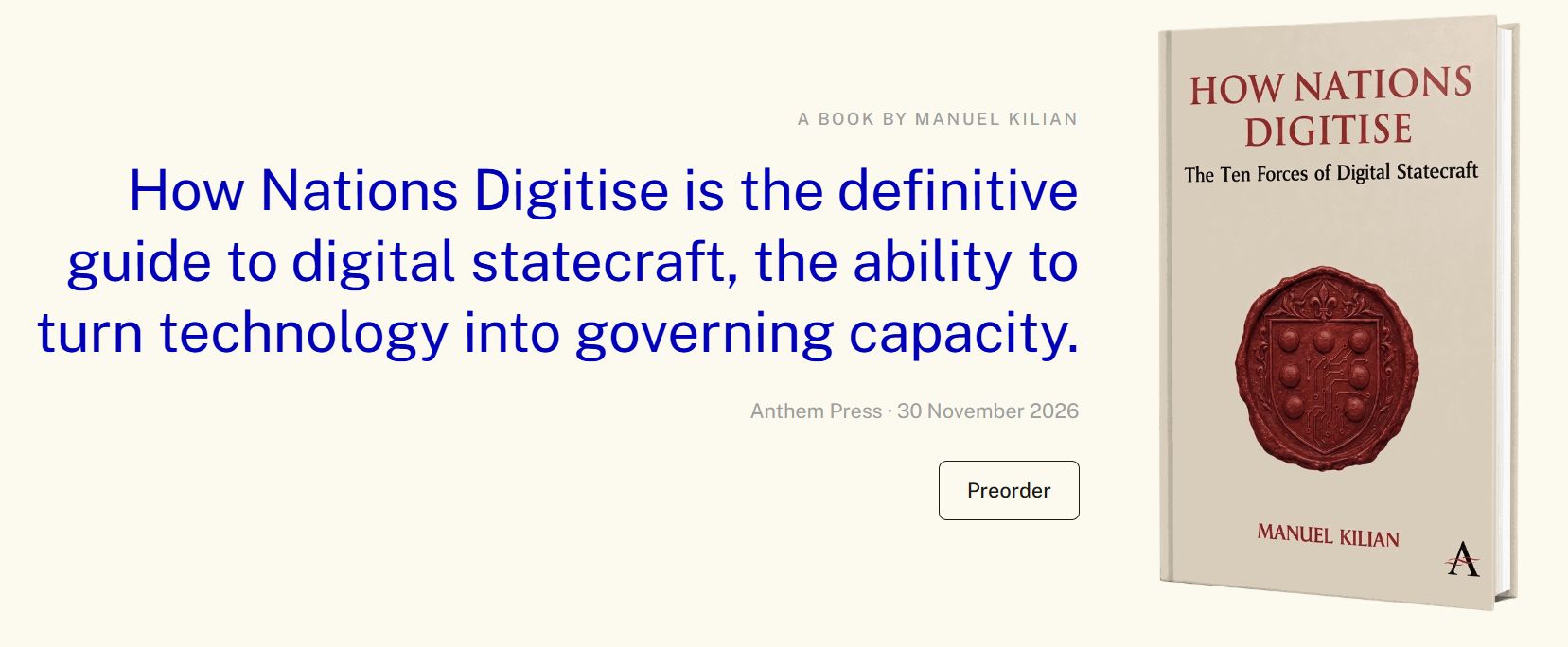
Kilian is publishing his book "How Nations Digitise: The Ten Forces of Digital Statecraft" this November. You can find out more about his book here.