
How AI and automation transform Singapore’s allied health workforce
By Cindy Peh
National University Health System (NUHS)'s Chief of Allied Health & Pharmacy, Adj. A/Prof Michael Ong, shares how workforce redesign, technology, and leadership are helping prepare allied health and pharmacy professionals for the future.
-1791360955635.jpg)
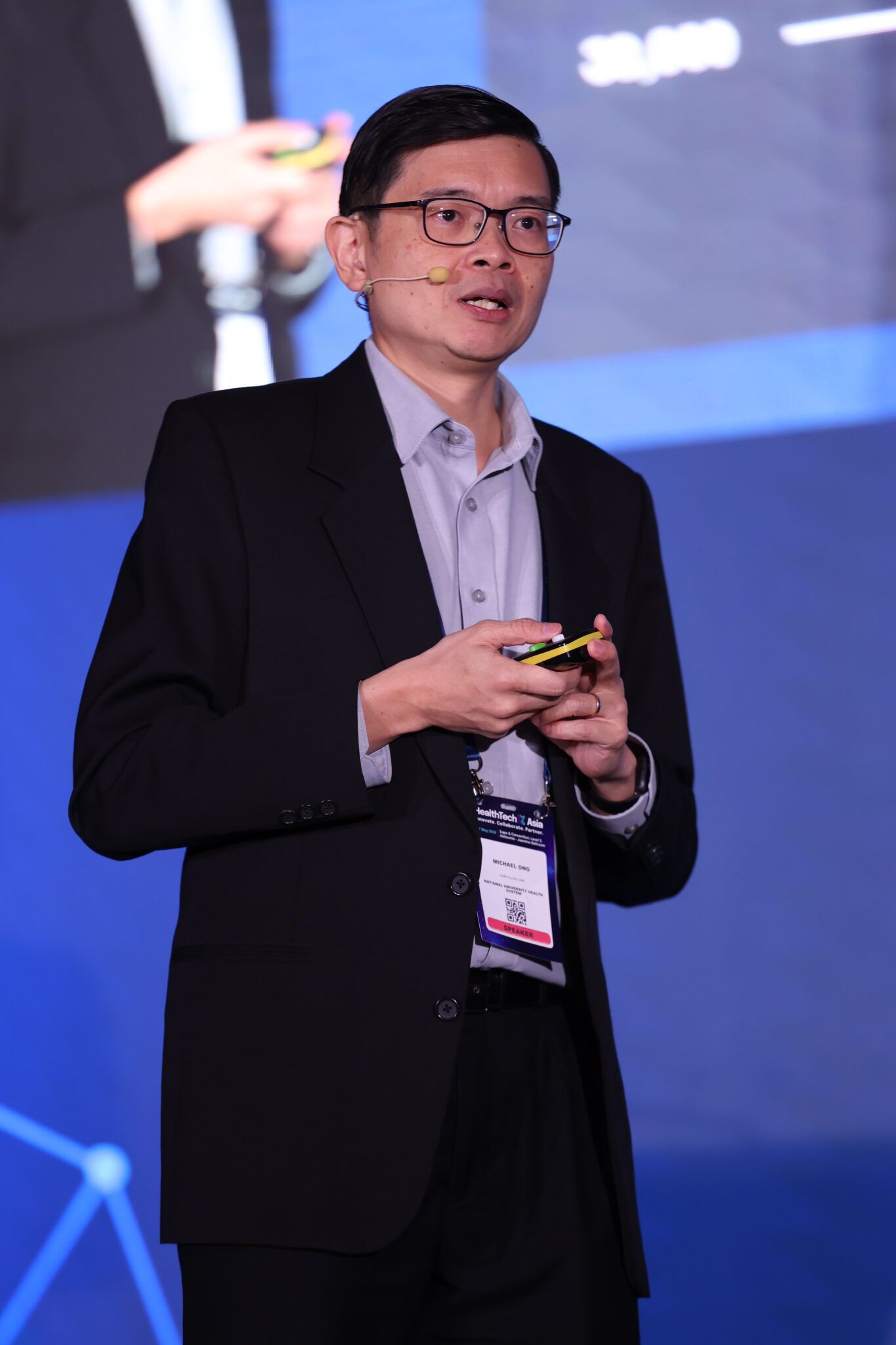
NUHS is using AI and automation as part of a broader transformation of how care is delivered. Image: HealthTechX Asia
By 2030, one in four Singapore residents will be aged 65 and above.
To meet demand from this growing pool of seniors, the local healthcare system will need around 6,000 new hires every year – a figure that is not sustainable.
For Adj. A/Prof Michael Ong, Chief, Allied Health & Pharmacy at the National University Health System (NUHS), simply expanding the workforce will not be enough.
“Workforce must transform and not just expand,” he said, during his presentation at the HealthTechX Asia 2026 conference.
For NUHS, this means using artificial intelligence (AI) and automation as part of a broader transformation of how care is delivered – rather than treating technology as a solution in itself.
NUHS’ Mission Command
With around 9,000 staff across NUHS, Prof Ong said leadership needed to be embedded at every level to keep the organisation agile.
Around five years ago, NUHS adopted a leadership philosophy known as “Mission Command”, where leaders at the top give clear direction and intent while empowering leaders downstream to act autonomously.
The organisation also brought different job families together through “triads” and “quadrats”, enabling doctors, nurses, allied health professionals, pharmacists and operations teams to work more closely on transformation initiatives.
This foundation became particularly important as generative AI gained momentum in 2022.
NUHS began assessing tools such as ChatGPT and Copilot while training staff in innovation and AI use.
Over the past 18 months, more than 40 per cent of its workforce has received training.
Prof Ong described the approach as a “Lighthouse” model: leadership sets the direction and identifies how care could be reimagined, while teams on the ground operate “greenhouses” where ideas can be tested in real ward and clinic environments.
Transforming allied health and pharmacy services
NUHS’s approximately 2,000-strong allied health and pharmacy workforce is made up of diverse groups from dietitians to physiotherapists.
Transformation starts with bringing everyone together to envision what allied health and pharmacies could be in 2030, said Prof Ong.
“We can augment the way we provide services by having our patients take on more self-care, increasing caregiver involvement, as well as leveraging technology to virtualise care where appropriate.”
At the same time, staff need to become proficient in AI and data so that decisions are increasingly informed by evidence rather than intuition or experience alone.
The longer-term ambition is to enable allied health professionals and pharmacists to take greater leadership in care delivery across the continuum.
What’s crucial is also developing a sustainable workforce and leadership pipeline.
Last year, the group identified 26 transformation initiatives, with 80 per cent already underway or completed.
But initiatives alone are not enough. The next question is whether they are effective.
Measuring what matters
NUHS is increasingly looking beyond activity measures to assess transformation across the six domains of healthcare quality, alongside operational measures such as manpower utilisation, cost, time and environmental impact.
One example came from medical social workers, who previously relied on manual processes to obtain consent from patients applying for financial assistance.
By redesigning the process so that consent is obtained by default, the team saved around 50 man hours while enabling patients to receive assistance faster.
In another case, radiographers examining the replacement of a computed tomography (CT) scanner opted to upgrade the existing scanner rather than replace the entire system and room.
The decision avoided around S$1.5 million in costs and reduced downtime from two months to two weeks.
Prof Ong said these examples illustrate that transformation is not necessarily about deploying the latest technology.
It is about examining how work is done and identifying where resources can be used differently.
Productivity is more than a number
Manpower remains an extremely limited resource in Singapore.
In 2023, NUHS began measuring productivity across 11 allied health professions, targeting to achieve 10 per cent efficiency gains by 2030.
But Prof Ong cautioned against interpreting productivity figures without understanding the context behind them.
Diagnostic radiographers, for example, achieved a 6 per cent increase in productivity over three years, while workload also grew by 6 per cent annually.
At first glance, productivity appeared to have plateaued.
A closer look showed that the mix of imaging work had changed, with NUHS handling more complex tertiary cases requiring CT, Magnetic Resonance Imaging (MRI) and Positron Emission Tomography (PET)-CT scans.
The opposite occurred in laboratory services, where productivity appeared to decline.
Further analysis found that this was partly linked to more prudent test ordering and increasing automation, leading to a dip in some tests and manual tasks.
“The numbers are not the whole story,” Prof Ong said, highlighting the need for leaders to interrogate data beyond first-order metrics.
Based on current trajectories of productivity gains and continued workload growth, NUHS estimates that it could begin to bend the curve of manpower growth around 2028.
Technology needs partnership and leadership
According to Prof Ong, the lesson is clear: AI and automation can augment healthcare work, but it cannot be achieved alone.
NUHS is building collaborations with policymakers, industry players and other healthcare clusters while continuing to invest in innovation.
Furthermore, technology alone will not resolve the workforce pressures ahead.
Quoting NUH CEO Prof Aymeric Lim, Prof Ong said: “We have the tools, we have the technology – but these alone will not be enough.”
“We must prepare our people. Leadership must act early and boldly to drive changes that are required – it is truly a discipline beyond any single initiative or project.”
The article was originally published in Hospital Management Asia here, and edited.
-------------------------------------------
Cindy Peh is the Content and Community Manager at Hospital Management Asia, which showcases trends and best practices in healthcare management via in-person and digital events, as well as an online publication.