
Indonesia learns from digitalisation of social protection pilot ahead of nationwide scale up
Government leaders and practitioners shared key lessons from Perlinsos in Banyuwangi, East Java, ahead of plans to expand to 40 regencies and cities across Indonesia.
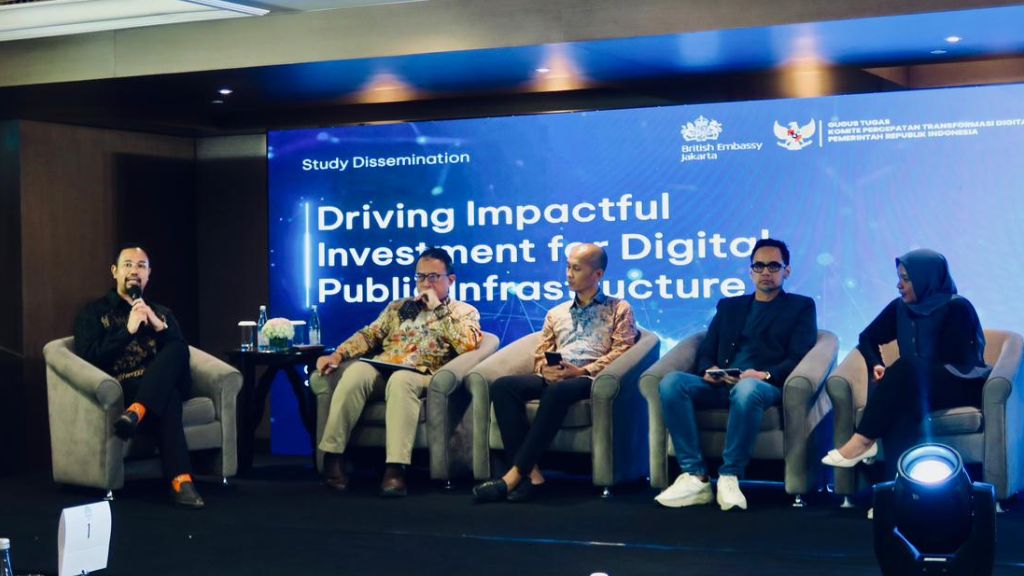
Panel speakers discussed Indonesia's social protection digitalisation programme scale up, building on implementation lessons from the Banyuwangi pilot. Image: Amana Solutions
The digitalisation of the social protection programme (perlinsos) in Banyuwangi, East Java, demonstrates how the adoption of digital public infrastructure (DPI) can transform service delivery.
Its first trials found that processes that previously took between 75 and 200 days can now be completed in minutes to a few hours.
Within three weeks, more than 359,000 families (around 60 per cent of Banyuwangi’s population) were successfully registered to receive assistance.
The government is now targeting to expand the pilot to 40 regencies and cities nationwide.
Behind these achievements lies a critical question: can a local level approach be effectively replicated across other regions on the national scale?
This question was at the centre of the event titled DPI for Social Protection and Investment Opportunities Discussion, organised by the British Embassy in Jakarta in collaboration with the Indonesian Committee for the Acceleration of Government Digital Transformation and AMANA Solutions on April 15 in Jakarta.
The event featured case study presentations and cross-sector panels discussing the country’s readiness to scale.
Here were some of the key takeaways from the event.
Streamlining processes and expanding access
AMANA Solutions’ Alexander Michael Tjahjadi and Jamilatuzzahro highlighted the tangible impact of the Banyuwangi pilot in their report titled "Social Return on Investment (SROI)".
AMANA Solutions is an Indonesian advisory firm specialising in public sector transformation.
Every IDR 1 invested generated IDR 1.35 in social value, which included time savings, reduced processing time and administrative burden, and improved access for underserved groups.
In addition, the cost incurred by citizens to register has dropped significantly to up to IDR 10,000 (S$0.75), which is significant for lower-income residents.
The study also emphasised the need to address fundamental bottlenecks before scaling to other regions, including connectivity, data governance, cybersecurity, and system fragmentation.
It also highlighted the importance of building the capacity of community-level agents or facilitators.
Aligning the problem statement
For the government, the success of the Banyuwangi pilot lies in clearly defining the problem to solve.
In his opening remarks, National Economic Council (DEN)’s Executive Director for Policy Synchronisation of Priority Programmes, Tubagus Nugraha, highlighted two longstanding issues in the social protection programme: targeting errors upstream and distribution challenges downstream.
He cited findings showing an exclusion error rate of 77 per cent in Banyuwangi, indicating that many eligible citizens had not been reached.
“This is the problem statement we are currently working on to address together,” he said.
Committee's Task Force Coordinator, Rahmat Danu Andika, added that social assistance was chosen as a use case because mistargeting has been a “common enemy” across ministries.
“We are not debating the problem statement. Everyone agrees that mistargeted subsidies do happen,” he said.
Andika also acknowledged his colleagues across government who have actively supported this digital initiative and expressed appreciation to the Ministry of Social Affairs for its willingness to serve as a “laboratory” to test this DPI use case.
Building on existing foundations
If the essence of DPI lies in leveraging existing components rather than building from scratch, then the social protection use case is moving in the right direction.
According to Andika, one of the breakthroughs in the pilot was the use of facial biometric verification managed by Ministry of Home Affairs’ Directorate General of Population and Civil Registration (Dukcapil).
“With coverage of more than 98 per cent of the population, registration and verification processes can be completed more quickly, without requiring additional budget for fingerprint or iris scanners,” he noted.
He added that cross-agency data exchange systems managed by the Ministry of Communications and Digital (Komdigi) enabled more transparent eligibility verification.
The system pulls data from multiple institutions to determine whether an individual qualifies for assistance, while still providing an appeals mechanism for applicants.
Challenges beyond technology
In the panel discussion, Universitas Gadjah Mada’s Economist Elan Satriawan said that while the initial results were promising, the government should avoid relying on a single metric.
“The SROI can capture the impact of social policies, but it is not a silver bullet,” he said.
He warned that scaling too quickly without addressing methodological limitations could risk amplifying errors.
He also pointed out that while DPI can improve efficiency, it does not automatically resolve more complex governance issues.
“DPI solves plumbing problems, but coordination, political economy, and policy design require additional reforms,” he said.
Multi-sector collaboration
Cross-sector collaboration will be increasingly critical as expansion is planned across dozens of regions.
During the panel, Indonesian Chamber of Commerce and Industry (KADIN) for Communication and Informatics’ Vice Chair, Firlie Ganinduto, said that the private sector will play a crucial role, particularly in system operations and maintenance.
However, he highlighted the need for regulatory clarity from the government.
“This is a long-term investment. Businesses need certainty in the rules of the game.”
British Embassy Jakarta’s Head of Economics and Social Affairs, Samuel Hayes, underscored that a strong digital ecosystem – built on public–private partnerships – is essential to ensure sustainability and long-term impact.
“The government sets direction and standards, while the private sector brings innovation and capabilities, from connectivity to cybersecurity,” he said.