
Indonesia prepares presidential regulations to guide AI adoption in government
The artificial intelligence (AI) roadmap and an ethics presidential regulation is intended as practical guidance to help government agencies use AI in public services and manage risks responsibly, says Komdigi's Said Mirza Pahlevi.
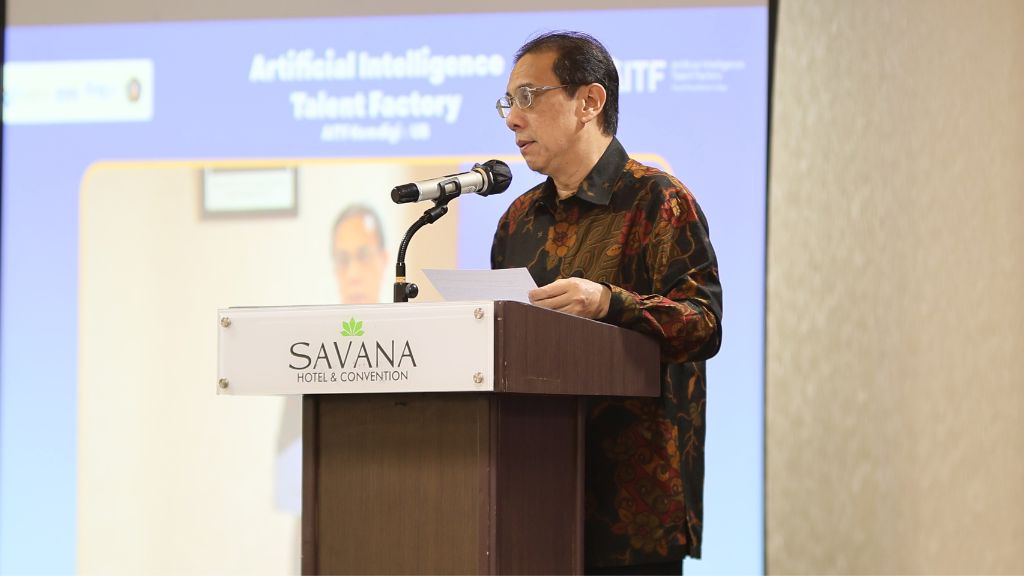
Indonesia will issue a presidential regulation governing the ethical and responsible adoption of AI in government. Image: Indonesian Ministry of Communication and Digital Affairs
The Ministry of Communication and Digital Affairs (Komdigi) is drafting a Presidential Regulation on the 2026-2029 National Artificial Intelligence (AI) Roadmap and a separate Presidential Regulation on AI Ethics.
Komdigi's Director of AI and New Technology Ecosystems, Said Mirza Pahlevi, says the AI Roadmap regulation is being prepared to give AI development a clear direction, programme, and division of responsibilities.
“Meanwhile, the AI Ethics Presidential Regulation will establish the basis for the safe and responsible development, deployment and use of AI,” Pahlevi tells GovInsider.
The National AI Roadmap regulation also entails establishing a National AI Coordination Task Force involving ministries, agencies and other stakeholders.
The task force will align implementation, as well as monitor and evaluate progress in AI adoption.
Komdigi previously drafted the 2025 National AI Roadmap White Paper, which was also released for public consultation and intended to be the foundation for follow-up to propose the Presidential Regulation.
This White Paper also serves as the foundation for the drafting of the Presidential Regulation, which is intended to provide strategic guidance for all stakeholders - government, industry, academia, the public and the media - in developing, managing and using Indonesia’s AI ecosystem in an ethical and responsible manner.
Pahlevi, who previously led the Digital Talent Development Centre, now has a broader mandate to orchestrate Indonesia’s AI ecosystem, including talent, infrastructure and data, as well as research and industry innovation.
“Talent remains an important priority, but its success also depends on investment, governance and cross-sector collaboration,” he says.
Pahlevi will speak at Tech Week Singapore, taking place at Sands Expo in Singapore on September 29-30. The forum brings together decision-makers and tech practitioners from Asia-Pacific.
Translating roadmap into government AI use
The AI roadmap will only have an impact if it can be translated into decisions and practices across ministries and agencies, says Pahlevi.
The approach will not be entirely uniform, as each agency needs to adapt the guidance to the characteristics of its sector.
Government agencies will identify the risks associated with AI use, protect data, ensure accountability and maintain human oversight, particularly when AI is used in public services that can affect people’s rights or access to services.
To support this, Komdigi, together with representatives from each sector, will facilitate cross-sector practical guidance to strengthen AI governance and regulatory sandboxes.
The guidance will help agencies identify appropriate use cases, assess benefits and risks, prepare data, test systems, and establish accountability and human oversight mechanisms.
He notes that the guidance is still being prepared, rather than a national playbook that has already been published.
Public services are a priority
According to Pahlevi, one of the biggest challenges to AI adoption in the public sector is to address the gap between the pace of technological development and agencies’ readiness.
He emphasises the importance of using AI to help civil servants improve the quality and speed of public services, such as finding information, summarising documents that are permitted to be processed, and preparing service responses.
Such uses will deliver broad benefits while giving agencies room to build their capacity to use AI responsibly.
“The principle is that AI helps officers work better while remaining accountable for their decisions,” he says.
Civil servants will need more than the ability to use AI applications. They will also need to be skilled at selecting appropriate use cases, checking AI outputs, protecting data, and recognising when a system requires greater oversight or more rigorous testing.
The next challenge is that AI adoption depends on quality data and adequate infrastructure.
He identifies three areas that need to progress together: strengthening literacy and talent, developing infrastructure and data, and establishing risk-based ethics and governance guidelines.
Talent as the bridge between AI and real-world problems
For Pahlevi, AI talent serves as a bridge between AI capabilities and real-world problems in the public sector.
“The government needs people who can understand service needs, prepare data, develop or adapt models, test their outputs and manage the risks,” he says.
Talent development therefore needs to go beyond the ability to use off-the-shelf AI applications.
Through the AI Talent Factory (AITF), Komdigi has been training AI practitioners and developing a number of AI solutions for government needs.
The AITF programme now operates with four universities, up from one: Brawijaya University, Sepuluh Nopember Institute of Technology, Gadjah Mada University and Padang State Politechnic.
AITF participants combine self-directed learning, exploration of technological developments and workshops to design solutions to real-world problems.
These include searching for and identifying online gambling websites, providing learning support for Sekolah Rakyat students, and detecting disinformation, defamatory and hateful content on social media.
Pahlevi says that the success of AITF is not measured simply by the number of participants or universities involved.
“What matters more is the growth of talent that can develop AI solutions, work with problem owners, and understand the responsibilities involved in deploying them,” he notes.
Indonesia’s approach to AI sovereignty
Talent capable of building practical solutions also forms part of the AI sovereignty that Indonesia is seeking to build.
Pahlevi highlights that sovereignty needs to be built through tangible capabilities, measured by talent that can develop and deploy AI, quality infrastructure and data, and research and innovation that address societal needs.
AI sovereignty, however, does not mean Indonesia has to develop all its technology itself.
To build domestic capabilities, Indonesia needs to make use of the best available technologies from abroad.
He gives the example of AI practitioners helping to develop and adapt AI models to Indonesia’s data, language and national needs, while technology from global partners can accelerate deployment.
What matters most is that Indonesia has the capability and room to make choices about the technology it uses, manage its risks and direct it towards national interests, he says.