
Indonesia's AI conundrum: Can it balance innovation with regulation?
Navigating the global sprint in artificial intelligence, Indonesia is establishing itself as a nation that seeks to balance technological innovation with careful regulation.
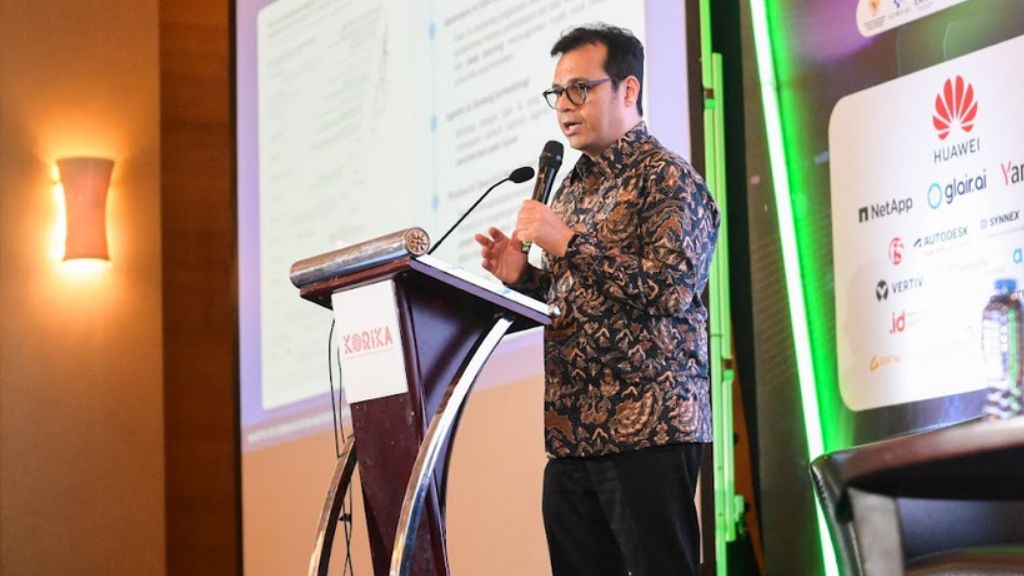
Amid the rapid development of global AI, Indonesia has chosen to seek a balance between innovation and regulation. Image: Indonesian Ministry of Communication and Digital Affairs
Albania made the headlines when it appointed an artificial intelligence (AI) programme as a minister, marking a significant and unprecedented moment redefining the relationship between humans and machines.
Discussions around generative AI (GenAI) are now increasingly shifting towards physical AI, which combines AI models with robotics.
This new dynamic suggests that AI is no longer just a practical tool, but as an entity that is blurring the lines between humans and machines.
Recognising the speed of AI development, Indonesia has no choice but to take steps and move forward, said Indonesian Ministry of Communication and Digital Affairs' (Komdigi) Vice-Minister, Nezar Patria.
According to him, the future of Indonesia’s national AI strategy will rest on the foundation of “balancing innovation and regulation,” ensuring that all risks associated with AI can be managed.
“Indonesia does not merely want to adopt, but also to shape an AI ecosystem that is ethical, inclusive, and dignified,” he added.
Patria outlined Indonesia’s AI strategy in the government keynote session at the AI Innovation Summit 2025 event, organised by the Artificial Intelligence Industry Research and Innovation Collaboration (KORIKA) on September 16 in Jakarta, Indonesia.
Advanced economies are struggling to find a balance between fostering innovation and implementing regulations.
While the European Union (EU) has focused on risk-based regulation with its landmark AI Act, the United States (US) has taken a different approach.
The US has prioritised removing regulatory barriers and developing an AI Action Plan to enhance its global dominance in AI. In contrast, China has moved swiftly with strict rules on GenAI.
“We want to adopt the best practices available globally so that the benefits of AI innovation can be felt more quickly,” Patria emphasised.
To subscribe to the GovInsider bulletin, click here.
Human-centred AI
Indonesia has unveiled its National AI Roadmap, which Patria described not simply as a technical document but as a strategic compass for guiding and implementing the nation’s AI journey.
“This roadmap is a guide for developing human-centric AI,” he explained.
He noted that the plan is built on key principles, including dignity, fairness, accountability, personal data protection, transparency, and security. It also emphasises sustainability, integrity, inclusiveness, and human involvement in every decision.
Developed with inputs from government, industry, academia and civil society, the AI roadmap white paper represents the largest working group ever formed by the Ministry of Communication and Digital Affairs.
The paper has since been widely circulated for public feedback.
The roadmap focuses on developing strategic AI use cases over the next five years, including food security, education, healthcare, the economy and finance, as well as bureaucratic reform.
The document also placed an emphasis on strengthening research and development.
According to Patria, President Prabowo Subianto has set a target to increase R&D investments from 0.4 per cent in previous years to one per cent of GDP “in the near future.”
“Hopefully we can achieve this, so that more research funds can be directed towards the latest technological innovations, including AI.”
He also underlined the importance of data quality and cross-sectoral interoperability to support strategic AI use cases.
He stressed that high-quality data is essential for creating AI products and that supporting the Satu Data Indonesia initiative is crucial for integrating data across different ministries.
AI strategic integration
Speaking at another keynote session, Komdigi’s Director-General of the Digital Ecosystem. Edwin Hidayat Abdullah, highlighted that “[AI] adoption alone is not enough.”
“We want strategic integration because AI will inevitably become embedded in our daily lives,” he said.
Addressing the vast economic potential of AI for Indonesia’s economy, he cited market analyses indication AI’s contribution to the country’s economy rising from 0.22 per cent in 2022 to 1.09 per cent in 2025. In an optimistic scenario, this contribution could reach 3.67 per cent by 2030.
“Imagine more than 3.6 per cent Indonesia GDP (equivalent to S$100 billion) of additional annual economic growth driven solely by AI. Such resources could be channeled into building schools, hospitals, roads, bridges, and more,” he added.
Even so, he acknowledged the major challenge of closing “the gap between the speed of technology adoption and our ability to master it.”
Within the national AI roadmap, the government plans to collaborate with stakeholders to reach a target of 100,000 AI talents annually.
Infrastructure challenges
The next challenges are technical. Indonesia requires foundational infrastructure such as a National Data Centre Hub, a high-performance computing (HPB) backbone, cloud, as well as GPU and TPU clusters.
All of this must be interconnected with reliable, high-bandwidth and low-latency connectivity.
Without these, real-time AI services such as telemedicine, autonomous control systems, and disaster prediction would not perform optimally, Abdullah noted.
Energy is also a critical factor, as AI consumes vast amounts of power that must come from sustainable sources.
Above all, he stressed that transparency is essential. “Without trust, there can be no sustainable adoption,” he concluded.