
Indonesia's digital economy strategy to close gap for AI infrastructure, says economic planner
Indonesia aims to increase more than triple the value of its digital economy to US$360 billion by 2030 by investing in digital infrastructure, talent and governance to foster public trust, says its Coordinating Ministry for Economic Affairs’ Assistant Deputy Minister for Digital Economy Development, Theodore Sutarto.
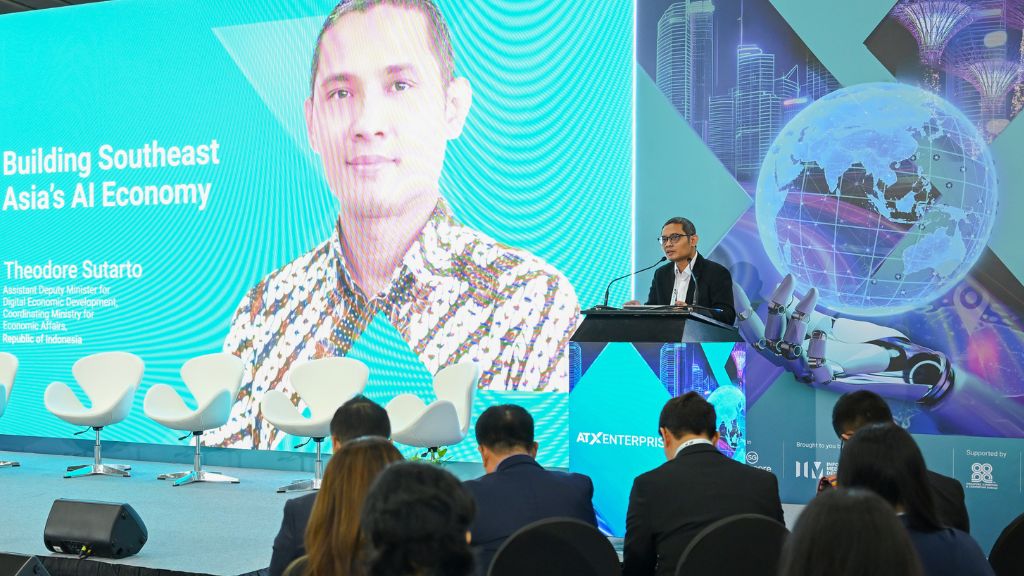
Indonesia’s Coordinating Ministry for Economic Affairs’ Theodore Sutarto emphasised the importance of digital infrastructure in enhancing the value of the digital economy. Image: ATxEnterprise Singapore
Indonesia's next leap in digital economy growth hinges on one thing: how ready its infrastructure is to support emerging technologies.
This is according to Indonesia’s Coordinating Ministry for Economic Affairs’ Assistant Deputy Minister for Digital Economy Development, Theodore Sutarto.
Drawing on the experiences of advanced digital economies like the US, China and Singapore, he points to digital infrastructure as a fundamental prerequisite for building artificial intelligence (AI) capabilities.
As of 2025, e-commerce still stands as the largest contributor of Indonesia’s digital economy, generating around US$71 billion (approximately 72 per cent of Indonesia’s overall digital economy), says a report by Google, Temasek, and Bain & Company.
By 2030, Indonesia’s Ministry of Communication and Digital Affairs targets to grow the country’s digital economy to US$360 billion.
Speaking to GovInsider on the sidelines of his speaker participation at ATxEnterprise event in Singapore in May, Sutarto shares that strengthening digital infrastructure has become one of the government’s key priorities.
The government efforts include developing a green data centre ecosystem, expanding low-orbit satellite networks, building fibre-optic and submarine cable infrastructure, and establishing Special Economic Zones (SEZs) focused on digitalisation and data centres.
Looking beyond e-commerce
Sutarto believes that achieving Indonesia’s long-term digital economy ambitions will require growing beyond the e-commerce sector alone.
Several high-potential sectors, including agriculture, healthcare, and financial services, are expected to play a much larger role in the years ahead.
“As a country with a strong agricultural foundation, Indonesia has significant opportunities to enhance productivity and food security through the adoption of technologies such as AI, Internet of Things (IoT), drones, and data analytics,” he says.
Healthcare also presents significant opportunities for digital transformation.
Telemedicine, AI-assisted diagnostics, electronic medical records, and health data analytics can improve healthcare quality, while expanding access to medical services, particularly in remote and underserved areas, he adds.
In addition, digital transformation is already accelerating within the financial services sector.
According to the e-Conomy SEA 2025 report, Digital Financial Services (DFS) is one of the key drivers of digital economy growth across Southeast Asia.
In Indonesia, double-digit growth has been recorded across digital payments, online lending, digital investment platforms, and digital insurance services.
Digital payment infrastructure such as Quick Response Code Indonesian Standard (QRIS) has also enabled millions of MSMEs and individuals to participate more actively in the formal digital economy.
Bridging the digital divide
Sutarto emphasises that addressing digital inequality remains essential if Indonesia wants to ensure that the benefits of digitalisation are shared more broadly across society.

Today, digital infrastructure investments are often concentrated in commercially viable areas, while regions that offer limited commercial returns typically require government intervention.
“To tackle this challenge, the government is currently developing a national digital infrastructure roadmap aimed at accelerating connectivity development and strengthening collaboration between government and industry,” he says.
At the same time, Indonesia faces a major shortage of digital talent, with an estimated gap of approximately 3.97 million digital workers by 2030.
To address this, the government has introduced a range of talent development initiatives, including the Digital Talent Scholarship (DTS), the international Tech X Indonesia–Singapore programme, gig economy pilot projects through Jakarta Creative Hub, and strategic partnerships with global technology companies.
“Another incentive put in place is providing a super tax deduction of up to 200 per cent for vocational training,” Sutarto adds.
Building trust in the AI era
Another critical pillar of Indonesia’s digital economy strategy is effective technology governance, particularly around AI and cybersecurity.
According to Sutarto, Indonesia believes that AI adoption must progress alongside public trust.
To support this, the government is preparing a Presidential Regulation on the National AI Roadmap 2026-2029, as well as a Presidential Regulation on AI Ethics.
“The government's approach is not intended to restrict innovation ... Rather, the AI ethics framework seeks to enhance public trust and promote the transparent, accountable, and responsible use of AI technologies,” he says.
Cybersecurity remains another pressing concern.
Data from Indonesia’s National Cyber and Crypto Agency (BSSN) recorded approximately 3.64 billion cyberattacks and traffic anomalies between January and July 2025 based on reported incidents.
In response, the government has introduced a range of policy instruments, including the Personal Data Protection (PDP) Law, the National Cybersecurity Strategy, and regulations governing cyber incident management.
Regional cooperation is shaping the digital future
Indonesia also views regional cooperation as a key factor in building a sustainable digital economy and achieving shared progress.
According to Sutarto, ASEAN collaboration will be instrumental in building a more inclusive, integrated and competitive regional digital economy.
“No single country can fully maximise its digital economy potential without collaborating with others, given that data flows, digital trade, investment, and innovation are inherently cross-border in nature,” he says.
Through the ASEAN Digital Economy Framework Agreement (DEFA), ASEAN’s digital economy is projected to double in value and reach US$2 trillion by 2030.
For Indonesia, such agreements not only create greater opportunities for digital trade and investment but also help address regulatory gaps through the adoption of international best practices.
Sutarto adds that regional forums such as ATxEnterprise are becoming increasingly important as platforms for dialogue between policymakers and industry leaders.
“This provides regulators with valuable insights to formulate more relevant and responsive policies,” he notes.