
Jonathan Yeo, Lead Data Scientist, Ng Teng Fong General Hospital and Jurong Community Hospital, Singapore
Meet the young public sector officials in the inaugural Young & Official Report 2026.
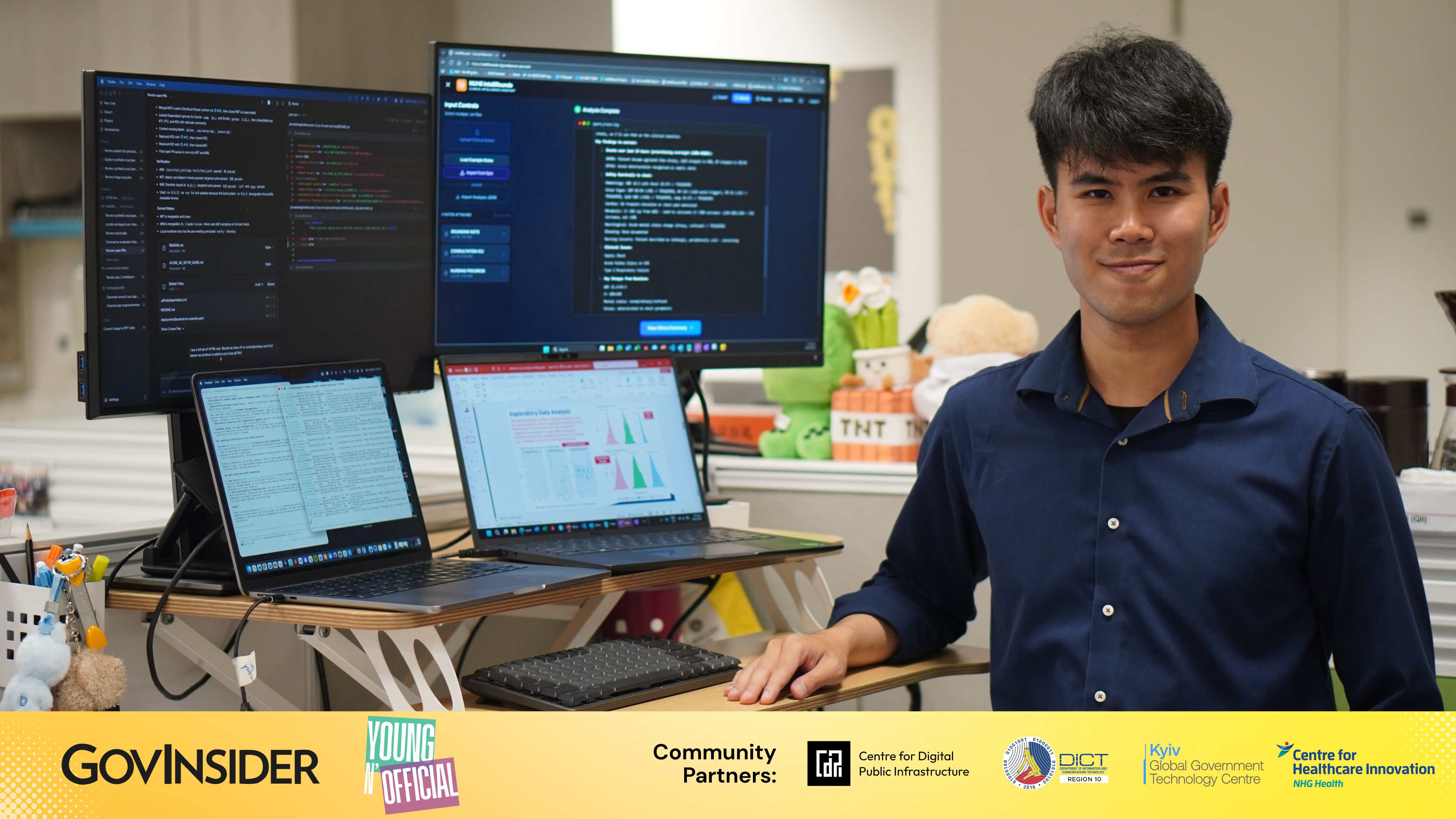
Jonathan Yeo, Lead Data Scientist, Ng Teng Fong General Hospital and Jurong Community Hospital, Singapore. Image: NUHS
1) What does public service mean to you? Can you share more about your role in the public sector?
To me, public service means building things that create a meaningful impact for people on the ground. I started in public policy before moving into healthcare, and that journey helped me appreciate how public services often sit at the intersection of ideas, systems, and people.
I am a Lead Data Scientist at Jurong Health Campus (comprising Ng Teng Fong General Hospital and Jurong Community Hospital) under the Digital Think Tank initiative, where I work on artificial intelligence (AI) and digital transformation initiatives in healthcare. Much of my role involves translating ideas into practical solutions that can be responsibly implemented in clinical and operational settings.
I have also been involved in leading a newly formed AI Centre of Excellence, focused on development, implementation, and research in healthcare AI.
To me, the work has never been just about technology. It is about trust, workflows, people, and whether a solution genuinely helps those who use it, and making sure technology supports sustainable transformation.
What keeps me grounded is the belief that good technology should make people’s work more meaningful, not more complicated.
2) Tell us about a project you championed. What impact did it have on the community?
One area I have been deeply involved in is developing AI-enabled tools to support clinical workflows and reduce cognitive burden on healthcare teams.
In healthcare, clinicians often need to piece together fragmented information across multiple systems while making time-sensitive decisions.
Through working with frontline teams, I realised the challenge was not simply to build an AI model, but to understand how technology could safely and meaningfully fit into existing workflows, and at the same time support trust and help teams focus their attention on patient care.
What stood out and made the work meaningful was the collaboration between clinicians, operational teams, governance stakeholders, and technical teams. The impact was not just automation. It was about helping healthcare workers spend less time manually synthesising information and more time focusing on patient care and decision-making.
3) As a young professional, how has your unique background or perspective allowed you to identify a solution that others in your organisations might have overlooked?
My academic background was in theoretical mathematics and statistics, which was quite different from my initial career in public policy. Over time, I realised they complemented each other.
Mathematics and statistics trained me to think rigorously and systematically about complex problems. Policy helped me understand organisational realities, stakeholder needs, and the importance of designing systems that work for people on the ground.
That combination shaped how I approach AI today. I do not see AI purely as a technical problem.
Sustainable systems require technology to be balanced with governance, trust, workflow integration, operational realities, and human adoption.
I also believe modern AI tools are lowering the barriers between “technical” and “non-technical”
staff.
Some of the best ideas come from people closest to operational pain points. Part of my role is to bridge ideas, people, and technology, so more individuals feel empowered to innovate.
4) What is your personal strategy for maintaining your creative energy when faced with bureaucracy?
I remind myself that sustainable healthcare innovation requires trust, governance, and careful implementation. Processes and alignment are not always obstacles; often, they are what allow solutions to scale responsibly.
What keeps me energised is the passion of the clinical and operational teams I work with. I genuinely credit them for much of the creativity behind the ideas we pursue. They are constantly finding ways to streamline processes, improve workflows, and use technology to enhance patient care.
At the heart of it, they are always doing it for people. Being around teams with that purpose makes it easier to stay motivated, even when implementation becomes complex.
5) If you had just one area to invest in to accelerate transformation in the public sector (regulation, technology, talent, etc.), which one would you choose and why?
I would invest in the people and build capability.
Technology is advancing rapidly, but the real differentiator will be whether organisations can cultivate teams that know how to translate technology responsibly into operational impact. This requires not only technical skills but also interdisciplinary collaboration, governance awareness, communication, and systems thinking.
The best public sector innovation happens when people closest to the problem are empowered to experiment safely, work across domains, and continuously learn together.
6) What is your greatest ambition as you grow in your public service career?
My ambition is to help build systems and ecosystems that make healthcare work better for both patients and healthcare workers.
I hope to contribute to a future where AI is not viewed as a standalone technology initiative, but as a trusted and well-integrated capability that supports frontline work.
More importantly, I hope to keep bridging the gap between ideas and implementation, translating innovation into solutions that are practical, trusted, and sustainable.
7) What is a “universal value” that connects everyone in your department – from interns to directors – and how do you use that to drive collaboration?
I think the shared value is meaningful impact.
Regardless of role, rank or seniority, people are generally motivated by the desire to improve care delivery, solve real operational problems, and contribute positively when they can see how their work contributes to something meaningful.
That shared purpose helps collaboration. Focusing conversations around the real-world problem, rather than hierarchy or ownership, helps strengthen collaboration.
When teams feel connected to a shared purpose, it becomes easier to align different perspectives and expertise.
8) What is the best piece of advice you’ve got for the next generation of public servants?
Keep your creative drive and curiosity.
Some of the most meaningful improvements in public service start from people who are willing to question existing processes, rethink workflows, and imagine how things could work better for others. “Why does this have to be done this way?”
“Could this be better for the people using it?”
At the same time, stay grounded in implementation. Real impact comes not just from having ideas, but from understanding people, operational constraints, governance, and trust.
I would also encourage young people not to be intimidated by technology. The barriers to building and experimenting are lower than ever. You do not need to fit a traditional definition of “technical” to contribute meaningfully to innovation.
9) What is a myth you wish to debunk about young public servants?
That young public servants only want speed, disruption, or shiny new ideas.
Many young professionals in public service understand the responsibilities that come with working in complex systems like healthcare. Innovation in the public sector is not about moving recklessly. It is about creating sustainable change responsibly.
I think younger officers today are increasingly systems-oriented, collaborative, and conscious of governance, trust, and long-term impact.
10) Write a letter to your future self in 2035. Please keep it within 200 words.
I hope you never lose sight of why you started.
Technology will continue evolving, but remember that the most meaningful work was never really about AI itself. It was about people, trust, and improving the lives of those working within the system every day.
Stay close to the ground. Keep listening to frontline realities. Build with empathy rather than ego.
Keep mentoring others and keep creating spaces where people feel empowered to contribute ideas, regardless of background or title.
Most importantly, remember that sustainable transformation is rarely driven by one individual. It comes from teams, shared purpose, and the willingness to build systems that people can trust over time.