
Lim Yap Kai, Senior Executive, Data Science Office, Institute of Mental Health, NHG Health, Singapore
Meet the young public sector officials in the inaugural Young & Official Report 2026.
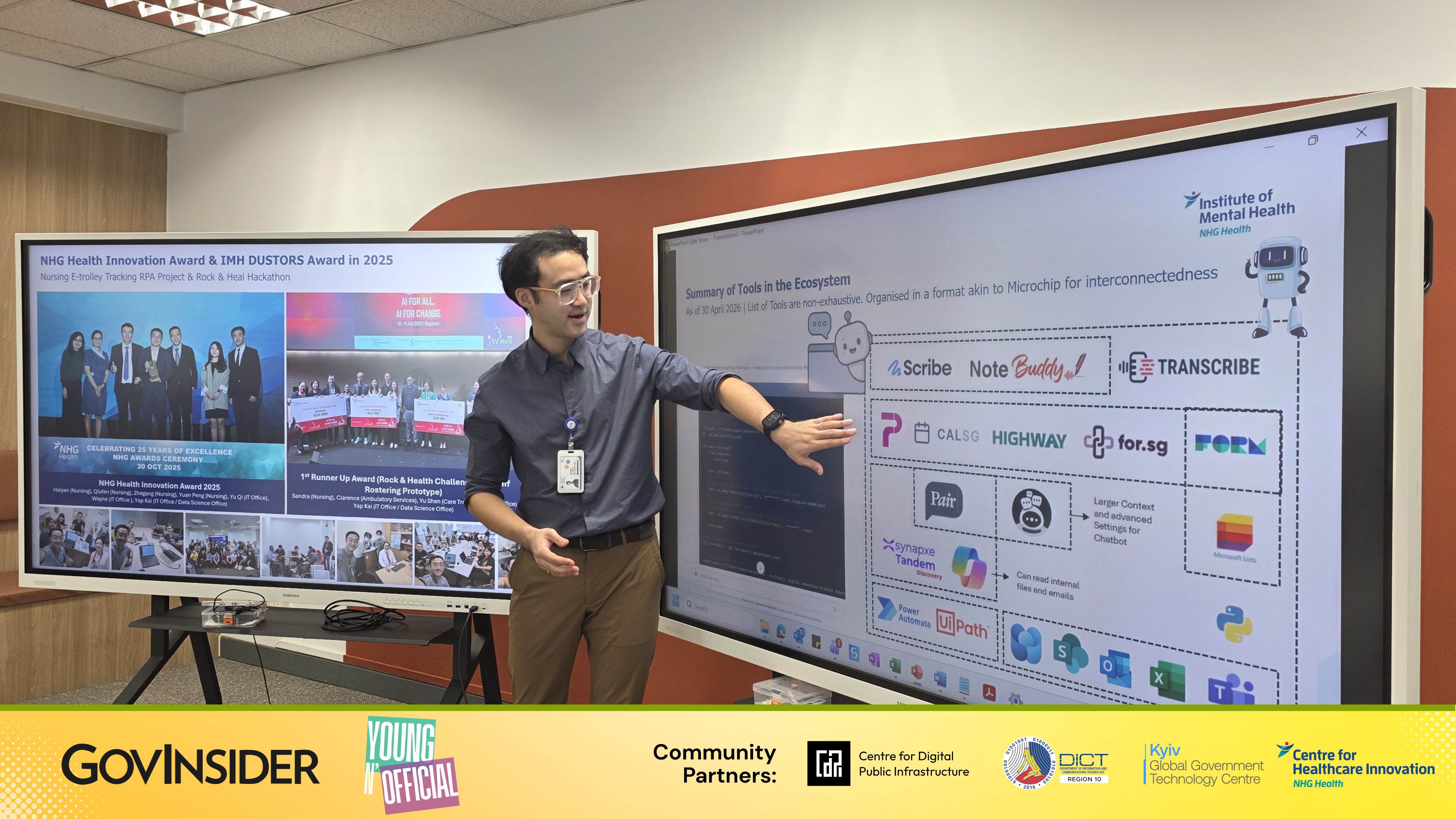
Lim Yap Kai, Senior Executive, Data Science Office, Institute of Mental Health, NHG Health, Singapore. Image: NHG Health
1) What does public service mean to you? Can you share more about your role in the public sector?
Public service means finding meaningful ways to contribute to society even when you're not on the frontlines.
Growing up with a mother who's a staff nurse and a brother who's a medical doctor, I witnessed firsthand the dedication required in healthcare.
While I'm not medically qualified, I realised I could channel my Business Analytics background from NUS School of Computing, to help improve healthcare operations.
I’ve spent three years in healthcare and half of it with NHG Health’s Institute of Mental Health (IMH) as a Digital Adoption Specialist.
I implement digital tools tailored to operational requirements that enable teams to achieve business outcomes.
My role involves identifying automation opportunities, developing staff capabilities as citizen developers, and running digital literacy programmes. It's about making healthcare more efficient behind the scenes so frontline staff can focus on patient care.
2) Tell us about a project you championed. What impact did it have on the community?
I'm particularly proud of our Nursing E-Trolley Tracker Robotic Process Automation (RPA) project, a collaborative effort with dedicated nursing colleagues.
This project automated hardcopy checklists into digital format, reducing manual checks while minimising human errors like missing or expired items.
We achieved time savings of about 900 hours annually.
More importantly, it frees up time for nurses for patient care.
The project won both the NHG Health Innovation Award and the IMH DUSTORS Award in 2025.
What makes me proud is seeing how this solution supports patient safety by ensuring that equipment in emergency trolleys is well maintained and ready when needed.
3) As a young professional, how has your unique background or perspective allowed you to identify a solution that others in your organisations might have overlooked?
My Business Analytics background with marketing specialisation gives me a different lens when approaching healthcare challenges.
While healthcare professionals focus on clinical excellence, I look at processes through a data and user experience perspective.
While others saw it as “just how things are done”, I view the complex room allocation process for a specialist outpatient clinic (SOC) as a rule-based system perfect for automation.
By applying Python scripting and Power Automate to transform this manual workflow into an automated process, we achieved time savings of about 176 hours annually for one SOC, while avoiding external RPA licensing costs, with potential for further scaling to other SOCs.
My fresh perspective helps me spot patterns across departments.
The email drafting automation I developed for nursing home training was later adapted for patient tele-consult communications, demonstrating how solutions can be scaled when you think systematically about workflows.
4) What is your personal strategy for maintaining your creative energy when faced with bureaucracy?
I've learned that resistance and limitations often spark the most innovative solutions.
When faced with restricted connectivity and limited access to advanced systems, I see it as a creative challenge rather than a roadblock.
For example, when IT policies prevented direct external emailing through automation, we modified the approach to include human intervention checks while still reducing manual work significantly.
I recognise that healthcare staff have demanding operational responsibilities. Rather than fighting the system, I work within it, using approved applications creatively and ensuring innovation doesn't disrupt business-as-usual operations.
When projects fail or face resistance, I view it as valuable feedback to explore new approaches more suitable for the healthcare environment.
5) If you had just one area to invest in to accelerate transformation in the public sector, which one would you choose and why?
I would invest in talent development, specifically building digital literacy and citizen developer capabilities.
Technology is only as good as the people using it, and sustainable transformation happens when frontline staff become empowered to identify and solve their own operational challenges.
Through our digital literacy programmes, I've engaged over 160 staff across 14 departments, with approximately 75 per cent reporting beneficial changes in their familiarity and proficiency with digital tools.
When you give people the skills and confidence to automate repetitive tasks, innovation becomes organic and scalable.
This approach addresses resource constraints by creating a network of citizen developers who understand both operational context and technical possibilities.
6) What is your greatest ambition as you grow in your public service career?
My greatest ambition is to influence transformation at a larger scale, helping healthcare catch up with more efficient operational backend work.
I want to see a future where administrative burdens don't prevent healthcare professionals from focusing on patient care, and where the public experiences healthcare that's clinically excellent and operationally smooth.
I envision leading initiatives spanning multiple institutions, sharing successful automation frameworks and digital literacy models across the healthcare system.
Ultimately, I want to contribute to making Singapore's healthcare system a global benchmark for operational efficiency and patient experience.
7) What is a "universal value" that connects everyone in your department, and how do you use that to drive collaboration?
The universal value connecting everyone at IMH is our commitment to patient well-being.
Whether you're a nurse, administrator, or IT specialist, we understand that our work ultimately impacts patient care.
I leverage this shared purpose when introducing automation projects.
Instead of focusing on technical features, I frame every solution in terms of patient outcomes.
This patient-centric framing helps overcome resistance because everyone sees how their efficiency gains contribute to providing excellent mental healthcare.
8) What is the best piece of advice you've got for the next generation of public servants?
Embrace constraints as catalysts for creativity, but know when to challenge them.
The public sector has regulations and limited resources, but these aren't barriers; they're design parameters forcing innovative thinking.
However, it's equally important to explore outside solutions and assess what's outdated versus what's worth investing in.
You need discipline to work within necessary constraints and the courage to question unnecessary ones.
Sometimes the most innovative solution is recognising when an existing system needs replacing entirely, not just automating. Sustainable change happens through people, not just technology.
The most elegant automation is worthless if people don't adopt it.
9) What is a myth you wish to debunk about young public servants?
The myth that young public servants are impatient and want to change everything overnight.
In reality, we understand that meaningful transformation in healthcare requires careful consideration of safety, compliance, and operational continuity.
My approach has always been gradual, sustainable change.
We pilot projects carefully, measure impacts, and scale up only when we've proven value.
The 2,600+ hours of total annual savings we've achieved came from methodical implementation, not disruptive innovation.
Young public servants bring fresh perspectives while being deeply committed to working within established frameworks to ensure patient safety and service continuity.
10) Write a letter to your future self in 2035.
Dear Yap Kai,
I hope you're reading this from a healthcare system transformed by the seeds we've planted 10 years ago.
Remember 2026, when we celebrated saving over 2,600 hours annually through RPA?
I hope that seems quaint compared to what you've achieved.
I hope you've stayed true to our belief that technology should serve people, not the other way around.
I hope that the digital literacy programmes we started have grown into a movement where every healthcare worker feels empowered to innovate.
Most importantly, remember why we started this journey – inspired by Mum's dedication as a nurse, Dad's precision as an engineer, Brother's commitment as a doctor and Wife's inspiration as an educator.
You may not wear scrubs, but you're part of the same mission: making healthcare better for everyone who needs it.
Keep pushing boundaries but never forget the human element that makes our work meaningful.
Your past self, Yap Kai (2026)