
Malaysian state Sarawak grows startup ecosystem while solving local problems
Sarawak Digital Economy Corporation (SDEC) is building the capacities of both the private sector and local government agencies to ensure innovative solutions meet policy goals.
-1752569624035.jpg)
Rather than adopting a standard, off-the-shelf solution, Malaysian state Sarawak is matching startups with public agencies to design solutions that address specific governance challenges. Image: Canva
Governments around the world are adopting innovation-as-a-service (IaaS) models by leveraging startup ecosystems to solve local challenges.
This is evident in countries like Thailand and New Zealand with smart city and governance challenges, as well as Ukraine with govtech challenges faced by public agencies.
Now, this same approach has been taking root in Sarawak, Malaysia's largest state in Borneo.
Speaking to GovInsider, Sarawak Digital Economy Corporation (SDEC)’s CEO Dato Ir. Ts. Sudarnoto Osman said: “We believe true innovation starts by solving local challenges, while staying open to global talent and capital”.

SDEC is the Malaysian government agency in charge of growing the digital economy of the largely rural state of Sarawak.
Tackling the persistent problem of road potholes, Sarawakian startup Neuon AI, which was supported by SDEC’s flagship initiative Digital Village Accelerator (DiVA), managed to digitise the end-to-end process of pothole management.
The simple and affordable solution, which comprised an artificial intelligence (AI)-powered mobile app for citizens and a cloud-based platform for public agencies, addressed the monitoring and detection, to tracking and reporting of potholes to road authorities.
The solution has already mapped over 4,000 km of roads in Kuching city and beyond since December 2021.
The homegrown startup has worked with Ministry of Science Technology and Innovation (MOSTI), as well as the Ministry of Works (KKR) of Malaysia to develop the innovative solution.
Rather than adopting a standard, off-the-shelf solution, this approach embodies the IaaS model, which involves matching startups and public agencies to design a solution that addresses specific governance challenges.
To subscribe to the GovInsider bulletin, click here.
Digital economy to tackle governance challenges
Osman’s long-term hope is for his agency to create more digital economy opportunities in rural and semi-urban areas of the state.
This would not only decentralise access and help reduce urban migration but also introduce high-value jobs, allowing the state to diversify its economy away from traditional timber, oil, and gas sectors, he adds.
The state has targeted to create over 48,000 digital jobs by 2030, according to Osman.
Initiatives like DiVA are designed to achieve the state's digital economy ambitions by linking innovative startups to challenges faced by the public sector.
The DiVA initiative stands out as it moves beyond startup capacity building by strategically integrating the startup solutions within Sarawak’s key development needs like education, agriculture, healthcare and e-commerce.
“These domains hold significant potential to strengthen food security, enhance access to quality healthcare, improve learning outcomes, and drive digital commerce across communities, making them essential to the region’s sustainable socio-economic growth,” he explains.
SDEC’s digital transformation efforts in Sarawak are twofold: Laying the foundations of digital infrastructure (4G, AI-ready internet), as well as supporting aligning startup growth with local challenges (one-on-one mentoring, fundings, and access to market opportunities).
Aligning startup growth with local development needs
To align startup innovations with governance needs, SDEC offers opportunities for startups to prototype solutions in live environments and fostering partnerships with public agencies to tackle challenges in infrastructure, sustainability, and service delivery.
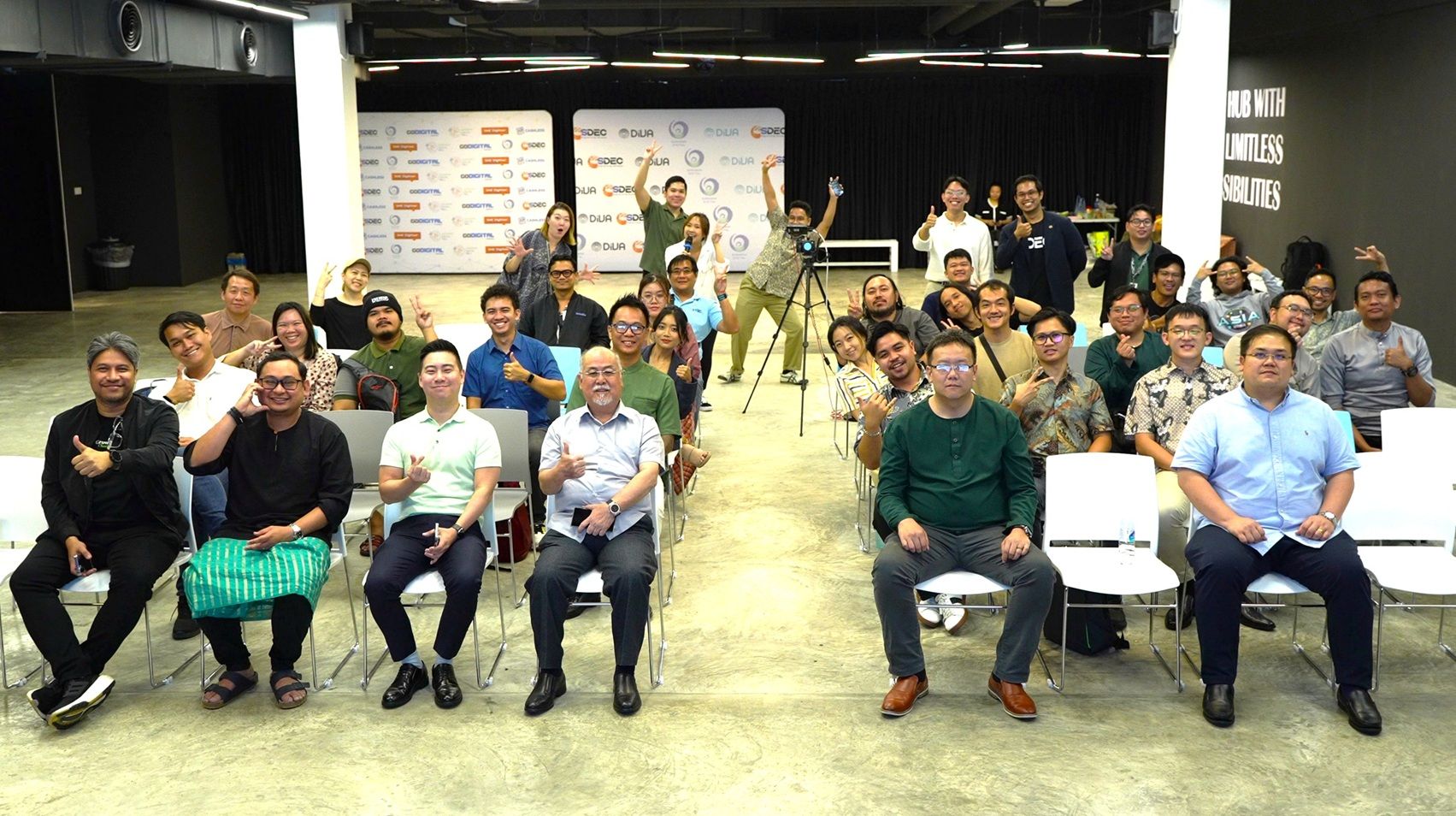
is now at its fourth cohort as of this April. Image: SDEC
In a typical scenario, startups would receive funding, technical and regulatory guidance to move their products from minimum viable products (MVPs) to sustainable solutions in the public sector and broader market.
In the case of the abovementioned startup Neuon AI, it did not just stop solving Sarawak’s road potholes problem.
It successfully expanded its reach beyond the public sector, demonstrating a clear path to the broader market.
This expansion has led to a RM60 million (SG$18 million) valuation, according to Osman, and the company is now in preliminary discussions with global venture capital firms.
“From SDEC’s standpoint, scalability and sustainability in Sarawak required a holistic impact beyond mere profitability,” he says.
Osman said a sustainable digital solution must meet several criteria, starting with a viable business model or demonstrable returns on public investment. This could manifest as creating long-term jobs, supporting local small and medium-sized enterprises (SMEs), and boosting digital entrepreneurship.
Secondly, such solutions should promote smart resource use and be maintainable locally, avoiding reliance on external parties.
Finally, the solutions must be designed to work effectively in both urban and rural communities, accounting for infrastructure limitations like connectivity and digital literacy.
Building capacities of civil servants
Osman notes that SDEC also sees an opportunity to collaborate with the private sector to build the capacities of public agencies.
“Civil servants are not only participants but co-creators,” he says, adding that civil servants from the ministries and public agencies are involved at the onset of innovation projects alongside their private sector partners.
To bridge the gap between a solution and its intended impact, the agency has also put in place public sector mentorship initiatives to match experienced government leaders with startup founders, ensuring that solution design meets policy goals.
Training, seminars, events, collaborations with multinational corporations (MNCs) are crucial for upskilling civil servants and government-linked company staff in the latest AI and other technological innovations, he notes.
Osman offers a clear example of how SDEC scales digital integration at the ministry level.
As a result of SDEC’s partnership with international tech companies, smart agriculture tools are now widely used across various authorities under the Ministry of Food Industry, Commodity and Regional Development (M-FICORD), as well as local farmers to improve their farming practices.
“Our focus is on reaching the last mile first, ensuring no community is left behind in Sarawak’s digital transformation. We build lasting platforms, not one-off projects,” he emphasises.