
Perrie Lim, Senior Engineer, Digital Hub, Defence Science and Technology Agency, Singapore
Meet the young public sector officials in the inaugural Young & Official Report 2026.
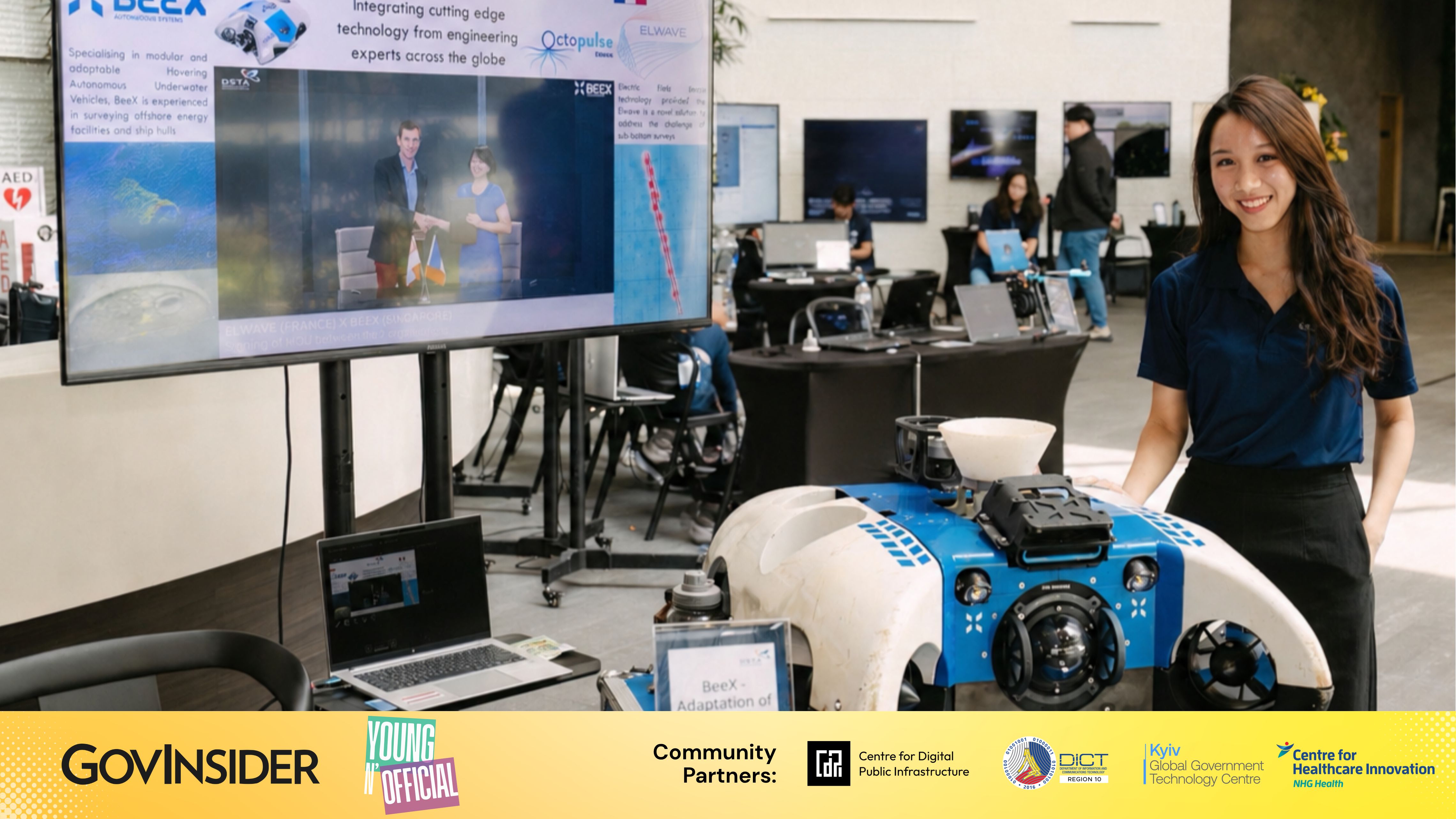
Perrie Lim, Senior Engineer, Digital Hub, Defence Science and Technology Agency, Singapore. Image: DSTA.
1) What does public service mean to you? Can you share more about your role in the public sector?
Public service means the opportunity to contribute to something larger, to systems that matter, with people who turn ideas into reality.
As a senior engineer at the Digital Hub of Defence Science Technology Agency of Singapore (DSTA), my role is to develop solutions for autonomous systems across various domains, including air, land and sea.
I close critical gaps in operations such as infrastructure monitoring and surveillance, enabling teams to be alerted faster, to monitor more areas continuously without gaps and to deploy fewer personnel to potentially risky locations. This results in operations that are both safer and more effective.
2) Tell us about a project you championed. What impact did it have on the community?
DSTA partnered with BeeX, a local start-up specialising in Hovering Autonomous Underwater Vehicles (HAUV), to customise and co-develop innovative solutions with their autonomous underwater vehicles (AUVs).
Rather than relying on off-the-shelf systems, my team and I worked closely with BeeX to understand the vehicle’s capabilities and build autonomy systems in-house, including software that allows the AUV to plan a path underwater, navigate, make decisions and carry out tasks with minimal human intervention.
This success was hinged on collaboration and cross-sharing at different levels, from teams across DSTA with different expertise and also with our external partner, BeeX.
This strengthens Singapore's naval defence capabilities by enhancing situational awareness and operational efficiency, ultimately contributing to the nation's security and safeguarding its community.
3) As a young professional, how has your unique background or perspective allowed you to identify a solution that others in your organisations might have overlooked?
I am grateful to have studied both the technical elements of Robotics and the user-centric considerations of Design Thinking, which shape how I conceptualise solutions.
Of course, I attribute much perspective to the many I have crossed paths with, including my mentors in DSTA who have guided me and even challenged my thinking, in areas I may have overlooked.
4) What is your personal strategy for maintaining your creative energy when faced with bureaucracy?
My strategy is to focus on the gaps. If bureaucracy slows things down, the friction reveals opportunities to rethink and improve how things are done.
From there, I lean on the systems that DSTA has in place to support innovation in a safe environment, iterating, learning and working on solutions with real, measurable outcomes.
5) If you had just one area to invest in to accelerate transformation in the public sector (regulation, technology, talent, etc.), which one would you choose and why?
I’ll invest in culture. Creating one that reinforces learning and sharing, with stronger feedback loops to turn ideas into outcomes, while supporting the people driving progress.
I've seen firsthand how DSTA's strong culture of innovation and collaboration has driven our success, from facilitating partnerships locally and globally to encouraging a culture of experimentation and learning.
I aim to build on this foundation, nurturing an environment that empowers our teams to thrive and drive meaningful impact.
6) What is your greatest ambition as you grow in your public service career?
I hope to bring people together across disciplines, aligned in purpose and direction.
I've been fortunate enough to work with people from all walks of life and various disciplines in DSTA, and can attest to the power of interdisciplinary collaboration. Not only have I learnt so much from my colleagues, but I've also grown as a person and a professional.
I've seen how different perspectives and expertise can come together to push creativity, innovation, and progress. I hope to continue this journey, leveraging the collective strengths of our team to drive defence tech innovation forward, where everyone thrives, builds connections, and makes a meaningful impact.
7) What is a “universal value” that connects everyone in your department – from interns to directors – and how do you use that to drive collaboration?
What connects us is a shared curiosity: Openness and Inclination to explore, try and learn. This common ground shapes collaboration, where we share and build on each other’s ideas, bringing concepts to outcomes.
In my department, that shows up in initiatives such as tech sharing and Agentic artificial intelligence (AI) workshops that encourage us to tap into the latest tech to rapidly translate ideas into minimal viable products, giving us opportunities to tap into one another’s strengths, explore ideas and develop with intent.
8) What is the best piece of advice you’ve got for the next generation of public servants?
Stay grounded in perspective; serve with empathy.
Keep learning, keep engaging and don’t shy away from things when they’re difficult. Take time to understand the people you work with – it matters more than most think.
Don’t just chase outcomes; enjoy the process. Do work that’s meaningful, measurable and makes a real difference.
9) What is a myth you wish to debunk about young public servants?
Perhaps there’s a tendency to equate age with ability.
I don’t think that holds. Every person brings different strengths and capabilities, and when time is taken to understand that, and understand them well, you can bring out their fullest potential.
10) Write a letter to your future self in 2035. Please keep it within 200 words.
Remember why you started, stay grounded, don’t rush the process. The setbacks and iterations are where real progress happens.
There will always be more to learn, gaps to close and experiences to chase. Go after them, but not at the cost of the present. Pay attention to the people around you, as these moments won’t come back.
In the end, it’s not just about what you deliver but the difference you made and who you made it with.