
Prof Dilnoz Muhamedieva, Digital Technologies and Artificial Development Research Institute, Uzbekistan
By James Yau
Meet the Women in GovTech 2025.
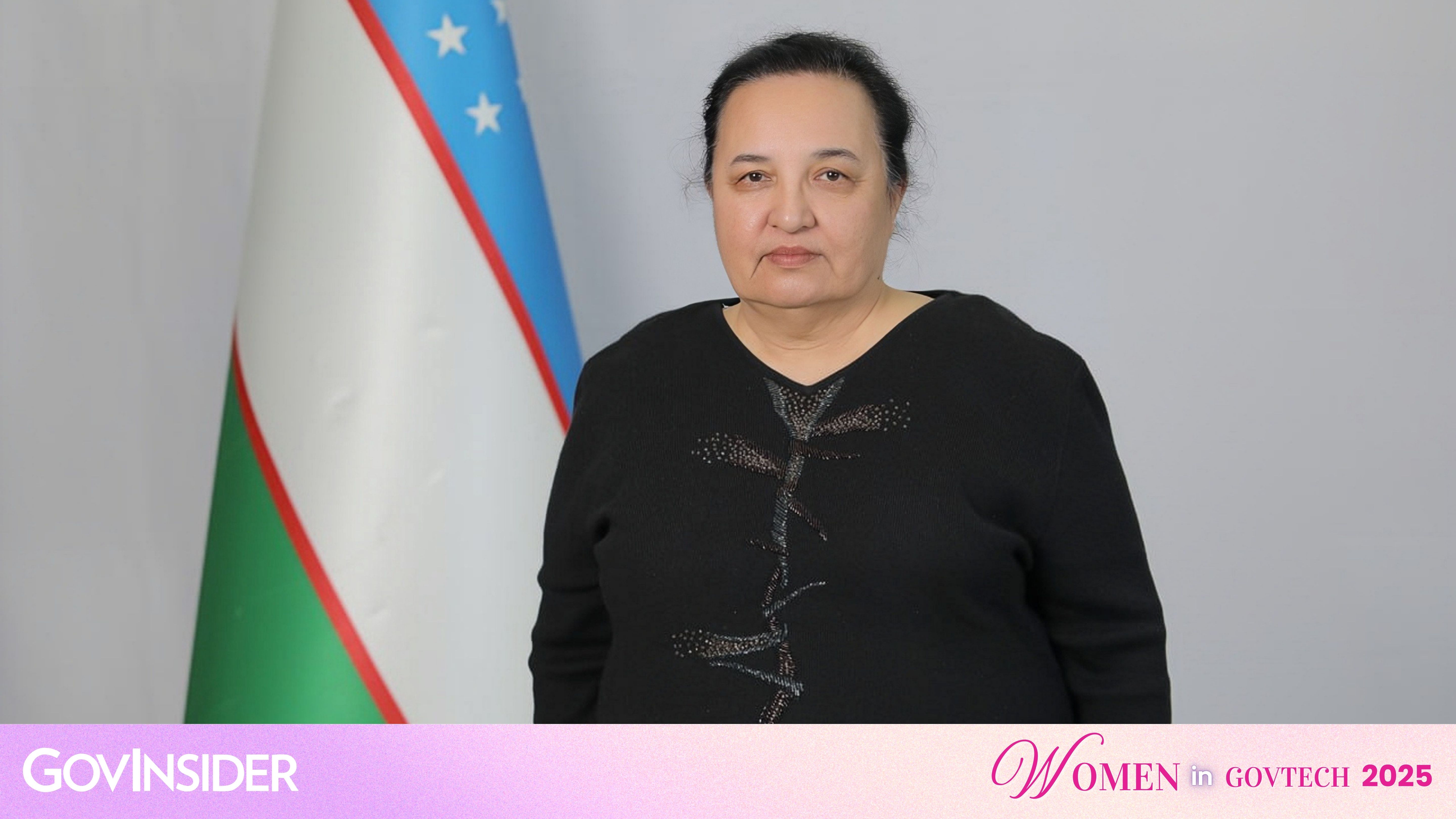
Prof Dilnoz Muhamedieva, Digital Technologies and Artificial Development Research Institute, shares about her journey. Image: Prof Dilnoz Muhamedieva
1) How do you use your role to ensure that technology and policy are truly inclusive?
My work as a Doctor of Technical Sciences and Professor is focused on making digital technologies equitable and inclusive for all citizens.
The solutions my students and I develop create fair and accessible systems in areas such as assessing soil fertility in agriculture, detecting plant and animal diseases using artificial intelligence, early diagnosis of heart and lung conditions in healthcare, and evaluating creditworthiness in finance.
Additionally, by digitising ancient manuscripts, we make cultural heritage more accessible to the wider public. These initiatives support the sustainable and inclusive digital transformation of government policies.
2) What’s a moment in your career when you saw firsthand how technology or a new policy changed a citizen’s life for the better?
Throughout my scientific career, I have repeatedly seen the real power of technology to improve lives. The most memorable moments, however, are when I witness my students’ achievements directly benefiting society. For example:
-
Primova Xolida conducted in-depth research on inconsistent problems, earned her doctoral degree, and was awarded the Presidential Medal—an important milestone for science and society.
-
Mingliqulov Zafar developed practical models based on fuzzy logic and bee algorithms.
-
Niyozmatova Nilufar created a text-to-speech conversion system in Uzbek, significantly contributing to the national technological ecosystem.
-
Iskandarova Sayyora developed systems for recognizing Arabic manuscripts and detecting COVID pneumonia.
-
Safarova Lola designed a new method for constructing logical models using an interval neutrosophic model, advancing research in mathematical uncertainty and decision-making systems.
-
Egamberdiyev Nodir created highly accurate models for diagnosing heart diseases by combining neural networks and neutrosophic sets, and also worked on credit risk assessment systems, crucial for financial inclusion.
-
To‘xtanazarov Nozir applied research on singularities for intelligent data analysis, achieving practical applications in plant disease diagnosis.
-
Xudoyberdiyev Aziz developed a novel hash function based on AI immune algorithms, outperforming SHA-256 standards in practice, a unique contribution to cryptography.
-
Hasanov Usmon created a system to detect fire causes using AI, helping save lives in emergencies.
-
Sotvoldiyev Dilshod developed a model for early detection of eye diseases through visual analysis, demonstrating significant social impact in medical diagnostics.
These achievements exemplify how technology can create meaningful change in society and human lives, making these moments the most unforgettable in my scientific career.
3) What was the most impactful project you worked on this year, and how did you measure its success in building trust and serving the needs of the public?
This year, the most impactful project I led was the “Medical Diagnostic Image Processing Portal Using Quantum Technologies,” in collaboration with the Innovative Development Agency.
The portal analyses MRI, CT, X-ray, and ultrasound images using quantum algorithms, significantly reducing diagnostic errors by 8-12 per cent. It provides uniform analysis quality for doctors in remote areas, enhancing medical equity.
Transparent visual reports increased patient trust, while quantum cryptography ensured data security. This project reinforced digital trust and social fairness in healthcare.
4) What was one unexpected lesson you learned this year about designing for real people? This can be about a specific project or a broader lesson about your work.
The most unexpected lesson was realising that any advanced model contains hidden layers of uncertainty.
I observed that in neutrosophic logic, “uncertainty” often becomes a decisive factor, immune algorithm-based hash functions can outperform classical SHA standards, and singularities can conceal the most critical parts of data.
Quantum algorithms also showed substantial advantages in speed and accuracy for medical imaging.
The key takeaway is that the reliability of digital solutions depends not on eliminating uncertainty, but on understanding it correctly.
5) We hear a lot about AI. What's a practical example of how AI can be used to make government services more inclusive and trustworthy?
From my research, the most important practical conclusion is that AI and quantum computing can transform government services into scientifically grounded, transparent, and truly citizen-focused systems.
Hybrid quantum-classical models can process complex data - citizen requests, regional needs, and social indicators - into a single optimised model. Quantum algorithms can explain the reasoning behind decisions, minimising human bias.
As a result, processes such as clinic workloads, transportation routes, and social assistance are managed fairly and inclusively.
To subscribe to the GovInsider bulletin, click here.
6) How are you preparing for the next wave of change in the public sector? What new skill, approach, or technology are you most excited to explore in the coming year?
I am preparing for the upcoming transformation by deeply integrating quantum computing and AI into public administration processes. I am particularly excited about using variational quantum algorithms to accelerate machine learning, optimisation, and predictive analytics.
Quantum optimisation allows for precise modeling of complex decisions in transport, healthcare, and subsidy allocation. The importance of quantum cryptography for securing government systems is also growing.
Next year, my main focus will be on deepening quantum AI, quantum optimisation, and post-quantum cryptography.
7) What advice do you have for public sector innovators who want to build a career focused on serving all citizens?
The most important advice is to align technology with human-centered social responsibility. Innovation in the public sector is not just about automation; it is about reinforcing fairness, inclusion, and trust.
Young researchers should study ethics, interdisciplinary thinking, transparent algorithms, and cybersecurity alongside technical skills. Experiment boldly, test solutions in pilot projects, and listen to citizens.
Only technology that delivers real benefits to human life can be considered true innovation.
8) Who inspires you to build a more inclusive and trustworthy public sector?
The greatest inspiration has been the eminent scholars of the Uzbek cybernetics school, particularly my mentor, Academician Vosil Qobulovich Qobulov.
Under his guidance, the scientific school laid a solid foundation in computerization, AI, and mathematical modeling. His dedication, human-centred approach, and principle of using technology for societal well-being deeply influenced my work and shaped the main direction of my scientific career.
9) If you had an unlimited budget, what would your dream project be?
With unlimited funding, my dream project would be to create fully functional quantum computers in Uzbekistan and build a strong scientific ecosystem around them. Quantum technologies could revolutionise the economy, energy, healthcare, security, and AI.
I would establish modern quantum centres, research labs, universities, and a quantum academy to train specialists capable of competing globally. This initiative could make Uzbekistan a global, rather than regional, leader in the science of the future.
10) Outside tech, what excites you the most?
In daily life, I am most inspired by the achievements of my loved ones and their contributions to society.
My daughter’s dedication to science, her attainment of a Doctor of Science degree, and mentorship of students; my son-in-law’s contributions to national development; and the growth of my grandchildren’s knowledge and talents - these motivate me every day.
Their hard work, dedication, and societal impact energise my own scientific, pedagogical, and innovative work. My greatest source of inspiration and love for life comes from witnessing the success of my loved ones and the bright future of the next generation.