
Punggol Digital District to be testbed for physical AI systems
The ATxSummit 2026 in Singapore saw several announcements that marked a “decisive shift” from exploring AI systems to building for real-world applications.
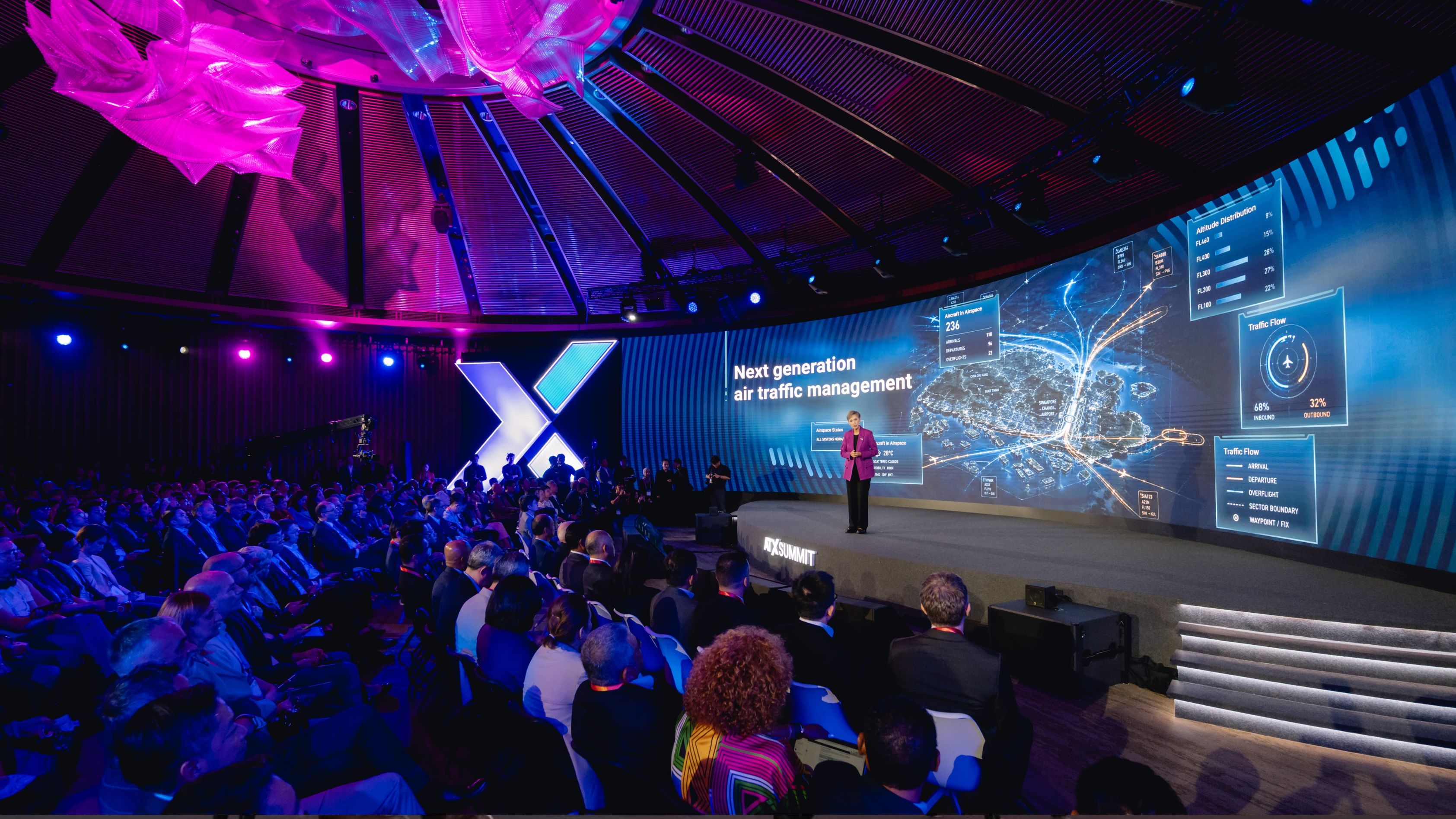
Singapore’s Minister for Digital Development and Information, Josephine Teo, delivering the keynote address at the ATxSummit 2026 on May 20. Image: MDDI.
Singapore has announced plans to set up a testbed for physical AI systems at the Punggol Digital District (PDD), the country's first smart district, to further the integration of artificial intelligence (AI) in the country.
Physical AI systems refer to the integration of AI with hardware and sensors, allowing machines to make decisions, perceive, and manipulate the physical world.
The testbed would be set up later this year under a collaboration between the Infocomm Media Development Authority (IMDA) of Singapore, JTC Corporation (JTC) and the Singapore Institute of Technology (SIT).
The PDD testbed would be Singapore’s first to enable multi-operator deployments at scale in a mixed-use public area.
Companies like Certis, DHL, Grab and QuikBot would be among the first to co-design, deploy, test and validate commercially viable robotics services at the testbed to validate their use within public spaces.
The tests would include food and parcel delivery as well as cleaning and security patrolling, to complement existing human operations.
To facilitate the tests, the Land Transport Authority (LTA) has issued a precinct-level exemption framework for PDD under the Active Mobility Act.
In a related move, IMDA and the National Robotics Programme, Singapore's national platform overseeing robotics research and development (R&D), have partnered with companies like FieldAI, Thoughtworks, and Unitree to advance Singapore’s embodied AI (EAI) capabilities and trial EAI applications.
EAI referred to advanced AI models that were put inside physical bodies like robots and autonomous vehicles to directly perceive, learn from, and act within the real world.
Testing will take place at the SIT’s new Centre for Intelligent Robotics in PDD.
This would provide a real-world environment to continuously refine robotic systems for safety, infrastructure integration, and regulatory compliance.
Major announcements at summit
The PDD testbed was among a slew of initiatives announced by Singapore’s Minister for Digital Development and Information, Josephine Teo, on May 20 at the ATxSummit 2026, the flagship event of Asia Tech x Singapore (ATxSG).
She said these initiatives marked a “decisive shift” for Singapore, from exploring AI tools to building, deploying and governing real-world AI systems.
The move was in keeping with the recommendations by the Economic Strategic Committee Review to make Singapore a trusted hub to develop, test and deploy AI solutions that solve real-world problems at scale.
NVIDIA Singapore hub
The government announced that AI chipmaker, NVIDIA, would launch an AI research lab, NVIDIA’s Singapore hub, focused on advancing embodied and efficient AI in collaboration with university researchers, industry partners, and government agencies.
This would be the US company’s second research presence in the Asia Pacific, after Taiwan.
The lab would focused on two strategic domains that have potential applications in manufacturing: embodied AI and efficient AI computing.
The latter focuses on optimising models and infrastructure to reduce compute costs, improve energy efficiency, and support scalable AI deployment.
In another major announcement, the Ministry of Digital Development and Information (MDDI) and Google announced an expansion of Google's collaboration with Singapore through a new National AI Partnership.
This partnership aimed to harness frontier AI models, including deploying AI to solve society's challenges, developing an AI-ready workforce in Singapore, and creating a secure and trusted ecosystem.
Google DeepMind presence
As part of this collaboration, there would be a Singapore office for Google DeepMind, as part of the company’s global National Partnerships for AI initiative.
MDDI also signed a Memorandum of Understanding (MOU) with OpenAI on a lab to grow its Singapore-based technical teams and embark on frontier research aligned with Singapore’s AI missions and national priorities.
The MOU comprises three pillars of collaboration: advancing applied AI innovation, building AI talent, and making AI accessible to citizens, enterprises and the public sector.
The partnership represented a commitment of more than S$300 million by OpenAI to strengthen Singapore’s AI ecosystem.
AI Foundry by Temus
To expand Singapore's AI talent base, Temus, a Temasek-established AI and digital transformation firm, has launched an AI Foundry, supported by Digital Industry Singapore (DISG).
The Foundry will hire 50 Singapore-based AI professionals to build AI accelerators, governance frameworks, and delivery capabilities for enterprise AI.
In addition, Temus and AI Singapore (AISG) have extended their collaboration to explore joint prototypes, reusable delivery frameworks and enterprise deployments that bring nationally-developed AI capabilities into real-world operating environments.
The partnership would also support multilingual AI use cases and the practical application of Singapore-developed models in enterprise settings.
Another major announcement was that A*STAR Institute for Infocomm Research (A*STAR I2R) would update Multimodal Empathetic Reasoning and Learning in One Network (MERaLiON) AI model with advanced capabilities in environments where understanding tone, intent and context were critical for decision-making.
The last update of the model was announced at last year’s ATxSummit.
MERaLiON to deliver paralinguistic intelligence
According to A*STAR I2R, the updated MERaLiON AudioLLM v3 would deliver paralinguistic intelligence across Southeast Asian languages, including speech and non-speech understanding.
MERaLiON would be available through cloud hosting and API access, as well as edge computing environments, such as Mac and iPad, enabling “scalable and privacy-preserving applications across healthcare, field operations and emergency response”.
Another update announced was to the Model AI Governance Framework for Agentic AI (MGF), first launched at the World Economic Forum (WEF) in January this year.
The update has included real-world case studies and new best practices.
The update featured more than 10 new case studies from public and private sector contributors such as Ant International, GovTech Singapore, Google, and more, showing how the framework’s recommendations could be applied in real-world agentic deployments across a range of sectors and contexts.
ASEAN-US AI Ministerial Roundtable
Minister Teo also attended an ASEAN-US AI Ministerial Roundtable on the sidelines of the ATxSummit.
The roundtable brought together Digital Ministers from ASEAN members, the ASEAN Secretariat, the US government, and industry leaders from Amazon and Google.
The roundtable marked the launch of The Road to 50 Years of ASEAN-US Relations under the ASEAN-US Comprehensive Strategic Partnership.
Discussions centred around inclusive AI adoption across the region.