
Singapore tertiary students leverage local LLMs to build healthcare solutions
At the NUS-Synapxe-IMDA AI Innovation Challenge, student teams used SEA-LION and MERaLiON foundational models to build AI-powered healthcare solutions designed to reflect local languages and lived experiences.
-1779969100286.jpg)
Team ASSURE receiving their prize from Mr Alan Goh, Assistant Chief Executive, Platform Services at Synapxe (on the left). Image: Synapxe, IMDA and NUS' joint press release
What separates a useful healthcare chatbot from a generic one?
For the winning team at the recent NUS-Synapxe-IMDA AI Innovation challenge, the answer lies in the foundational models underneath.
Team Assure, which compromises of six students from National University of Singapore (NUS)’ Business Analytics course, built a voice-enabled artificial intelligence (AI) companion within four months that conducts daily check-ins with elderly cardiac patients.
The check-ins were done in ways that reflect local language patterns, cultural nuances, and the sensitivity that care settings demand.
To do so, the team tapped into Singapore’s homegrown models, SEA-LION and MERaLiON, to “move beyond a generic chatbot and design something natural and familiar for elderly users, without compromising on the human-in-the-loop safeguards that sensitive care scenarios demand,” says a spokesperson from Team ASSURE to GovInsider.
While SEA-LION (Southeast Asian Languages in One Network) focuses on text and data, MERaLiON (Multimodal Empathetic Reasoning and Learning in One Network) goes beyond standard text-based AI by integrating multiple modes like speech-to-text, emotional and paralinguistic intelligence and more.
For the team, using local models was not an afterthought, but what made the solution viable for the people it was built to serve.
“Having LLMs that genuinely understand local language patterns and cultural nuance is what makes that possible,” he says.
The winning team clinched the S$10,000 top prize, which was announced at the conclusion of the challenge on April 22.
In its 12th edition, the challenge was organised by NUS, Singapore’s Infocomm Media Development Authority (IMDA) and the national healthtech agency Synapxe.
This edition welcomed 880 students from 18 institutes, including universities, polytechnics and junior colleges, forming 181 teams to develop AI-powered solutions for chronic conditions like diabetes, hypertension and high lipid levels.
Most students used the SEA-LION and MERaLiON models, including the top eight teams, to develop solutions for this challenge.
Homegrown LLMs finding their way into the home
IMDA's involvement in the challenge reflects broader ambition: To translate the use of SEA-LION and MERaLiON models into solutions that serve Singapore and the region.
Its Director for Business & Ecosystems at its BizTech Group, Dr Lawrence Wee, said the agency's goal was to cultivate an ecosystem of partners and innovators to enable that.
Developed under the National Multimodal Large Language Model Programme (NMLP), both models were built to handle the code-switching, mixed-language communication styles, and cultural nuances common in the local Singaporean setting.
In healthcare particularly, Dr Wee noted that such models can help bridge the language gap
between elderly patients and care providers, enabling care that is not just efficient but more empathetic and inclusive.
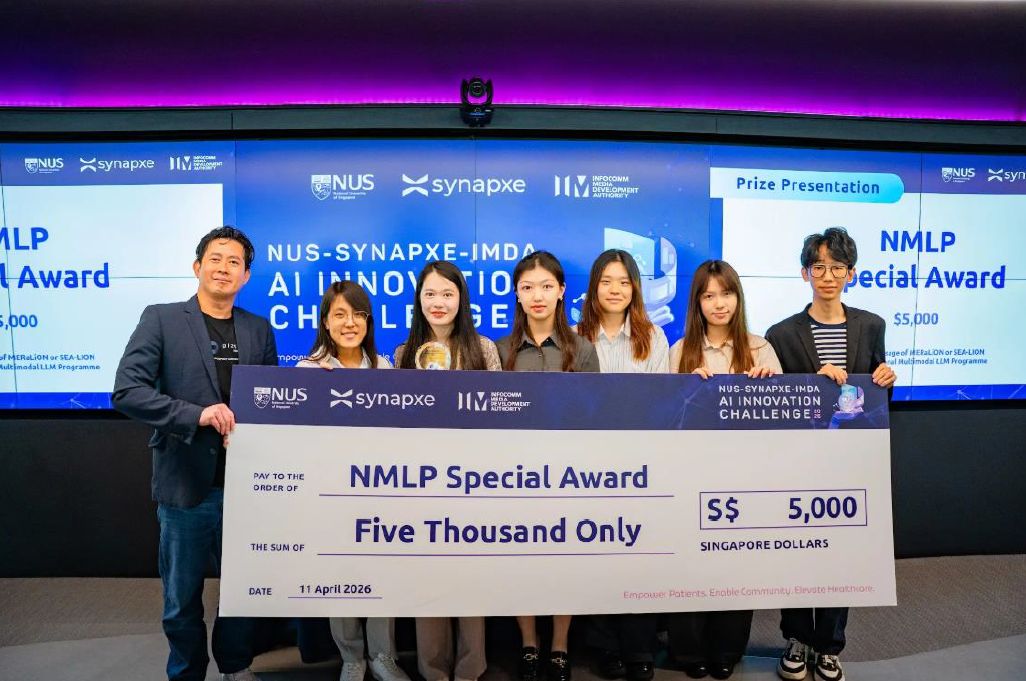
The NMLP Special Award of S$5,000 went to VitalSense, built by Team Wait for a Name, which generates a health summary in five minutes using a webcam, microphone, and self-reported vitals – all without a clinic visit.
“SEA-LION didn't just power our reporting layer, it raised the bar for what an AI-generated health summary could look like in a real-world clinical context,” a spokesperson from the team tells GovInsider.
The team used SEA-LION to synthesise multimodal inputs - camera footage, motion data, voice, and questionnaire responses - into health reports.
It was also able to generate structured summaries, risk interpretation, and recommendations, he adds.
“To maximise reliability, we standardised input and output formats, while building a backend fallback mechanism that allows the system to deliver consistent results even during large-text processing, extended outputs, or occasional API instability,” he explains.
Next steps following the challenge
Synapxe’s Assistant Chief Executive Alan Goh tells GovInsider that the winning use cases will be shared with public healthcare clusters, and that the agency is working with NUS to extend internship opportunities to selected participants who want to pursue healthcare AI capstone projects.
“The goal is to build skills and insights essential to refining and strengthening ideas, rather than future implementation,” he shares, adding that the challenge provides an opportunity for young innovators to immerse in real-world healthcare challenges and constraints.
The intention is to cultivate an innovation and design thinking mindset among students.
For public healthcare partners, challenges like this also offer an early window into the emerging ideas, approaches and capabilities.
Goh is candid that the path from a challenge entry to real-world deployment depends on multiple factors: real-world demand, ability to integrate with existing workflows and infrastructure, and rigorous assessment by multiple stakeholders.
Getting the path right, he adds, is ultimately what separates a good idea from a practical solution that frontline teams can rely on.
Second prize of S$7,000 went to Team SilverGait for an AI system that monitors elderly adults for frailty using computer vision and wearable data, while the third place of S$5,000 went to Team Med-SEAL for a diagnostic platform that supports clinicians by automating clinical reporting and delivering clearer, multilingual medical explanations to patients.