
Singapore's public healthcare cluster built four pharmacy AI tools in nine months. The plumbing took five years
It took the pharmacists' clinical judgement to shape the tools, and shared platforms like Endeavour AI and Horus with interoperability and safeguards built in, says the National University Health System (NUHS)'s Deputy Group CTO Dr James Lee and Cluster AI in Pharmacy (NCAIP)'s project director Tan Chwee Huat.
-1785468962219.jpg)
Pharmacists at NUHS have built four AI tools, bundled into the NUHS Cluster AI in Pharmacy (NCAIP) platform, to speed up medication triage, reconciliation and order verification. Image: NUHS
Imagine yourself having to wait 40 minutes in the pharmacy to get two strips of painkillers.
Outside the patient's experience, pharmacists across the National University Health System (NUHS) handle up to 730 medication reconciliations and review 13,000 orders and counselling sessions a day.
NUHS is one of three Singapore's public healthcare clusters.
These routine and low-complexity tasks eat up 173 man hours of the pharmacists' time, losing time to attend to patients who most need their expertise.
That was the everyday reality that pushed pharmacists at NUHS to build four artificial intelligence (AI) tools, bundled into the NUHS Cluster AI in Pharmacy (NCAIP) platform, to speed up triage, reconciliation and order verification.
Once fully deployed, this is expected to reduce up to 20 per cent of the time taken for in-person dispensing, saving as much as two million Singapore dollars.
From the first conversation to validated results, the build took nine months.
To build and scale so quickly, this took the clinical judgement of pharmacists to shape what the AI tools needed to do, as well as the cluster's shared data platform, Endeavour AI, that was built five years with the interoperability, rules and safeguards already in place.
At its launch on July 28, GovInsider speaks to the team to find out what came before the AI, and what comes after it.
Where the hours go, and where they could go instead
The four AI tools, namely MedTriage, Admission MedRecon, Discharge MedRecon and MedVerify, currently work in the background or with a click of "Run LLM", without the need for the user's manual prompting.
The AI-generated outputs incorporated into the existing systems are designed as recommendations for pharmacists.
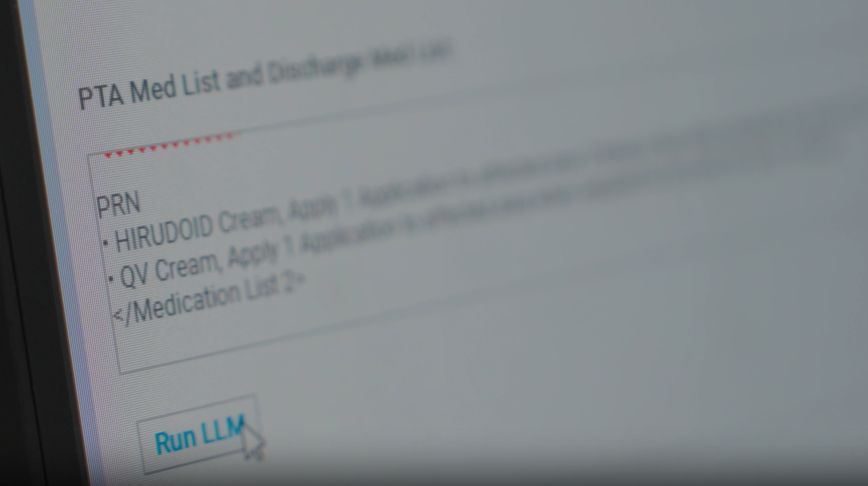
According to the team consisting of pharmacists across the cluster, each tool was designed around a specific pain point in the pharmacist's workflow.
For example, to reduce patient's waiting time while ensuring patients with complex needs are attended to, MedTriage sorts patients at the pharmacy counter into two categories: Those who can collect medications remotely or be self-guided, and those who require counselling.
Admission and Discharge MedRecons catch the gaps in the patient's medication lists as the patient moves across different care settings, while MedVerify screens every order for dosing issues and drug interactions before it reaches the patients.
The tools have been tested against real patients. For instance, MedVerify has flagged a dangerous interaction between an anti-nausea medicine and a mental health drug, recommending the order be rejected which was agreed by a pharmacist.
As of the date of publishing, all four tools have been designed and validated as proof-of-concepts (POCs), and will move on to be developed as minimum viable products (MVPs).
MedTriage has currently secured funding and is targeting deployment in 2027.
According to Alexandra Hospital's Consultant Pharmacist and NCAIP's Project Director, Tan Chwee Huat, the time savings have enabled the pharmacists to focus on more complex patients, participate more actively in multidisciplinary ward rounds and patient care planning, as well as take on "frontier clinical roles" like predictive clinical services, precision medicine and more.
The shared platforms and the team behind it
When pharmacists juggle so many disparate systems from the Epic national electronic health records (NEHR), internal clinical notes to reports of patient findings, how do the AI tools draw from all of them at once?
NUHS' Deputy Group Chief Technology Officer for AI, James Lee, described a decision made by the cluster years before NCAIP existed.
"If you look at any commercial solution now, they only have their own database," he says, adding that "The reason why NUHS could do it is because the plumbing work had already been committed five years ago."
NCAIP leverages Endeavour AI and HORUS, which are the shared platforms in data and AI respectively built by the cluster's tech team.
-1785471357409.jpg)
While Endeavour AI centralises data scattered across systems into one platform, Horus is the big data AI initiative built on top of Endeavour AI that helps to derive insights from large-scale clinical data and build algorithms for clinical decision support.
In NCAIP's case, Lee explains that Endeavour AI fetches live patient data from the Epic NEHR and then orchestrates multiple AI models in a "multi-agent setup" enabled by Horus to derive outputs that can support the pharmacists.
Without the foundation, he estimates that the AI tools would have taken "two to maybe even five years" to build elsewhere.
The team also highlighted that technology was only half of the game.
Tan highlighted that instead of having IT hand down the tools to the pharmacists, the requirements were driven by a core team of 26 pharmacists and interns across four NUHS hospitals.
Additionally, the heads of pharmacy from each institution worked through what he called "frank and honest discussions" to decide which tools were most impactful in improving workflows before scoping the build.
Dr Lee acknowledged the struggle with adoption when tools are prescribed top-down because they "don't meet the users' needs."
NCAIP worked backwards instead: By starting from what pharmacists said they needed, then checking if it's feasible to deliver something within a year or two.
"We achieved really a sweet spot," he said, referring to NCAIP.
From HealthHub to the rest of Singapore
Tan highlights NCAIP as another platform and not an end product, as it has been built to "empower the development of further new tools in the future."
The bigger move after this is also beyond the NUHS cluster.
He confirms that the cluster has been in "deep conversations with Synapxe [the national health tech agency] since more than a year ago" about extending NCAIP across other clusters.
Data integration remains the main hurdle still being worked through.
As healthcare increasingly shifts towards a cloud-based architecture alongside improved frontier AI models, Dr Lee calls the moment a "perfect storm" where a cluster with the right tools could scale something beyond their own walls.
On the patient-facing front, Tan also lays out a vision for using HealthHub mobile app, where patients could order medications through the app and MedTriage would steer the simpler cases towards the right collection mode like home deliveries and medlockers, so in-person time goes to the patients who need it.
Even patients opting for delivery who do need guidance wouldn’t be skipped, he says, highlighting that pharmacists can still "proactively" reach out to the patients to arrange counselling.
Watch the video below to see the two AI tools from the NCAIP platform, namely the MedRecon (00:12) and MedTriage (00:29), in use:
GovInsider is organising Healthcare Day on September 15, 2026, in Singapore. You can find out more about the event and register here.