Singapore’s public healthcare sector to roll out 36 redesigned job roles over the next decade
The CHI Workforce Accelerator is targeted to support healthcare professionals to redesign and prototype these new roles in their organisations within three to six months.
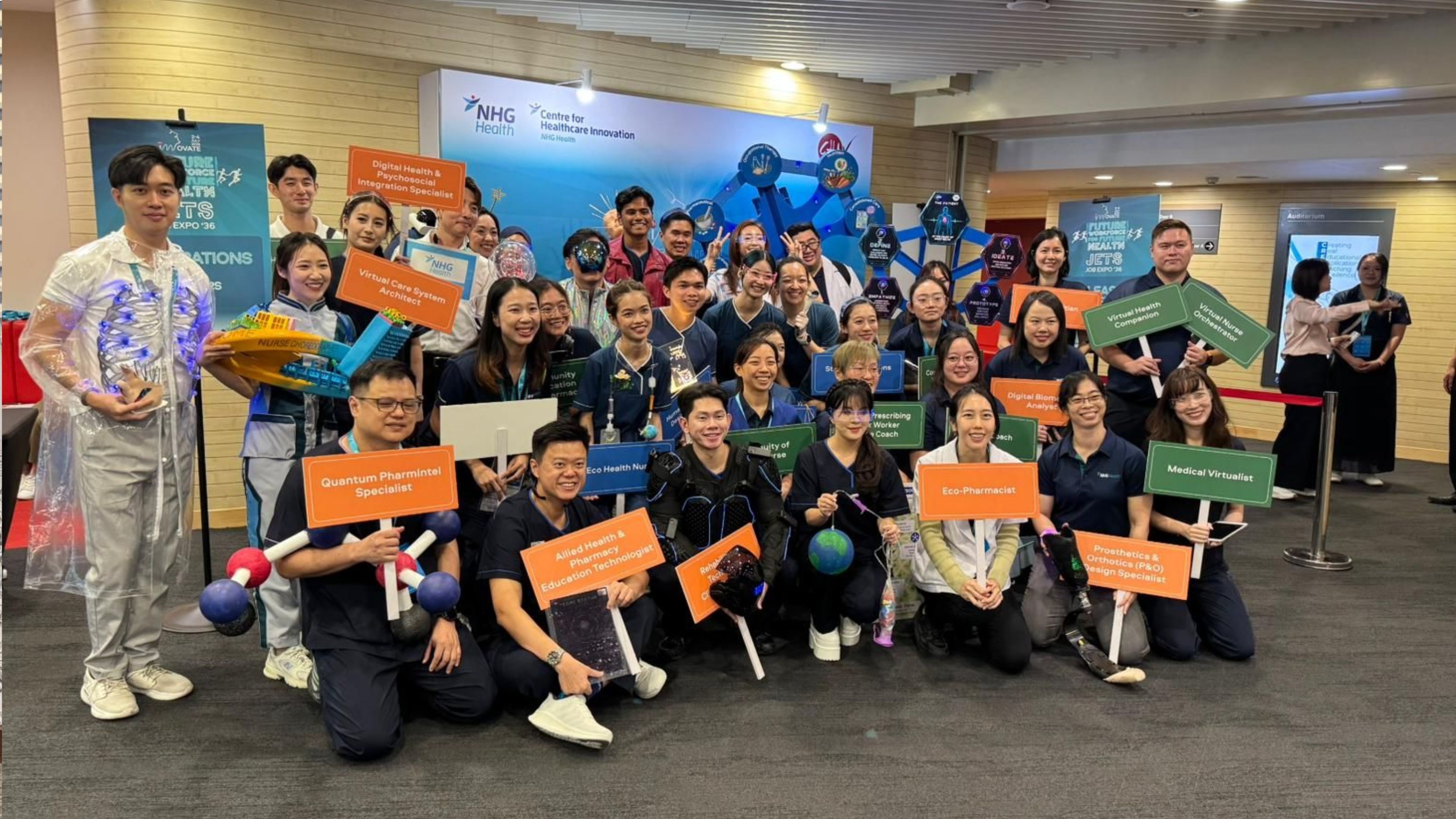
Thirty six redesigned job roles were announced at the CHI INNOVATE 2026 event on July 2 in Singapore. Image: Centre for Healthcare Innovation (CHI)
We often think of technology as the only thing that can be rapidly prototyped. But new roles and care models can be too.
It's now possible to prototype redesigned roles in Singapore’s healthcare sector through the CHI Workforce Accelerator by the Centre for Healthcare Innovation (CHI), parked under one of the country's public healthcare clusters, NHG Health.
“It’s about rapid prototyping your redesigned roles. As you go through the process, you naturally land on the right mix and refinements,” says CHI’s Learning & Organisation Development Office’s Deputy Director, Thomas Liew, to GovInsider.
Unlike conventional upskilling courses and one-off workshops, the accelerator provides a structured platform for healthcare professionals to redesign their roles around future care models, prototype the roles in their own institutions, and then roll them out within three to six months.
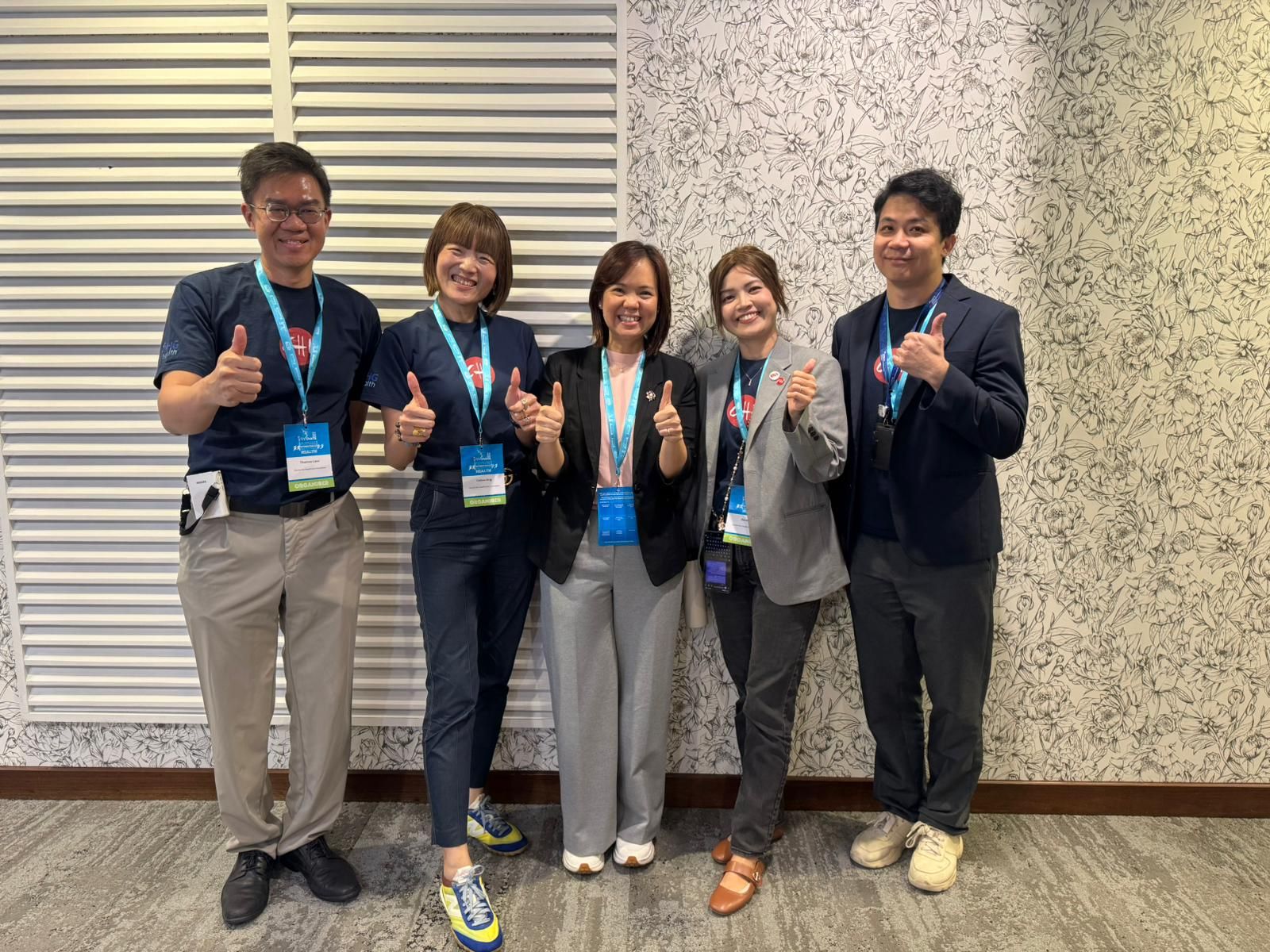
Liew explains that the accelerator is largely driven by the process, rather than being a top-down prescription, because some parts of the process call for creativity while others involve trial-and-error.
The accelerator was launched on July 2 at the CHI INNOVATE 2026 event, where 36 redesigned roles were announced during the accompanying Job Expo ’36 (JETS).
The redesigned roles span the full spectrum across medical, nursing, allied health, community and social, as well as volunteer domains.
These roles are expected to be piloted and developed over the next ten years.
Three nursing roles, for instance, are already being piloted in some of NHG Health's hospitals, says Tan Tock Seng Hospital’s (TTSH) Assistant Nursing Director James Ang.
These include the nursing choreographer, who coordinates end-to-end care across settings for patients with chronic diseases; the integrative care nurse, who looks at holistic patient care, including caregivers' well-being; and the vascular care nurse, who manages advanced vascular access through imaging and clinical judgement.
We speak to the team behind the accelerator, as well as the workshop participants on what it takes to land workforce transformation in the evolving healthcare landscape.
What it takes to prototype a redesigned role
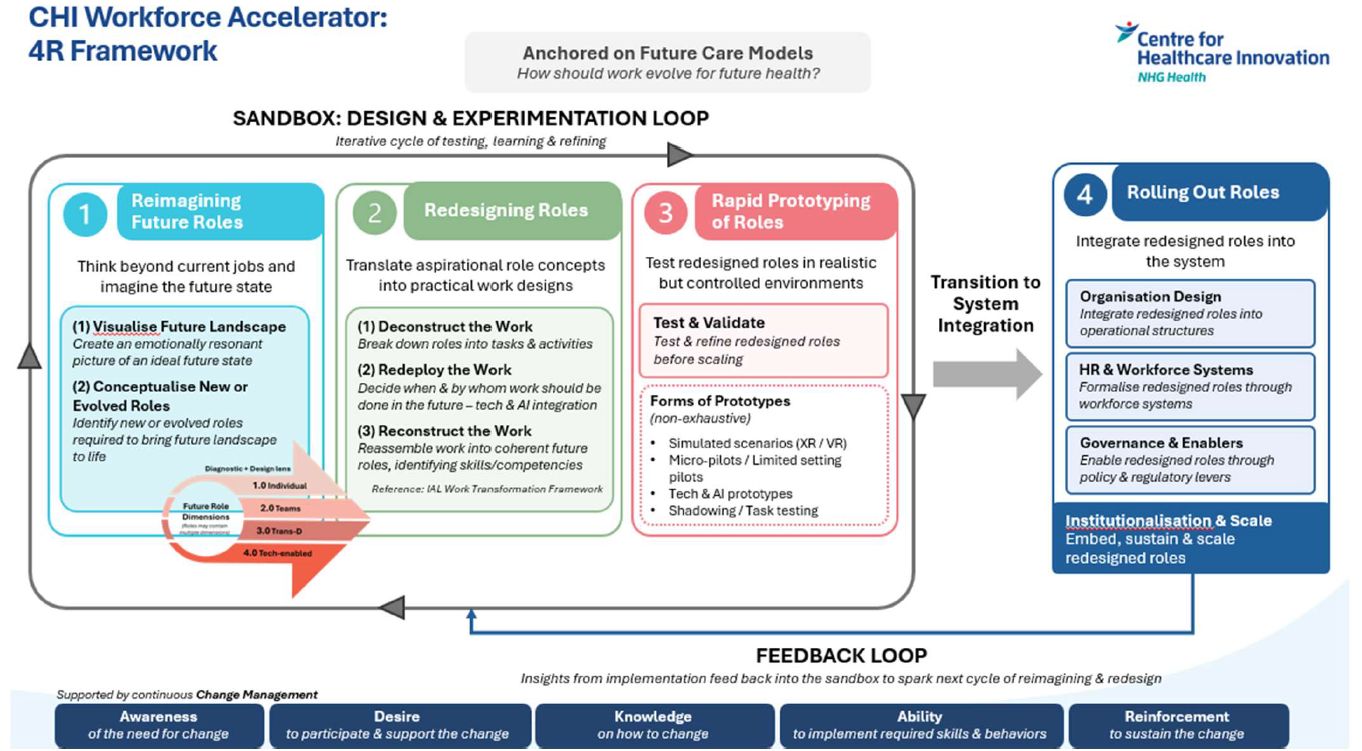
According to the team, prototyping a role means mapping its current tasks and skills, deciding what to keep, remove, automate, or share across professions, then redesigning it across different levels from individual, team, trans-disciplinary, to tech-augmented.
This is also why the accelerator avoids the format of a traditional course, says Liew.
Traditional upskilling, he says, puts courses on the table for people to attend, learn and later apply back in their own context.
This was a model suited to routine, one-size-fits-all factory jobs, but not to today's more complex healthcare roles.
CHI's approach folds learning and doing together instead: participants apply each tool as they learn it, working out what a redesigned role should look like as they build it.
The framework used for the accelerator also took time to get right.
Since last August, CHI organised 30 work redesign workshops involving 300 participants, including medical staff and youth volunteers, to experiment with a variety of tools before landing on only eight tools.
“We sandbox our own sandbox,” Liew says, describing how the framework has been refined along the way.
Ang from nursing, for example, personally found guided visualisation to be an impactful tool.
He describes the tool as one that first lays out the change context, then helps participants set aside their baggage, before visualising ten to 20 years ahead to find what, if done right, would make things better for both the nursing workforce and patient care.
“I have learned that designing the conversation is equally as important as designing the transformation.
"Because we know that, if you ask people to think about the future, they only tend to go in with a lot of baggage.”
Starting with the patient, not the process
In the accelerator, healthcare professionals are pushed to imagine an ideal version of care first, before being guided through a more structured and systemic process to ground the ideas into practice.
Participants start by focusing on the patients’ needs, the challenges they face, and the gaps in the system, instead of their current processes, says TTSH’s Senior Principal Speech Therapist, Zenne T’ng.
This shifts from designing roles around current services to designing them around future ones, according to TTSH’s Head Nurse, Dr Hoi Shu Yin.
T’ng is part of the Centre for Allied Health and Pharmacy Excellence (CAPE), while Dr Hoi and Ang are part of the Centre for Asian Nursing Studies (CANS) - both of the centres were involved in last August’s workshops.
“It’s a very rare opportunity where different groups are using the framework at the same time,” says Ang.
Traditionally, most workforce transformation efforts have happened in silos and negotiated boundaries only after the fact.
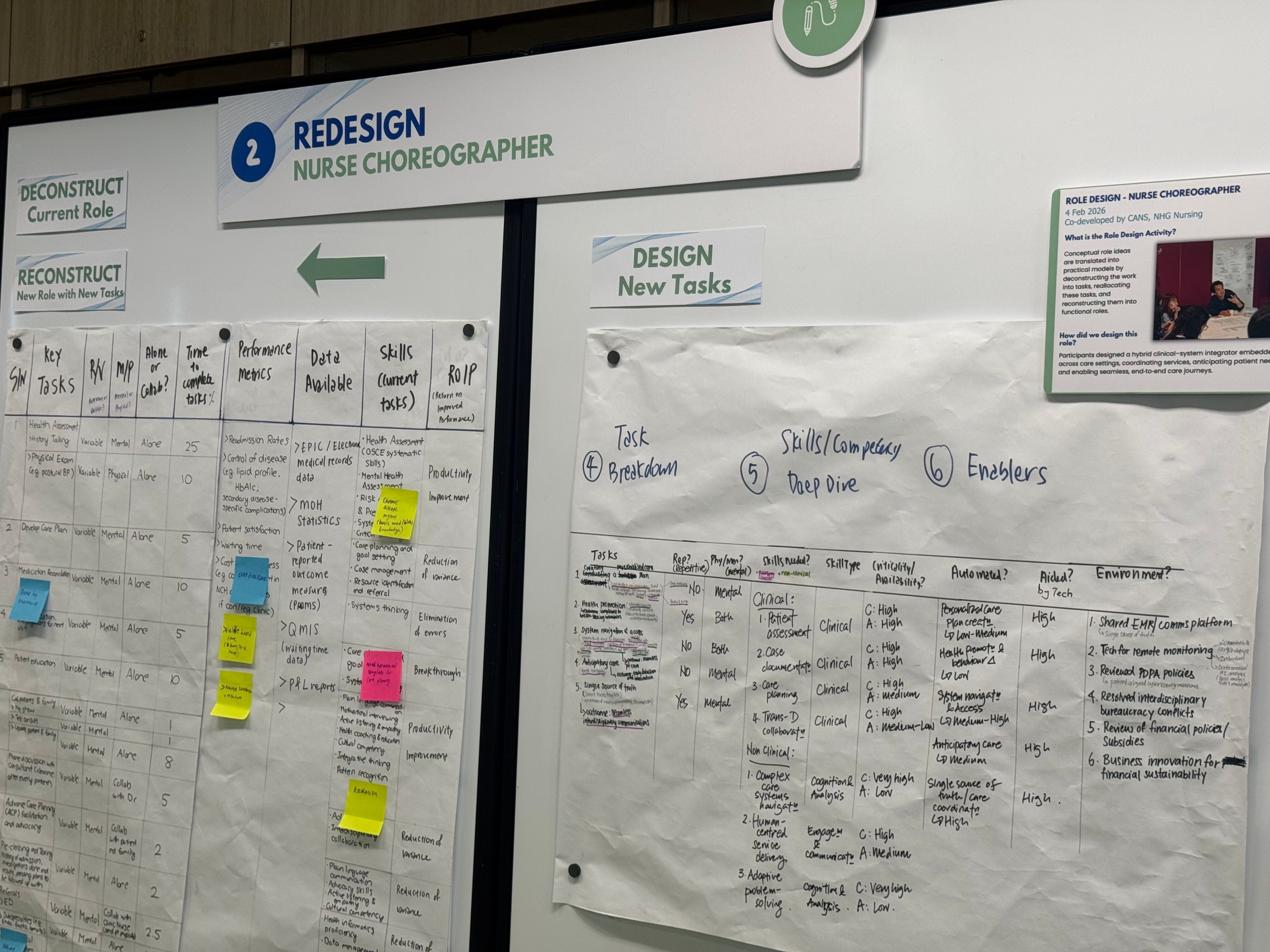
Pairing futures thinking alongside systems-level thinking also prompts different groups to think about how care connects across settings from the wards to the patients’ homes, says Dr Hoi.
The first reimagining stage, which Liew calls “the fun part”, is meant to shift mindsets before the practical work begins.
“We want people to think about the future in a positive way, to bring out the best in their imagination rather than their doubts,” he says.
After shifting mindsets, the rest of the process, like deconstructing and rebuilding roles, then becomes smoother, he explains.
Bringing in the whole village
To institutionalise and scale the job roles, partnering with institutes of higher learning, the Ministry of Education (MOE), the human resource (HR) departments, and healthcare unions will be key, says Liew.
In a separate media stop, Liew shares that the partnership allows CHI to then mainstream the new roles beyond the sandbox phase, build career pathways and learning pathways, as well as to work out the compensation and HR parameters to align with regulations.
The Centre for Health Activation (CHA)’s Director, Celine Ong, explains the need to involve students and volunteers in the ecosystem to create upstream impact for a workforce shift.
To that end, the team has designed a separate workshop bringing youth through the same futures-thinking exercise to consider opportunities in the healthcare system.
To broaden how participants imagined the future, Dr Hoi says the team brought in thought leaders from outside healthcare when designing the guided visualisation workshops, including sports coaches who train high performers on resilience and teamwork, strategic foresight specialists, and sustainability experts.
The uncomfortable question: what happens to me?
Merging two roles into one, or automating parts of a job, raises a harder question: What happens to the people whose roles are streamlined out?
Liew highlights this as a shared responsibility. While employers will manage the transition, employees have a duty to keep upskilling “since what we learn from school is never enough to equip ourselves for the workplace.”
Even in a worst-case scenario where a role is genuinely displaced, he says, workers rarely need to start from scratch.
“Your skill [as a healthcare worker] is never so specialised that you cannot apply to another context,” he notes, highlighting the importance of catching at-risk roles early enough that people have time to pivot to something adjacent.
Reflecting on her experience in the speech therapy department, T'ng admits that roles will not stay the same, but will evolve as therapists move more towards the community or work alongside artificial intelligence (AI) tools.
Rather than letting the uncertainty sit unaddressed, T’ng says that she would ask workshop participants: What could you offer that makes you irreplaceable a decade from now?
This then shifts the conversation from fear toward higher-value work.