
Sustained efforts needed to build global trust in an AI-driven era
Speaking at the Global Dialogue on AI Governance, Singapore’s digital minister Josephine Teo reiterated the country’s efforts to develop AI infrastructure, capabilities and governance frameworks along with multilateral cooperation.
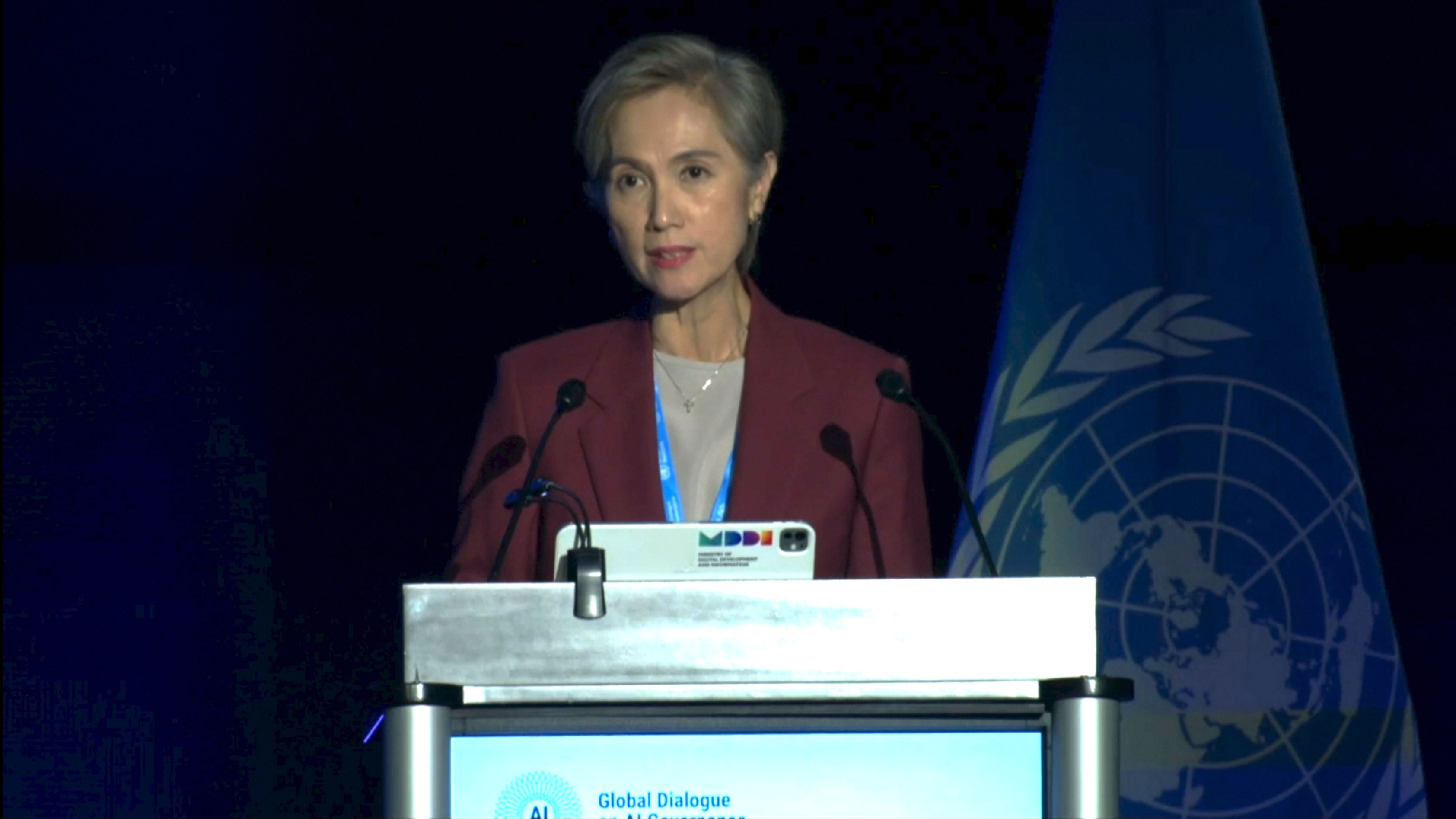
Singapore’s Minister for Digital Development and Information, Josephine Teo, speaking at the inaugural Global Dialogue on AI Governance in Geneva on July 7. Image: MDDI.
Speaking during the second day of the first Global Dialogue on AI Governance, held in Geneva on July 6 and 7, Singapore’s Minister for Digital Development and Information, Josephine Teo, reiterated the country’s position that artificial intelligence (AI) can be a significant force for good.
The Minister noted that realising the full potential of AI requires “patient, sustained effort”, which included building public infrastructure, developing capabilities, and putting governance frameworks in place.
The opening dialogue also saw UN Secretary-General António Guterres appealing for worldwide controls on AI.
He warned of increasingly powerful civilian AI chips shifting to the battlefield, where "killer robots" were becoming the norm. Any future agreement on AI must be "worthy of global trust" and prioritise safety, he said.
“AI is advancing at runaway speed. The question is whether we will govern it together – or let it govern us.
“For the first time, the AI dialogue gives every country a seat at the table. We must now turn global participation into global action – to make AI safer, fairer, more accessible and more ethical”.
While there have been previous dialogues on AI, such as the AI Safety Summit at Bletchley Park in 2023, these meetings were largely driven by a select group of technologically advanced nations and industry leaders.
All 193 member states involved
The UN Global Dialogue on AI Governance in Geneva marks the first time all 193 member states have convened to negotiate AI governance.
The event ensures that the geopolitical discourse moves beyond the interests of leading tech superpowers like the US and China to include the voices of the entire international community, according to the event officials.
Minister Teo noted that there was an urgent need to build trust, “because people will not use a technology [AI] they do not trust”.
This meant publishing practical guidelines, updating laws to deal with AI risks, partnering with international bodies on technical standards, and acknowledging that so much is still unknown about AI risks, the Minister added.
In May, Singapore hosted the Second International Scientific Exchange on AI Safety (ISE), bringing together over 100 contributors, including frontier developers, government safety institutes, academia, and civil society, from 13 different countries.
The resulting document, the 2026 Singapore Consensus, established global priorities on critical technical AI safety research, focusing heavily on societal resilience, managing autonomous AI agents, and mitigating the risks of open-weight models.
Protection of children major priority
At the conference, UN Secretary-General Guterres said a central pillar of the proposed global governance rules was the protection of children.
Guterres called for nations to adopt the AI Child Safety Pledge.
He noted with concern that AI has reached children’s learning and private lives “without the rigorous safety testing required for toys or medicine”.
Under this pledge, developers are required to prove safety through independent oversight, maintain zero tolerance for AI-generated sexual abuse of children, and ensure systems connect distressed users to real human support.
At the conference, other participants also raised concerns about AI, including the generation of deepfakes.
UN General Assembly President Annalena Baerbock cited data to note that 99 per cent of deepfakes are sexual in nature, disproportionately targeting women and girls.
AI can compress decades of development
Guterres noted that used well and shared widely, AI “could compress decades of development into years” and become “the great equaliser of the 21st century”.
But before this could happen, he said, the technology should be tested thoroughly for safety and legal responsibility assigned.
“When countries align on how to test [AI] systems, measure risk and assign responsibility, safety travels with technology.
“When they do not, a patchwork of incompatible rules raises costs, divides the world – and protects no one,” he said.
Building on Guterres’ point, Minister Teo highlighted Singapore’s own efforts in aligning AI efforts within the ASEAN region.
She noted that one of the first governance lessons learned by Singapore was that “we need a few building blocks to achieve our AI goals for the economy and society”.
One, she said, was reliable infrastructure, including the software layer that makes AI accessible and useful. Two was access to quality data.
“Among the 11 states of ASEAN, we have established a Digital Economy Framework Agreement to develop common rules and interoperable standards to support cross-border data flows,” she said.
The third lesson was the need to develop capabilities.
“People and organisations that know how to use AI confidently, maximising its upsides and minimising its downsides,” she said.
Call for more public investment in AI
The UN Secretary-General called for great public investment in AI.
He noted the significant discrepancy between private funding for AI infrastructure, approximately US$500 trillion (S$646 million), and public support for AI capacity in developing countries, which remained “a rounding error” by comparison.
To help close this gap, the UN chief announced that more than 20 countries had supported his initiative for a UN-supported Global Network for Exchange and Cooperation on AI Capacity Building.
He noted that the network will build on existing initiatives, sharing knowledge, promoting cooperation, and expanding access to capacity-building, particularly for developing countries.
“I will shortly submit to the General Assembly my recommendations for a Global Fund for AI – to build skills, data and affordable computing power everywhere,” Guterres said.
“We cannot allow the digital divide to harden into an AI divide and the AI divide to become a development gap, a security gap, and a sovereignty gap,” he added.
The UN chief also urged every major AI company to measure and publicly disclose the full footprint of its systems: carbon, water and land – and to commit to powering every data centre with renewable energy by 2030.
Citing the UN AI Environmental Transparency Initiative, Guterres noted that by 2030, AI companies “could use more electricity than all but five nations – and enough water to meet the needs of all 1.3 billion people in sub-Saharan Africa for an entire year”.