
Tabitha Quake, Head of Foot Care and Limb Design Centre, Tan Tock Seng Hospital, Singapore
Meet the Women in GovTech 2025.
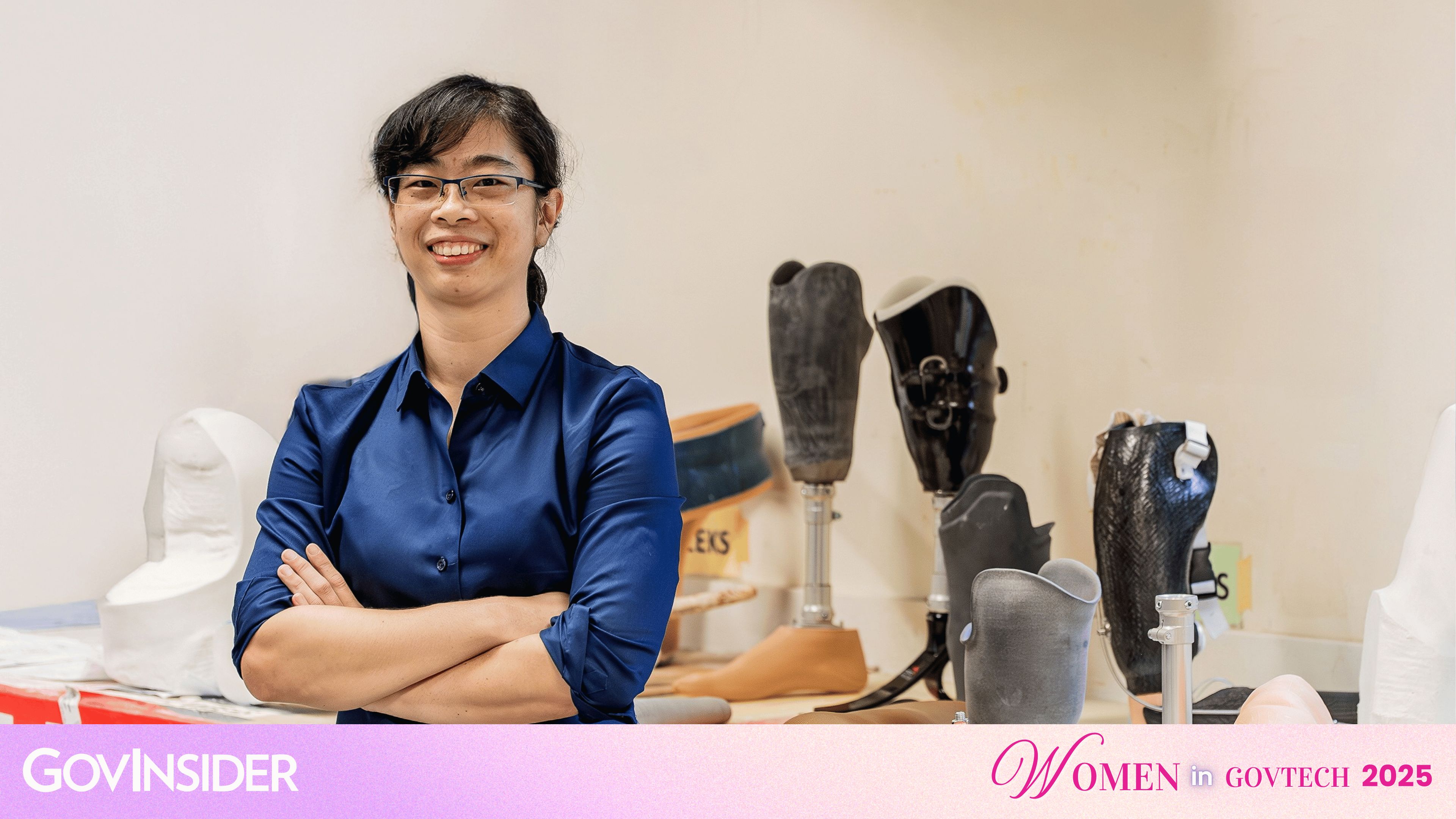
Tabitha Quake, Head of Foot Care and Limb Design Centre, Tan Tock Seng Hospital, NHG Health, Singapore, shares her journey. Image: NHG Health.
1) How do you use your role to ensure that technology and policy are truly inclusive?
I’ve been a practising Prosthetist/Orthotist (P&O) in the public sector for over 10 years and am the current Head of NHG Health’s Tan Tock Seng Hospital’s (TTSH) Foot Care and Limb Design Centre.
Over the years, my role has evolved from creating individualised artificial limbs and braces for persons with physical disability to one that puts me in a decision-making capacity and a greater sphere of influence.
Prostheses and orthoses are not just assistive devices.
They are a means of increasing inclusion and participation in society, and thereby in life itself.
On a direct level, my role allows me to use my clinical and technical expertise to chart the service’s direction in introducing new P&O technologies and methods to improve the accessibility and quality of care for patients.
In 2021, I authored a piece on the applications of digital technology in P&O for the Special Report.
Since then, my role has grown to include advisory consultancies on policy recommendations for service users.
I have had the privilege of collaborating with agencies such as SGEnable and Agency for Integrated Care (AIC) to advance affordable and accessible P&O care by providing perspectives on behalf of clinicians and service users to ensure that systems and policies are inclusive and equitable.
2) What’s a moment in your career when you saw firsthand how technology or a new policy changed a citizen’s life for the better?
As a P&O, I have experienced firsthand how fitting a prosthesis or brace has a direct and tangible impact in restoring independence and dignity to patients, enabling them to participate more fully in society.
Advances in technology have also enabled improved functionality of the range of P&O products our service provides, enabling more patients to benefit from innovations at their respective price points.
Policy-wise, I am heartened to see increased government efforts to create a more inclusive society.
Better awareness and recognition of P&O services and stronger funding support for mobility aids and assistive devices in recent years have helped facilitate access to this niche but essential healthcare service.
3) What was the most impactful project you worked on this year, and how did you measure its success in building trust and serving the needs of the public?
This year, I had the opportunity to work with the Ministry of Health (MOH) and professional counterparts in Jordan to put together a humanitarian aid package comprising a hundred sets of rapid-fitting prosthetic solutions for Palestinians who had sustained amputations in the Gaza conflict.
The spirit of the mission embodies Singapore’s public service approach – understated, discreet, behind-the-scenes, helpful and respectful – and honours TTSH’s roots as a people’s hospital serving the underprivileged of all nations.
This mission resonated deeply with our local and international P&O community as well as members of the public, showing that impact is measured not just in terms of numbers, but in the trust that is built through knowing that each contribution symbolises the values that we stand for, and through knowing that even a small community can create far-reaching impact beyond our shores.
4) What was one unexpected lesson you learned this year about designing for real people? This can be about a specific project or a broader lesson about your work.
One thing I’ve had to learn early on as a P&O is that design is as much about the heart as it is about the head. As healthcare professionals, we are taught to design and implement treatment plans.
However, humans aren’t machines.
A fixed input does not always equate a guaranteed output. Designing for real people means appealing to their pathos as well as the logos.
To subscribe to the GovInsider bulletin, click here.
Design must remain adaptable, relevant and of personal meaning to the user, otherwise it will fail to gain acceptance.
I’ve found that the most successful human design is one that aligns both heart and head in a process of co-creation.
This means having real conversations with service users to understand their experiences and values, and bringing my professional expertise to the table in a collaborative rather than prescriptive approach.
5) We hear a lot about AI. What's a practical example of how AI can be used to make government services more inclusive and trustworthy?
Artificial intelligence (AI) has lowered barriers to skill sets that previously required years of training.
In government services, AI has been useful in summarising and presenting large amounts of content for professional documents in a short span of time, which can then undergo further vetting and refinement by a human.
The trustworthiness of AI reflects our trust in the humans who create such systems. As users of AI systems, we have a responsibility to ensure ethical and accountable use such that public trust is not misplaced.
6) How are you preparing for the next wave of change in the public sector? What new skill, approach, or technology are you most excited to explore in the coming year?
The public healthcare sector is going to see increasing use and integration of technology to support and augment human capabilities.
I am excited to explore how applications of virtual/augmented reality and generative AI can be used to combine technological precision with the human touch to elevate care standards.
I am also keen to explore how these technologies can facilitate learning and skill enhancement, enabling workers to stay relevant and improve their career longevity.
7) What advice do you have for public sector innovators who want to build a career focused on serving all citizens?
At the risk of sounding cliché, remember who your innovation is meant to serve.
Keep an open mind and listen to what the people you are designing for are really saying.
Good design is not self-serving; it is like a thoughtful gift that says, “You were on my mind.”
8) Who inspires you to build a more inclusive and trustworthy public sector?
My staff, peers and mentors who are currently in or have chosen to return to serve in the public sector, who I have seen bring heart to their work to better the lives of those they serve.
It is their shared belief that inspires me to build a system that is inclusive and worthy of trust.
9) If you had an unlimited budget, what would your dream project be?
Improving access and inclusivity of design within my professional field.
In the World Health Organisation's (WHO’s) global report on assistive technology, only half of users found their products suitable for their environment.
We tend to speak of technology in terms of domain-specific advancements, which lends itself to exclusivity.
Technology is the application of knowledge for practical purposes, and P&O technologies should address local needs and realities.
I would like to see more P&O design for everyday, and not just for increasingly specific groups or scenarios – in particular, more design representing our Asian population, women and children.
10) Outside tech, what excites you the most?
While I’m excited by new gadgets and tech, my hobbies are mostly non-tech related.
Nowadays, we’re constantly connected to and surrounded by so much technology that we can end up in a constant state of overstimulation.
Hobbies such as travelling, cycling, tending to the office green corner, reading and working with my hands allow me time to purposefully disconnect while remaining grounded.
These “system resets” bring fresh perspectives and moments of clarity when I’m able to see the pieces of a puzzle fall into place, renewing my excitement to give form to those ideas.