Taiwan's experience getting a local-language AI past the classroom door
National University of Tainan's Professor Lee Chang-Shing shares how moving a pilot to sustainable use meant winning over teachers and keeping the system running when the network or computing does not.
-1794990130693.jpg)
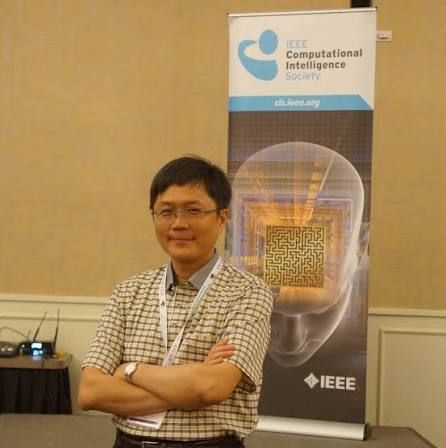
National University of Tainan's Professor Lee Chang-Shing and his team won an award for the National Science and Technology Council (NSTC)'s industry-academia collaborations category. Image: Prof Lee
Taiwan's local-language artificial intelligence (AI) model, known as Trustworthy AI Dialogue Engine (TAIDE), can handle idioms its global rivals have missed.
But when researchers built a chatbot on TAIDE, the first hurdles that came up in the classroom were about people, not language.
These challenges include clunky logins, teachers reluctant to use AI and worrying about the extra workload.
This was the finding from a pilot by the National University of Tainan, where a team implemented a Taiwanese-English learning chatbot built on the TAIDE model in an elementary school.
"Promoting AI education requires more than simply providing a system," says Professor Lee Chang-Shing who leads the team of researchers from the National University of Tainan, to GovInsider.
"It is essential to consider teachers’ practical needs and gradually build their confidence in using AI tools through simplified operations, clear guidance, and appropriate resource support," he adds.
Like SEA-LION for Southeast Asia, TAIDE serves as a foundational layer that provides the linguistic and cultural intelligence tailored for Taiwan’s main languages like Hokkien and Hakka.
How the local-language LLM got into a classroom
When TAIDE was made available to the academic community in 2024, Prof Lee's team jumped at the opportunity to integrate the AI into their learning platform.
His team initially tapped into Meta's translation model, which struggled with Taiwan-specific cultural expressions in the school materials.
"These datasets served as the foundation for model training and optimisation, enabling us to continuously fine-tune the models and improve their performance," he says.
With computing resource support from National Centre for High-Performance Computing (NCHC), it launched the Taiwanese-English Co-Learning Family Pilot Programme at Rende Elementary School in Tainan City in September 2024.
The pilot was a government-industry-academia collaboration, which involved textbook publisher
Jen-Pin Publishing and NUWA Robotics.
The learning platform aimed to keep students engaged in their language classes, says Prof Lee.
Instead of conventional textbook reading exercises, students could directly converse with the chatbot.
The programme took the form of putting NUWA AI chatbots on tablets for students to use during formal classes and extracurricular clubs.
It also invited families with children at school to co-create learning experiences.
By using tools such as the TAIDE Taiwanese-English learning platform, generative AI imaging, and co-learning knowledge graphs, both students and their relatives could learn Taiwanese and English together, while getting used to interact with AI.
Prof Lee highlighted another reason why his team chose schools for the AI application.
"School curricula have more clearly defined learning objectives and content," he explains, noting that this results in "more concrete" system design, testing and performance evaluation.
Making it work in the classroom
To move the AI platform from a pilot to sustainable use, Prof Lee emphasised the need to embed the tools into teaching practices, instead of rolling it out as a once-off demo.
The platform was continuously adjusted based on the team's observations and user feedback on how students and teachers actually use it.
Early in the pilot, the team found that the basics got in the way of use.
Firstly, the login process for teachers and students was relatively complicated, which risked disrupting the class schedule and putting students off using the platform.
Working with industry partners, the team replaced it with a scratch-card-based login method, which reveals a code under the coating instead of setting up a username and password.
Secondly, some teachers were less comfortable with digital devices, or reluctant to use AI at all.
After interviewing them, Prof Lee's team found that teachers worried that their lack of proficiency could disrupt lessons, and that it would add to their existing workloads.
This led the team to simplify the interface so teachers could follow step-by-step instructions, visited the school to demonstrate the functions and offered timely assistance to teachers when problems came up.
The school also provided partial financial support to recognise the extra time teachers put into learning the tool, and a dedicated classroom for tech-enhanced learning with more reliable equipment and network access.
Thinking about sustainable use from Day 1
Part of sustaining the platform’s use is also considering the long-term operating costs in school environments after the pilot.
Presently, the platform's speech data is stored in servers managed by NCHC, which also provides computing support for the project.
When services are interrupted, the team says it contacts NCHC’s technical staff to diagnose the problem and restore service so lessons can continue.
To reduce this dependence, the team is working with its industry partners to develop on-premises AI computing.
"We integrate our developed AI models and supporting tools into computing devices such as AI PCs, enabling offline inference when suitable hardware is available," he explains.
This would limit classroom disruption from unstable connections, speed up responses and lower the long-term cost of cloud computing, he says.
The fine-tuning process is currently still managed by the team alongside its industry partners, such as reducing the likelihood of AI generating inappropriate responses or deviations from the topic.
"We use prompt engineering to define the scope of chatbot responses and limit their length.
"This helps ensure that responses align with the instructional objectives of Taiwanese-English learning and avoids excessively long, unfocused, or contextually irrelevant content," says Prof Lee.
Video starting with a demo of the AI learning platform. Video:
OASEEVENT ASAP
What happens to a student’s voice
The platform currently only collects audio recordings of the student's speaking practice, usage logs, and their basic demographic information.
According to Prof Lee, the collected speech and interaction data are used to train and improve the model's Taiwanese speech recognition.
The speech recognition runs on Whisper, an open-source model from OpenAI that the team fine-tuned, while TAIDE handles the translation.
The team used consent forms to track the participant (and the parent)'s consent.
Audio recordings are also split into short clips and anonymised before going into a protected academic database.
Participants also have the option to withdraw their consent and discontinue using the platform, which would result in their account being deactivated and associated data deleted.
However, he highlighted that once data has gone into model training, it can’t be pulled back out.
The parameters that have already incorporated the data can’t be individually extracted or directly deleted, although deleted data won’t be used in later applications.
"Through clear disclosures, parental consent procedures, and explicit data usage policies, we aim to advance AI development for indigenous language learning while safeguarding students’ privacy and data rights," he adds.
Did AI improve learning?
Prof Lee's team plans to use one academic semester as the main observation period, with pre-tests at the start and post-tests at the end to compare students’ language skills.
If there is no improvement, "we will need to further examine whether the tool has achieved its intended instructional objectives," he says.
His team has also begun integrating Japanese language into the platform, with plans to include Malay, Indonesian, Vietnamese, and other Southeast Asian languages moving forward.
"We envision it as a trusted AI conversational engine that respects cultural differences and provides appropriate and reliable responses, serving as a bridge that connects different languages, communities, and cultures through AI," he says.