
The next AI risk may emerge between agents, not inside them
By ServiceNow
Eighty-two per cent of organisations have discovered AI agents their IT teams did not know existed — a sign, speakers at the ServiceNow Public Sector Summit Singapore 2026 warned, that old problems of fragmented workflows and conflicting rules are becoming a new source of AI risk as agents begin working across government agencies.
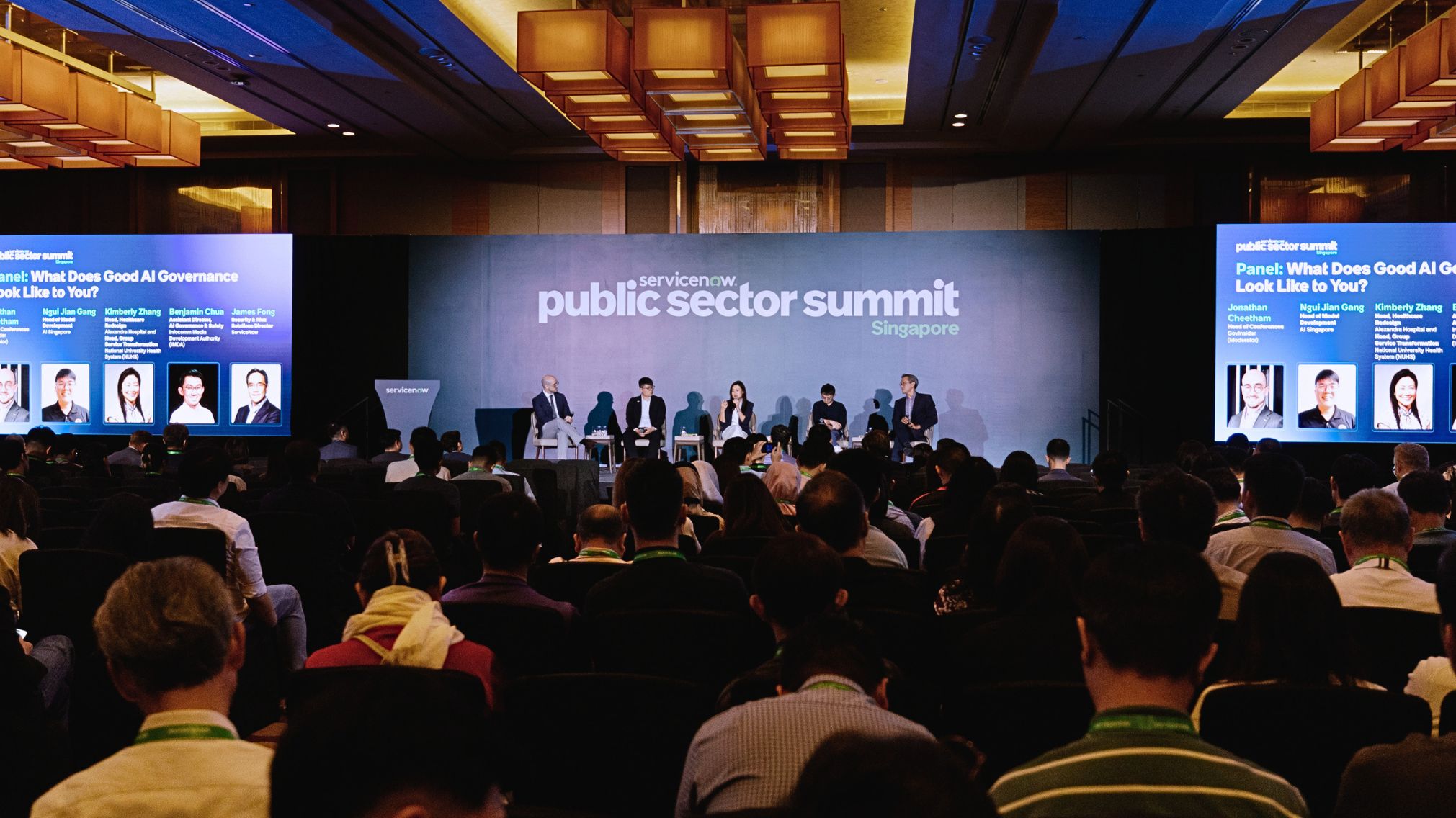
Public sector and technology leaders gathered at the ServiceNow Public Sector Summit Singapore 2026 to discuss how governments can scale and govern AI responsibly. Image: ServiceNow
A fallen tree should be a straightforward problem to solve.
But in government, it could involve one agency responsible for the tree, another for the road it has blocked, and another for clearing the surrounding area.
Though each agency could be made faster using artificial intelligence (AI), it might not make the government’s overall response any more coordinated.
The example, raised at the ServiceNow Public Sector Summit Singapore 2026, points to a bigger challenge as governments move towards agentic AI: what happens when multiple AI agents, workflows and government systems have to work together?
Coordinating these systems becomes even harder when organisations lack visibility over the AI agents already operating within them.
Data shared by Amit Zavery, president, chief product officer, and chief operating officer of ServiceNow, during his presentation showed that 82 per cent of organisations have discovered AI agents their IT teams did not know existed.
Additionally, 60 per cent did not have the ability to shut down some systems once they were running.
When individually functioning agents fail together
AI governance has largely focused on individual systems. However, new layers of risk are created when individually functioning agents are connected.
As such, the “unit of analysis” governments use may now need to go beyond a single model as AI develops into systems of multiple agents working together, said Benjamin Chua, assistant director for AI Governance and Safety at Singapore's Infocomm Media Development Authority (IMDA).
Multi-agent systems introduce the possibility of “collaboration failures”, including miscoordination, conflict, and even collusion between agents.
Miscoordination could occur when two agents interpret the same objective differently, while conflict could arise when agents have legitimate but competing goals.
Chua gave the example of a customer-service agent designed to resolve complaints, that encountered a revenue-protection agent instructed not to issue refunds above a certain threshold.
Neither agent necessarily has to malfunction for the system to produce a problem.
The problem is part of a broader AI “blind spot”, characterised by AI sprawl and a lack of visibility, governance, audit trails and guardrails, according to ServiceNow’s technology workflow, security and risk solutions leader for Asia, James Fong.
“Once they get running, you have no idea what they’re doing, and they’re doing it at a machine speed that humans cannot react or keep up with, and there’s no clear ROI associated with that,” said Zavery.
The governance challenge is therefore bigger than whether an individual AI model produces the right answer.
Agencies also have to understand which agents are operating, what they can access, how they interact, and what happens when their instructions collide.
AI is running into government's old silos
But agentic AI did not create these boundaries. Governments have spent years trying to connect services across organisational silos; AI agents are now being asked to operate across them.
Citizen services already show how a seamless digital experience can already mask fragmentation behind the scenes.
While governments may provide citizens with a single digital “front door” to access services, resolving a request can still require officers behind it to navigate multiple systems and agencies, shared Prem Ganesan, head of CRM & industry solution sales for Asia, India and Korea at ServiceNow.
Connecting agents without addressing the underlying workflows, risks making fragmented processes faster rather than connecting them.
Deterministic government processes may thus become more important in an agentic world.
Traditional workflows can provide predictability over what happens next and under what conditions. AI agents can instead handle ambiguity, interpret free-form requests and make recommendations.
“The true value is when both actually combine,” said Joseph Tan, deputy chief information officer at HTX.
Combining the two could allow AI agents to handle ambiguity and make recommendations while deterministic workflows constrain how consequential actions are executed.
Alongside deterministic execution, AI needs organisational context too, such as the relationships between assets, people, services, dependencies and policies, said Zavery.
Without that context, connecting more intelligent agents does not necessarily produce a more coordinated system.
Governance has to follow the whole system
If risks can emerge through interactions between agents and systems, governing each AI model only when it is approved or deployed may no longer be enough.
Agencies may increasingly need to track what happens between systems over time.
Singapore's broader approach to technology governance is already moving in this direction.
Changes to the government's Instruction Manual 8, or IM8, have given agencies greater flexibility in developing lower-risk systems, while initiatives such as GovAssure aim to make assurance more continuous.
That shift becomes particularly important for AI systems whose risks can change after deployment as they encounter new data, systems, and other agents.
Check and balances should remain embedded in workflows even after an AI tool is deployed, rather than treating governance as a one-off hurdle before deployment, stressed Kimberly Zhang, head of group service transformation at the National University Health System.
The emergence of multi-agent systems means governments may ultimately need to rethink not only what they assess, but also how they assess risk, added Chua.
For governments, agentic AI could therefore make an old digital-government objective much more urgent: building services around the whole journey rather than individual agencies and applications.
The next major AI failure may not come from one rogue model making an obviously wrong decision.
It may come from several systems doing exactly what they were designed to do, only to discover that government never designed them to work together.