
The rise of interoperable digital ID systems in Latin America
The digital ID system of Uruguay and neighbouring countries has been responsible for a parallel rise of sovereign digital ID brokers that are helping to connect the digital ID systems across Latin America.
In Uruguay and Brazil, progress has been made towards integrating both national digital ID systems. This is how digital ID brokers emerged in the region. Image: Canva
This is the first of a two-part story on interoperable digital ID systems in Latin America. The second part of the story can be found here.
In 2023, G20 leaders defined Digital Public Infrastructure (DPI) as “a set of shared, secure, and interoperable digital systems, built on open technologies, to provide equitable access to public and/or private services at a societal scale”.
DPI has been an accelerator for achieving the 17 Sustainable Development Goals (SDGs) adopted by all United Nations member countries in 2015, as part of the 2030 Agenda for Sustainable Development.
The development of DPI is a critical factor in improving people's quality of life.
DPI comprises fundamental digital technologies, systems, standards, and services, and is based on three pillars: digital identification, data interoperability, and payment methods.
During the pandemic, many people who needed to resolve their needs in Uruguay, such as foreign property or business owners, were unable to come to the country in person.
If they attempted to provide services digitally, they lacked reliable Uruguayan digital IDs or methods to validate their identity. This highlighted the need to evolve the use of digital IDs, just as traditional ones have been used for many decades.
Instead of requiring a foreigner to obtain an account with a Uruguayan ID provider, they should have been able to use a reliable digital ID from their country for Uruguayan digital services.
Based on this situation, a cross-border plan was developed to move forward in this direction, under the concepts that govern DPI.
Rising trend of integrating digital ID systems
For several years, various digital services on the Internet have been integrating ID providers, delegating user identification to them. Similarly, large hubs of user credentials have begun positioning themselves as digital ID providers.
Today, it is possible to access Spotify, Booking.com, and many other digital portals and services using an account (ID) from Google, Apple, LinkedIn, or Facebook, among others. This trend has simplified and reduced risks in the digital world.
Some countries have been developing unified digital ID services, some known as "single account" services, under the vision of a national digital ID system.
In Uruguay and Brazil, progress has been made toward integrating both national digital ID systems. This is how digital ID brokers emerged in the region, particularly ID Uruguay.
The cross-border collaboration was inspired by the regulatory framework and best practices promoted by the European Union and the US National Institute of Standards and Technology (NIST).
What’s a digital ID broker?
A digital ID broker is a platform that positions itself between digital systems and digital ID providers suitable for its ecosystem. The following diagram illustrates this situation in a simplified form:
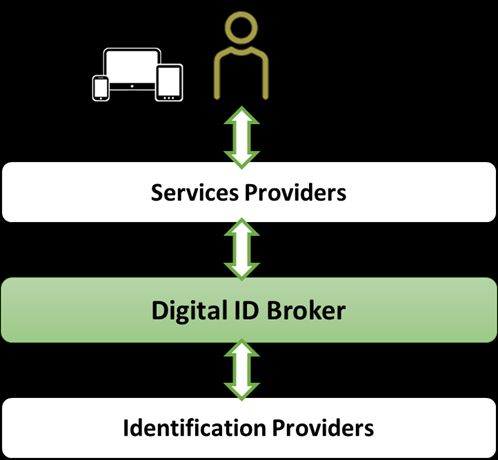
A citizen who needs to access a digital service in the ecosystem chooses an ID provider through the broker, digitally identifies themselves with their provider, and returns to the service, accessing their personal information.
The services delegate the digital identification (or authentication) of individuals to the providers integrated with the broker.
To subscribe to the GovInsider bulletin, click here.
In this way, an individual's digital ID is unique throughout the ecosystem, as is the case with traditional IDs.
Furthermore, the broker acts as a single sign-on, meaning it maintains the active session for all integrated services, avoiding the user having to identify themselves for each service.

In Uruguay, ID Uruguay has been operating as the broker since 2018 and currently has four digital ID providers regulated by the Electronic Certification Unit (UCE), which manage three levels of trust or security in digital ID:
Basic: A user registered online, validated their account from their email, and the system performed some simple checks, but there is no guarantee that the person is who they claim to be since their identity has not been validated. When they identify with themselves digitally, they use their username and a strong password.
Intermediate: A user who initially registered as a basic user and validated their identity through an authorised means (in person, via video call using facial biometrics, or using a digital signature). When they identify with themselves digitally, they use their username, a strong password, and a second authentication factor.
Advanced: A user who registered with a provider in person and had their fingerprint biometrically validated against the public registry. The registration expires, so it must be renewed periodically.
When they identify with themselves digitally, they do so by using a digital certificate recognised by the National Public Key Infrastructure, using the advanced electronic signature for digital identification.
This level, according to Uruguayan regulations, is considered equivalent to in-person access.
The growth of Uruguayan digital ID ecosystem
Currently, more than 190 services, portals, public agencies, and digital systems, both for citizens and for internal government management, are integrated into ID Uruguay.
On average, more than 90,000 identifications were performed daily on business days (Uruguay has a population of 3.5 million). For the past year, the use of the advanced level has surpassed the basic level, achieving greater security and trust in digital identification across the entire ecosystem.
The ID Uruguay ecosystem has grown rapidly in recent years.
In 2021, six million authentications were performed through ID Uruguay.
By 2022, it had grown by more than 50 per cent, reaching more than nine million authentications, and in the last year (2024), 17 million digital authentications were performed.
Of those 17 million, 30 per cent used the advanced level, providing complete trust for both parties.
The next part of this article will discuss how ID Uruguay is being integrated with similar systems in Brazil and other countries in Latin America to provide a seamless service to residents of the region, allowing them to access services in each other’s countries.
-----------
The author is the Digital Identity Manager at AGESIC, the Govtech agency of Uruguay. He is responsible for developing the national digital identification and signature platforms in collaboration with the national ecosystem.