
Tiffany Nguyen Phuong Thanh, Senior Staff Nurse (Nursing Informatics), Tan Tock Seng Hospital, NHG Health, Singapore
Meet the young public sector officials in the inaugural Young & Official Report 2026.
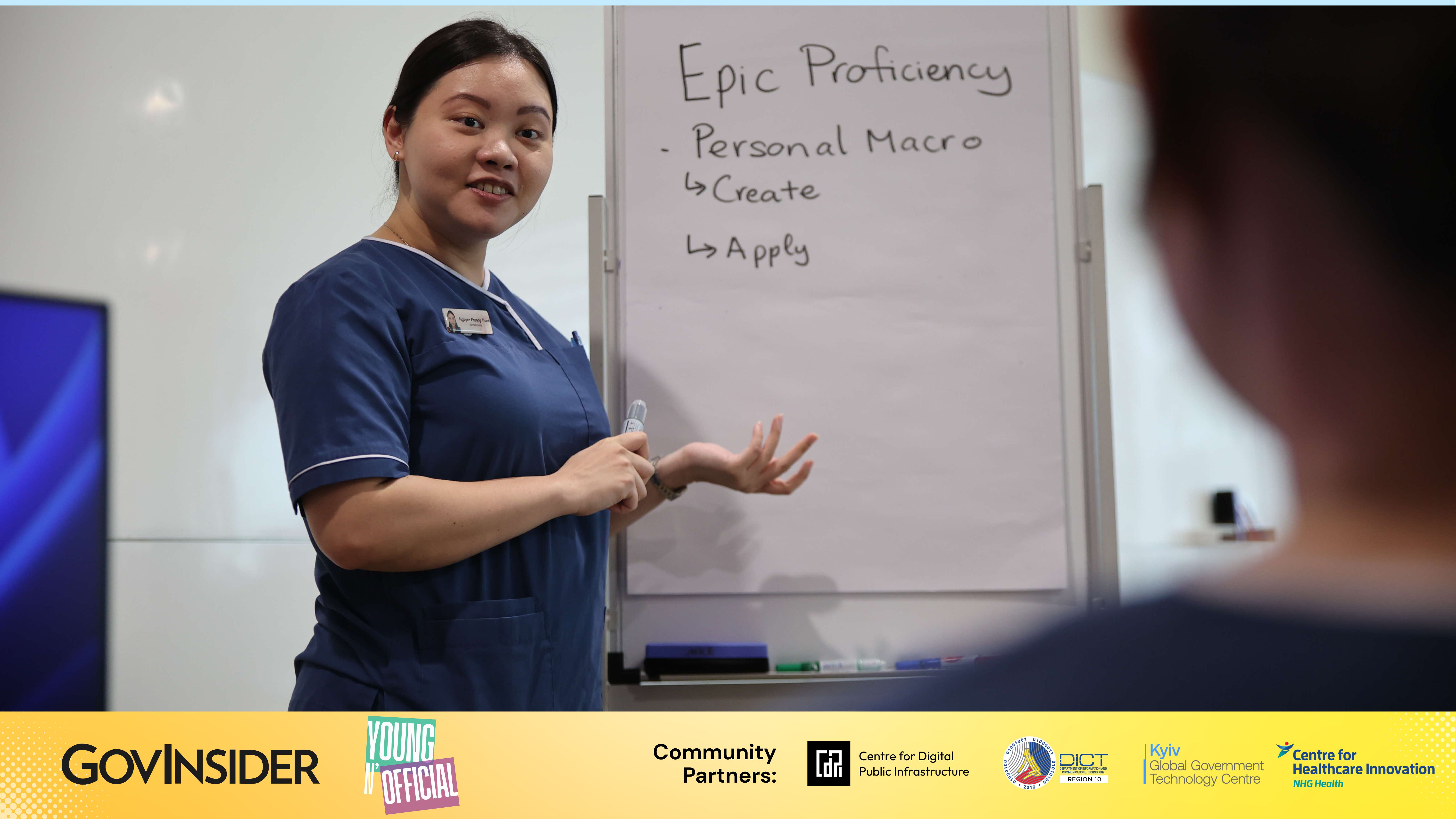
Tiffany Nguyen Phuong Thanh, Senior Staff Nurse (Nursing Informatics), Tan Tock Seng Hospital, NHG Health, Singapore. Image: NHG Health.
1) What does public service mean to you? Can you share more about your role in the public sector?
Public service, to me, is the privilege of contributing to something larger than myself, where the impact of the work is felt not in metrics alone, but in the lived experience of every patient and every nurse on the ground.
I am a hybrid clinical and nurse informaticist. My time is split between the ward, where I practice as a nurse, and my work as an informatician, where I enhance our electronic medical record system, support clinical data extraction and analysis, and empower the nursing community through technology literacy and workflow efficiency.
2) Tell us about a project you championed. What impact did it have on the community?
A project close to my heart is an evidence-based educational series designed to enhance nurses’ efficiency in using the electronic medical record system.
The system is rich with efficiency features that often go undiscovered by busy ground users. The series was grounded in efficiency data from the prior year, combined with our team's clinical and system knowledge, delivered through multiple learning formats tailored to the nursing community's diverse needs.
The programme catered to 3,000 inpatient nurses. Participants told us they discovered capabilities in the system they had never known existed, and over time, we observed measurable reductions in time spent on system use and time returned to patient care.
Beyond this, my work spans other areas such as helping clinicians gain access to meaningful clinical data, querying and analysing clinical databases to surface insights that guide evidence-based care decisions, as well as collaborating with clinicians and technical teams to enhance the system as healthcare itself evolves, ensuring new capabilities are woven in in ways that genuinely serve the people using it.
In all of this, the role is the same: a bridge between clinical reality and technical possibility.
3) As a young professional, how has your unique background or perspective allowed you to identify a solution that others in your organisations might have overlooked?
The dual nature of my role gives me a vantage point that is difficult to replicate. What might appear to a purely technical team as a minor system quirk often registers to me as a meaningful friction point, because I have encountered it myself, on a shift, mid-documentation.
Equally, being present on the ground gives me a real understanding of my audience: what matters in nursing's daily workflow, what language resonates, and how to reach nurses in a way that feels relevant rather than prescriptive.
Technology adoption is also about whether the people it is built for can see themselves in it and bring it to life. That connection between a builder's intent and a user's reality is something I am well positioned to tend to.
4) How do you balance the rigour that patient safety demands with the openness to experiment and innovate?
Safety and innovation in healthcare are complementary, and the pandemic made that clearer than ever.
The work of ensuring patient safety is held collectively across clinicians, administrators, informaticians, and many other stakeholders, each stewarding a different dimension of care.
Within that structure, there is more room for thoughtful experimentation than people often assume. New ideas are welcomed when they arrive with appropriate safeguards and are shaped by collective expertise. Innovation, to me, means moving with purpose, in partnership, and with a clear view of who the work ultimately serves.
5) If you had just one area to invest in to accelerate transformation in the public sector (regulation, technology, talent, etc.), which one would you choose and why?
Talent.
There is a misconception that the rise of technology and AI will diminish the human element in healthcare. But if anything, the opposite is proving true. Greater capability tends to generate greater demand, and in healthcare, that demand is increasingly for what is irreplaceable: human judgement, compassion, and presence.
Healthcare is, at its core, a deeply human endeavour. Investing in talent, in equipping and empowering the people who make up the sector, yields compounding returns. Technology and infrastructure matter enormously, but without the right people to wield them purposefully, their potential remains unrealised.
6) What is your greatest ambition as you grow in your public service career?
I aspire to be part of a nursing community where every nurse is technologically enabled, where data-driven thinking and a spirit of innovation are simply part of what it means to be a nurse.
In this envisioned community, innovation is not confined to the creation of new technology. It encompasses new methodologies, new ways of knowing, and new approaches to care delivery. I wish to see nurses pushing the boundaries of what is possible simply because they are equipped and inspired to.
And I hope the healthcare system we build this within is a robust, humane, and resilient one, where individualised care is afforded not only to the patients it serves, but to the people working within it.
7) What is a “universal value” that connects everyone in your department – from interns to directors – and how do you use that to drive collaboration?
Compassion for our patients.
Regardless of role or seniority, there is a shared and deeply felt commitment to quality care. That common ground makes collaboration less of a managed process and more of an instinct. When everyone is oriented toward the same patient, the work finds its own cohesion.
8) What is a myth you wish to debunk about young public servants, and what is the best piece of advice you’ve got for the next generation of public servants?
A common myth is that public sector work is predictable, or that roles within it are fixed. My own position is evidence to the contrary. What I do today emerged from a confluence of need, technology, and a willingness to work at intersections that had not yet been named by the leaders before me.
To the next generation: the roles that will matter most in the coming decade may not yet have names. The challenges that will need solving have not fully emerged. What public service asks of you is not certainty, but curiosity and commitment to the people your work is ultimately for. More than ever, this is the right time to step forward and help define what public service can look like.
9) Write a letter to your future self in 2035. Please keep it within 200 words.
Dear future me,
By 2035, the question will no longer be whether technology and artificial intelligence (AI) belong in healthcare; it will be whether we have built it right.
Predictive analytics is moving from retrospective reporting to anticipating patient deterioration. Clinical decision support is shifting from static alerts to contextual, real-time guidance embedded in the workflow of care. The gap that will define the next decade may not be a technology gap, but a translation gap, and that is where nurse informaticists (like us) will matter most.
By now, I hope we have closed more of that gap. I hope the nursing community has moved from being consumers of technology to genuine architects of it, shaping not just how systems are used but how they are designed, what they prioritise, and whose needs they centre.
I hope the ground nurses I worked alongside are not just more efficient, but more empowered, more data-literate, and more confident that the systems around them were built with their reality in mind.