
Video: The problems that brought GovTech Indonesia's design head to government
The success of government digital transformation depends not only on technology, but also on better service design, says INA Digital Edu’s Lody Andrian.
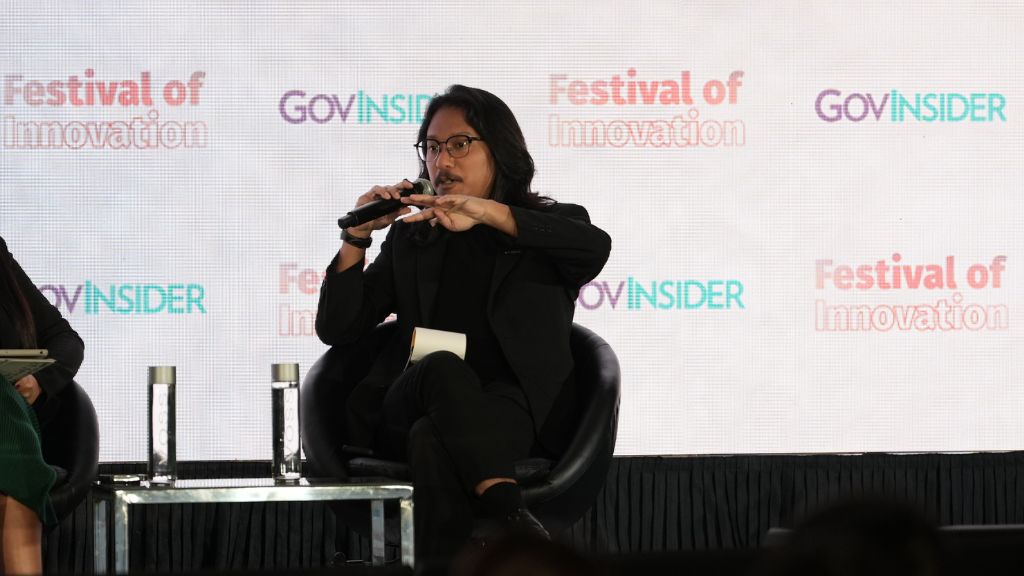
At recent GovInsider’s Festival of Innovation 2026, INA Digital Edu’s Head of Design and Research, Lody Andrian, shared why governments must shift from simply building systems to delivering services that truly work for citizens. Image: GovInsider
Design is often understood as focusing more on visual appearance and aesthetics.
In digital public services, however, design plays a major role in determining the ease of access for citizens.
INA Digital Edu’s Head of Design and Research, Lody Andrian, noted that design should be the critical foundation of every government digital service.
“We are not talking about graphic design or visual design alone, but also product design and service design that shape public services,” he said.
Speaking on the Civic Punks’ podcast during GovInsider’s Festival of Innovation (FOI) 2026, Andrian explained how a design-led approach helped governments build digital services that were more effective, user-friendly, and responsive to citizen needs.
Supporting public sector transformation
Andrian was drawn to INA Digital Edu by challenges he had never encountered in the private sector; problems that were unique to government.
Before joining the public sector, he had worked at the World Bank, United Nations agencies, and in digital consulting firms.
INA Digital Edu was part of Peruri, Indonesia’s GovTech agency, and it worked with the Ministry of Primary and Secondary Education to develop the country’s digital education ecosystem.
In his current role, Andrian led a team of 22 designers, researchers, writers, and visual designers developing digital initiatives for teachers, students, local governments, and parents.
The team also managed the foundations of design systems, design principles, and UX writing guidelines.
He said working in the government presented very different set of challenges from those found in the private sector.
“Some of the government apps and digital services are very scattered, overlapping, and not connecting to each other. That was the first problem we identified,” he said.
The challenge was compounded by the continued use of legacy systems. Many functions and services were already there, but they were not utilised to their full potential.
As a result, a key part of his work involved mapping existing systems, identifying gaps, and understanding unmet user needs.
For Andrian, these challenges were precisely what made working in the public sector exciting.
“There is a great opportunity for designers, researchers, and creative practitioners to really push the limits in the public sector,” he said.
From building systems to delivering services
Andrian highlighted that the greatest challenge in government’s digital transformation was not tech itself, but changing mindsets.
For years, many government agencies have focused on building systems rather than delivering services to citizens.
“We are trying to shift from building systems to delivering services,” he said.
This was where design became critical.
Rather than focusing solely on technology features, the INA Digital Edu team promoted co-creation and in-depth research when designing services. They believed good design should be rooted in a deep understanding of citizens’ behaviour and needs.
Bad design, on the other hand, could impose significant costs on the public sector, from additional training and outreach efforts to increased complaints from citizens.
To drive change, he advocated a simple approach.
“The first thing is very simple: establish practical design principles that are repeatable and actionable,” said Andrian.
Decision-makers may not always read lengthy research reports or understand complex service blueprints, but consistently applying simple principles could gradually change the way organisations design services.
One example was the need to balance speed with reassurance in government digital services.
“When using a government application, what people need is not always a faster process, but confidence that every step they take is correct. These services deal with identity, money, and many other important matters,” he said.
Looking ahead, Lody saw a growing awareness among local governments about the value of design and product thinking in public services.
He was optimistic that these practices would move beyond specialist teams and become embedded within the way government institutions operate.
“I’m really hopeful that this approach becomes more embedded in their own processes. It’s not about following our exact process; it’s about adapting it in a way that works for them,” he added.
You can watch the full video below: