
Why the AI-driven future requires institutional builders, not technologists
The defining leadership crisis of the next decade will not be a lack of technological capability. It will be a profound and pervasive failure of imagination.
-1781660478522.jpg)
The arrival of an AI-driven world does not demand that leaders become chief technologists, but institutional builders who can design organisations fit for an entirely new era. Image: Canva
In corporate boardrooms, public sector corridors, and international institutions, leaders are moving with frantic urgency to integrate artificial intelligence (AI) into their daily operations.
Billions of dollars are being deployed, task forces are being assembled, and software suites are being upgraded.

Yet, beneath this hyper-activity lies a fundamental flaw. The question that executives are universally asking - “How do we use this new tool to do what we currently do, just faster and cheaper?” - is misdirected.
This mindset is a dangerous, seductive trap.
It operates on the flawed assumption that AI is merely an instrument for optimisation - a slightly
better bulldozer or a faster typewriter.
But forcefully overlaying advanced cognitive capabilities onto an outdated, analogue organisational structure does not create a future-ready enterprise.
It simply creates a slightly faster dinosaur.
The real challenge of our era is not technical adoption; it is structural reimagining.
The arrival of an AI-driven world does not demand that leaders become amateur data scientists or chief technologists.
Instead, it demands that they step into their true mandate: becoming institutional builders who can design organisations fit for an entirely new era.
The operator trap: The comfort of "doing"
Over three decades of observing, advising, and analysing large-scale institutional transformations globally, I have witnessed a recurring pathological pattern.
Brilliant professionals rise to the pinnacle of leadership because they are exceptional operators. They are celebrated for their ability to execute tasks, navigate existing hierarchies, manage budgets, and put out immediate operational fires.
Their entire careers have been a testament to the power of "doing".
Yet, when confronted with a paradigm shift, this deeply ingrained operational focus ceases to be an asset. It becomes their greatest liability.
Leaders are psychologically wired to find comfort in execution.
Checking boxes, resolving localised disputes, and diving into the weeds of a project provide an immediate, tangible sense of productivity. It delivers a dopamine hit that strategy rarely offers.
In contrast, thinking deeply about long-term structural alignment feels abstract, slow, and uncomfortably quiet.
Consequently, when faced with the anxiety of a massive technological shift like AI, many leaders default to what they know best: they get busy.
They micro-manage the procurement of software, attend endless product demonstrations, and demand weekly updates on pilot projects.
But if a leader’s calendar is entirely consumed by the immediate, the tactical and the urgent - in other words, if they are too busy in the "doing" - then they have stopped leading.
They have allowed themselves to be reduced to super-operators.
In doing so, they inadvertently transform into the ultimate bottleneck of their organisation.
While they are busy steering the ship by pulling every individual rope, no one is watching the horizon and charting the course through uncharted waters.
Shift in altitude: From operator to builder
True leadership in an era of exponential change requires moving away from the mechanics of execution and stepping upward into the realm of institutional architecture.
To navigate this transition successfully, leaders must abandon the illusion that they need to understand the intricate mathematical algorithms powering the modern world. They do not.
A premier developer knows how to write the code; an exceptional engineer knows how to deploy the platform.
A leader’s responsibility is entirely distinct: they must understand the implications of the technology, not just its applications.
This requires a mental evolution from an operator of the present, to a builder of the future.
Institutional builders do not concern themselves with automating existing tasks. Instead, they apply design thinking and strategic foresight to ask a completely different set of questions:
- If we were building this institution from scratch today, knowing what technology can achieve, what would it look like?
- How does our core purpose manifest when human cognitive limitations are no longer the primary constraint?
- What structural barriers are preventing our organization from operating with fluidity, intelligence, and speed?
This is not a passive or academic exercise.
It is the hard, often highly resistant work of dismantling silos, rewriting organisational charts, and altering the flow of power and information within an institution.
The three pillars of modern institutional design
To move beyond the rhetoric of transformation and actually build a future-ready enterprise, leaders must focus their energy on three core pillars of institutional design.
1. Structural fluidity over hierarchical silos
Traditional institutions are built like fortresses, rigid, vertical, and highly siloed.
This design was highly effective in the industrial era, where the goal was predictability and the containment of information.
In an AI-native world, however, data is the lifeblood of the organisation. If data is trapped within departmental walls, the institution remains blind.
Institutional builders do not just buy software; they redesign the organisational blueprint to ensure data liquidity.
They tear down artificial boundaries between departments, creating a cross-functional architecture where information flows seamlessly to where it is needed most.
That is, they replace the rigid pyramid with a fluid network.
2. Guarding cognitive bandwidth
The most scarce and valuable asset in any modern organisation is not capital; it is executive cognitive bandwidth.
When leaders are bogged down in operational details, their mental energy is depleted. They lose the capacity for deep thought, nuance, and long-term reflection.
A builder intentionally designs systems that filter out the noise.
They leverage automation and trusted governance structures to handle routine operational decisions, intentionally preserving their own mental space - and that of their senior teams, to look around corners, anticipate societal shifts, and manage complex geopolitical or market risks.
3. Cultural autonomy and the subsidiarity principle
When leaders act as operators, they inadvertently breed a culture of dependency.
Teams stop thinking for themselves and instead wait for instructions from the top, slowing down the entire organisation.
The institutional builder counteracts this by embedding the principle of subsidiarity: ensuring that decisions are always made at the most immediate or local level consistent with their resolution.
By setting a strategic vision and designing clear ethical and operational guardrails, the leader can safely grant immense autonomy to their teams.
The leader’s job thus shifts from approving decisions to coaching the decision-makers.
The fallacy of incrementalism
The greatest resistance to this style of leadership comes from the advocates of incrementalism.
Skeptics will always argue that tearing down legacy structures is too risky, too expensive, and too disruptive.
They advocate for a safer, gentler path: making small, iterative adjustments to the existing model.
While incrementalism is a valid strategy during periods of stability, it is a guaranteed recipe for obsolescence during a period of exponential change.
You cannot cross a chasm in two small jumps. Trying to fix a fundamentally analogue institutional model by adding a layer of advanced technology is like putting a jet engine on a horse-drawn carriage.
The carriage will not become a jet; it will simply tear itself apart under the strain.
Managing the friction, anxiety, and inevitable chaos of this structural transition is precisely what leadership entails.
It requires immense courage to tell an organisation that the very habits, structures, and metrics that made them successful in the past are the exact elements that will compromise their future.
The feedback loop: disengagement vs. empowerment
It is vital to clarify a critical distinction: stepping back from the "doing" is not an invitation to hands-off abdication.
There is a profound difference between an empowered organisation and a neglected one.
Strategy is ultimately expressed through execution decisions.
A leader who completely detaches themselves from the ground reality becomes an isolated figure in an ivory tower, drafting elegant visions that fail the moment they touch the real world.
The institutional builder does not disengage from the work; rather, they fundamentally alter their relationship with it.
They replace direct, micro-managed supervision with a robust, systemic Strategic feedback loop.
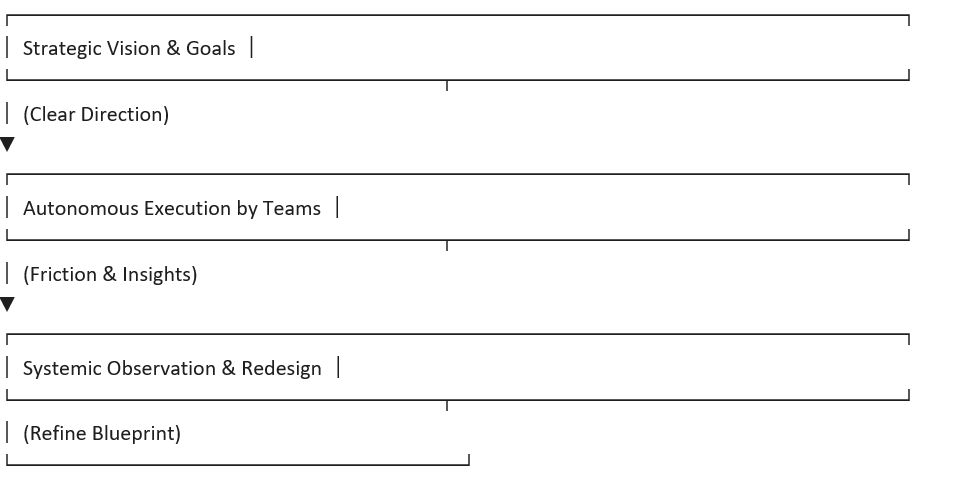
They stay close enough to the frontline to actively observe operational friction, feel the institutional tremors, and listen to their teams.
However, instead of diving to personally fix the localised problem, they step back up to the blueprint level to redesign the system that allowed the friction to occur in the first place.
They do not solve the mistake; they re-architect the environment to prevent the mistake from being repeated.
A call for institutional visionaries
We must stop treating this era of profound digital and technological advancement as an IT project.
It is a societal, cultural, and institutional revolution.
The technology is no longer the limiting factor.
The algorithms are already sophisticated enough. The computational power is readily available. The infrastructure is maturing daily. The true bottleneck is, and remains, human leadership.
The future belongs to the leaders who have the discipline to step away from the comforting routine of daily execution, the resilience to withstand the gravitational pull of the weeds, and the imagination to build entirely new institutional architectures.
The question facing modern executives is no longer about what technology to buy, but who they intend to be.
Will you remain an operator of a fading paradigm, or will you become the builder of the institutions of tomorrow?
The views expressed in this article are those of the interviewee and do not reflect the official views of the Pakistan Digital Authority.
---------------------------------------
Mohammad J. Sear serves as a Member and the Vice Chairperson of the Pakistan Digital Authority (PDA). He has over 25 years of experience advising governments and organisations globally on digital transformation. His expertise spans 12+ years in the UK government (under Thatcher, Major, and Blair), leadership as a senior partner of digital government and startup practices for a global consultancy in the MENA region. He has published four books called "Becoming Digital Nations – reimagining countries for the digital era", AI Native Government, Digital Society, and Digital Economy - the battle ground of the digital era”