
With the vendor saying ‘no’, Thai civil servant built his own tools
Digital Economy Promotion Agency (DEPA)’s Senior Expert in Smart City Promotion, Non Arkara, shares how AI and low-code tools have empowered him to build his own tools and the implications for emerging digital governments.
-1778029635661.jpg)
Thailand's story is one of those featured in the GovMesh Digest special report
Thailand's story is one of those featured in the GovMesh Digest special report. You can find the individual stories on the other participating governments at GovMesh 4.0 here.
The first time he approached a software house to build a citizen complaint dashboard, they passed. The second time also, they passed again.
The third time, the answer was the same.
The reason: Government contracts don’t pay well enough, and there was better work elsewhere.
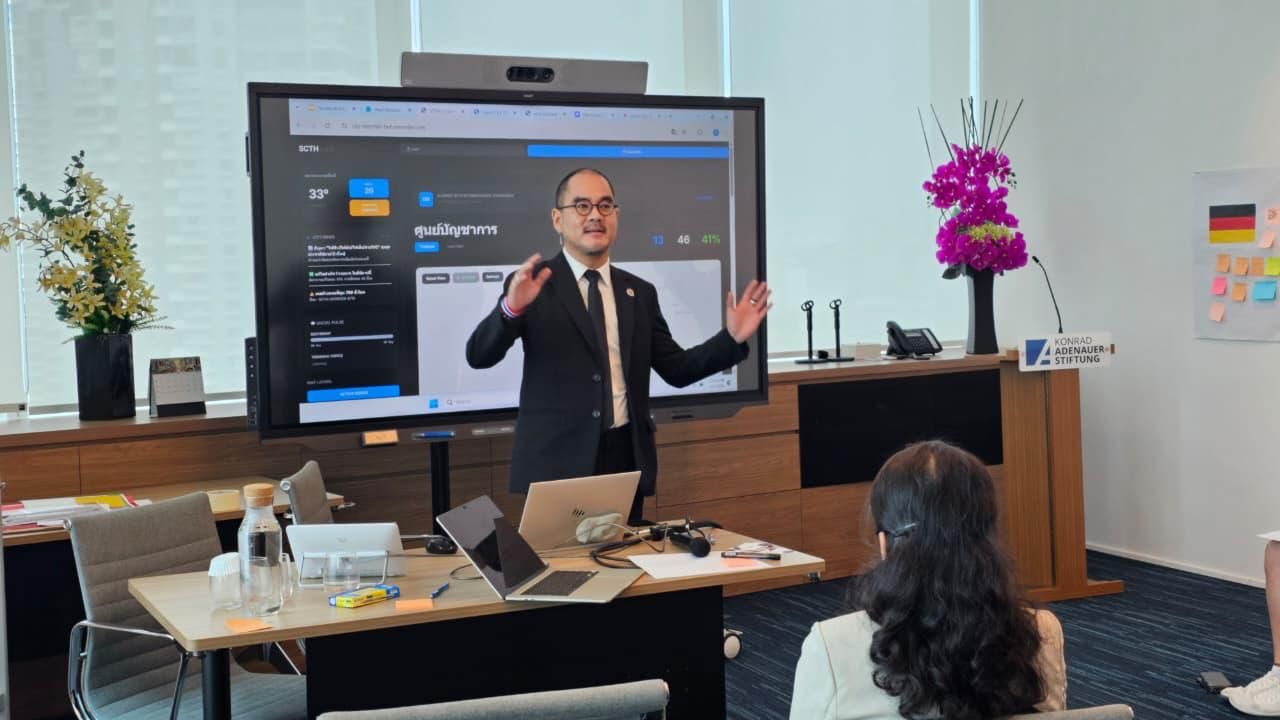
Not one to take “no” for an answer, Thailand’s Digital Economy Promotion Agency (DEPA)’s Senior Expert in Smart City Promotion, Non Arkara, built it himself.
Speaking at the GovMesh 4.0 event, co-organised by GovInsider and interweave.gov, Arkara admitted that he was not a professional software developer; rather he trained as an architect.
With some working knowledge of Python, JavaScript and using a couple of free ecosystems from Google, he built a suite of digital tools that now serving thousands of users across Thailand and Southeast Asia.
His journey pointed to a structural problem that emerging governments around the world must reckon with: When tech talent flows out of the public sector and procurement rules continue to slow things down, what gets built?
Building the tool the market won’t
Arkara’s agency needed a system to allow citizens to report infrastructure problems, but no vendor would take it on at the price or pace that worked.
This got him to look at everyday tools citizens already use, such as messenger apps like LINE, WhatsApp, and Telegram, as well as building a unified backend system that automatically extracts key information to route real problems and filter trolls.
His effort has paid off. While previously Arkara’s team used to get around 10 queries a day, they now receive around 2,000 per day through this system.
For the civil servants, he has created a dashboard that lets them categorise the complaints, assign them to the right teams and send status updates to citizens, all in one click.
This turned a simple reporting tool into a full feedback loop.
Laying artificial intelligence (AI) on the system has also allowed civil servants to analyse the resolution times, workloads, and overall team performance, later then tying these metrics to staff incentives.
Arkara has open-sourced the whole stack, instead of monetising it.
“I decided to open-source it completely... it's better to give it away for free.
“We live in a world where if we just keep it to ourselves, patent everything proprietary, we're not going to get different government,” he said, effectively turning this from a one-off solution into a replicable public infrastructure.
In another interview with GovInsider, Arkara also shared about introducing the Innovation-as-a-Service model to local governments in Thailand and ASEAN, as a means to tackle resource constraints and rigid, pre-made solutions offered by the market.
A model to follow, or simply a workaround?
The deeper question hidden behind Arkara’s initiative was whether a bottom-up movement, powered by low/no-code tools and AI, represented a model to be encouraged across public service, or should it be seen as a workaround that masks a problem that governments should be fixing at the root.
What does it take for governments to build sustainable digital infrastructure?
On one hand, what Arkara has done, at very low cost, demonstrates that govtech implementation is possible even in environments where formal digital capacity is thin.
On the other hand, the tools built by one talented and motivated person, or even a team, may not survive his departure or make a digital government strategy.
While his approach worked, it also underscored a tension that Arkara does not shy away from.
“I'm operating as a one-person service for now,” he said, adding that cybersecurity hardening, formal authentication and team oversight are under his purview.
Responding to an audience's question about data quality and the reliability of underlying data feeding the dashboards and tools, Arkara emphasised the importance of human review and continuous usage to determine the data quality.
What Thailand’s experience makes clear is the gap between what governments need and what the market will supply.
How public agencies respond to the gap, whether by revamping procurement rules, building in-house tech capabilities, or simply relying on the individual’s initiatives, will shape the quality of public services for years to come.
Read more: Low-code powers a sailor-led digital transformation across the Singapore Navy, March 11, 2026