Joyce Lau, Project Manager, North Development Office, Civil Engineering and Development Department, Hong Kong
By Si Ying Thian
Meet the Women in GovTech 2025.
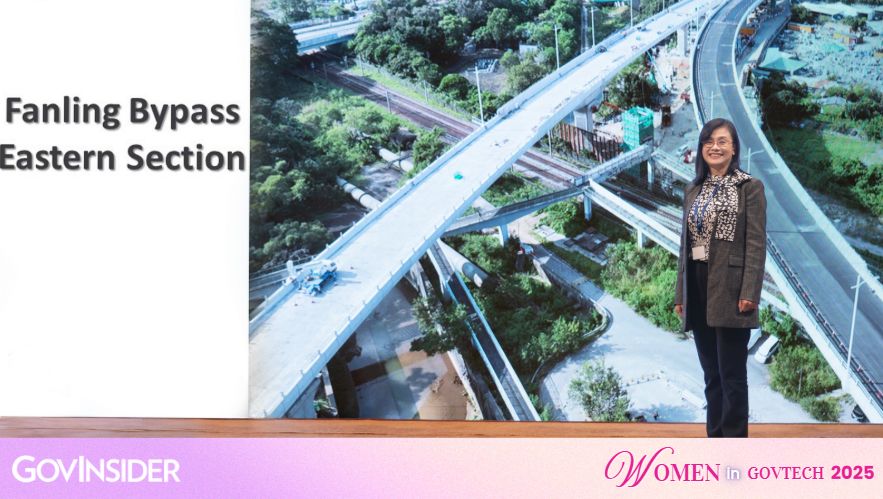
Joyce Lau, Project Manager, North Development Office, Civil Engineering and Development Department, Hong Kong, shares about her journey.
1) How do you use your role to ensure that technology and policy are truly inclusive?
As a Project Manager for the North Development Office in the Civil Engineering and Development Department, I lead multi-disciplinary teams to deliver mega land development and infrastructure projects for Hong Kong’s Northern Metropolis.
This unprecedented initiative spans 30 000 hectares, with 3 000 hectares of developable land. It will house 2.5 million people - nearly one-third of Hong Kong’s current total – solidifying the city’s role as an international innovation and technology centre.
My role is to steer these projects toward making Hong Kong a world-class sustainable and resilient city, by leveraging construction technological innovation within the people-centric principle.
2) What’s a moment in your career when you saw firsthand how technology or a new policy changed a citizen’s life for the better?
A powerful example was the construction of the Fanling Bypass Eastern Section over the East Rail Line, using an innovative bridge rotation technique.
Traditional methods would have required over 100 nights of work across two years. Instead, we rotated the viaducts into place in just two nights.
The public benefits were immediate and profound: the construction period was dramatically shortened by about one year. This meant less noise, fewer traffic disruptions and enhanced construction safety.
This achievement exemplifies how technology, combined with a collaborative New Engineering Contract (NEC) spirit, delivers tangible positive impacts for the community.
3) What was the most impactful project you worked on this year, and how did you measure its success in building trust and serving the needs of the public?
Beyond the Fanling Bypass Eastern Section, our key achievements this year include:
- Spearheading the world’s first application of S960 ultra-high strength steel in two footbridges. Its exceptional strength-to-weight ratio reduced foundation requirements, minimised utility conflicts on congested roads and led to more efficient and sustainable structures. By codifying this design, we are positioning Hong Kong at the forefront of global material science.
- Championing digital transformation via a centralised digital platform integrating 3D Building Information Modelling, real-time Internet of Things sensors, drone survey and AI. This enables real-time safety and progress monitoring, data-driven decisions and enhanced stakeholder engagement.
- Strengthening project governance under a collaborative NEC approach, augmented by digital contract management and AI-enabled payment systems, we streamlined processes, improved efficiency and minimised disputes.
These achievements have earned numerous awards and, most importantly, positive feedback from our stakeholders and communities, which is the true measure of trust and success.
4) What was one unexpected lesson you learned this year about designing for real people? This can be about a specific project or a broader lesson about your work.
Simplicity and continuous engagement are paramount. In developing digital platforms, we held workshops with the supply chain to understand their needs.
This led us to create user-friendly interfaces for all skill levels and easy-to-understand visual flowcharts to illustrate the workflows.
People embrace technology that simplifies their work, not complicates it. Success depends on user-centric design and clear communication.
5) We hear a lot about AI. What's a practical example of how AI can be used to make government services more inclusive and trustworthy?
We are adopting AI in the following ways to enhance efficiency, safety, and quality:
- Automating contract payment verification to reduce administrative burden and human error.
- Creating a subcontractor rate database to facilitate cost analysis.
- Reviewing draft tender documents and advising on contract issues.
- Conducting regular aerial safety monitoring to identify safety hazards, alert supervisors of high-risk situations and generate reports, enabling a shift from reactive to preventive management.
We are also developing AI in other areas like AI-powered drone technology for tree surveys. Together, these applications make services more trustworthy by ensuring consistency, reducing errors and proactively protecting worker well-being.
To subscribe to the GovInsider bulletin, click here.
6) How are you preparing for the next wave of change in the public sector? What new skill, approach, or technology are you most excited to explore in the coming year?
Leveraging our digitisation, we are developing an automated Programme Management Information System (PMIS) for complex projects.
The PMIS will provide a single source of truth for project performance, enabling faster and data-driven decision-making.
I am excited to see its launch and am confident it will provide significant value.
We will continue cultivating an open-minded and people-centric culture that consistently prioritises public needs while embracing innovation.
7) What advice do you have for public sector innovators who want to build a career focused on serving all citizens?
Success lies in championing both human elements of change and technological innovation.
Adopting innovation requires open-minded leadership and transparent communication to build buy-in.
Sharpen your change management skills to foster a collaborative culture that accelerates decisions and shares risk fairly.
A more responsive and trusted government is built by those who can lead people through transformation, not just manage technology.
8) Who inspires you to build a more inclusive and trustworthy public sector?
I am inspired by my Director, Mr Michael Fong.
His open-minded and collaborative leadership has been instrumental in advancing our vision of people-centric services.
He actively champions innovative construction technologies and has cultivated colleagues that embrace challenges, as evidenced by our world-first application of S960 steel, innovative bridge rotation method and our commitment to digital transformation.
9) If you had an unlimited budget, what would your dream project be?
My dream project would be a city-wide platform to revolutionise public infrastructure management.
Centered on a fully integrated city-scale Digital Twin, it would merge infrastructure, environmental, social, and economic data into a unified ecosystem.
This would empower city planning and management, enhance urban resilience, and provide citizens with accessible information—laying the foundation for a truly smart, inclusive, and future-ready city.
10) Outside tech, what excites you the most?
Beyond technology, my passion lies in fostering collaboration that enables innovation.
I believe in the power of mentoring and communication, particularly for young women in the public sector, as diversity is a key driver of innovation.
I am fascinated by how human values shape technology adoption and am committed to ensuring our services remain people-centric.