
Can a prompting competition unlock public sector AI literacy? GovTech shows how
Prompt Royale, Singapore’s largest public sector prompt engineering competition, engaged over 2,500 officers experiment with a wider range of the government AI products.
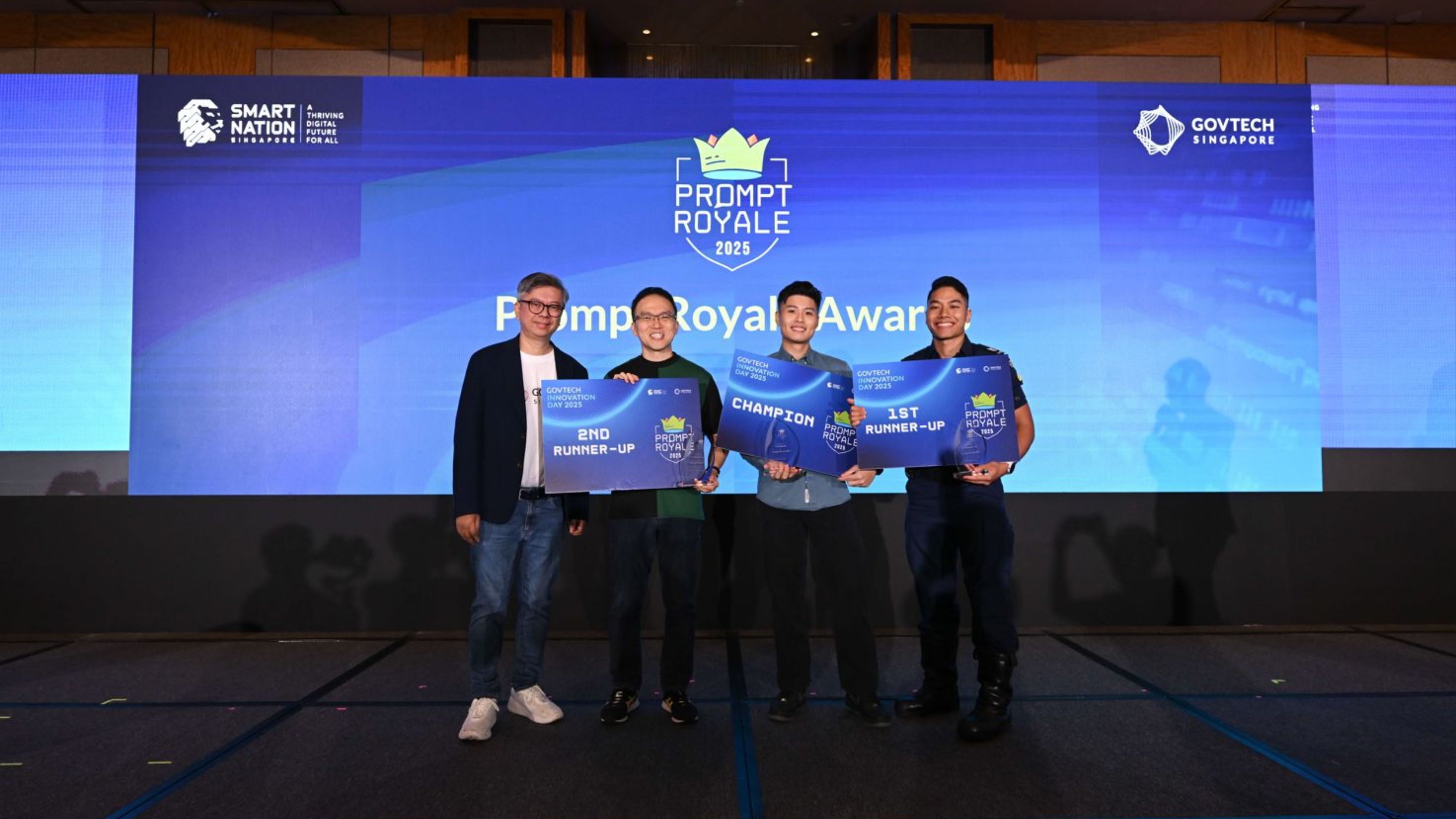
Left to right: GovTech Singapore's Chang Sau Sheong; Ministry of Education (MOE)'s Chua Tung Kian; Housing Development Board (HDB)'s Matthew Lee; and Singapore Civil Defence Force (SCDF)'s Aniq Azman. Image: GovTech Singapore
An architect, a firefighter and a school principal emerged as the top three finalists among over 2,500 public officers across 114 agencies who competed in Prompt Royale.
In its third edition this year, Prompt Royale is Singapore’s largest whole-of-government prompt engineering competition designed to upskill public officers in using generative artificial intelligence (GenAI) for their work.
Prompt engineering refers to the process of crafting prompts to guide a GenAI model to produce desired outputs.
Over five months, GovTech conducted 18 hands-on workshops for participating public officers to explore government AI tools like AIBots, AISAY, Pair and Transcribe to address challenges in their work.
It’s key to note that when Prompt Royale launched in 2023, it had only tapped into OpenAI’s GPT models but has since expanded to train participants on a wider range of both government and private sector’s AI tools.
This year, participants also learnt to use a low-code, no-code builder, Lovable, as well as Google’s AI image and video generation tool, Flow.
The finalists had no technical backgrounds in AI coding or engineering, and came from the Housing Development Board (HDB), Singapore Civil Defence Force (SCDF) and the Ministry of Education (MOE).
They competed on stage live, in front of a Singapore public sector audience at the GovTech Innovation Day on November 13.
To subscribe to the GovInsider bulletin, click here.
The AI community that expands and inspires itself
Speaking in a doorstop interview, GovTech’s engagement manager and Prompt Royale’s lead, Nicole Lee, shares how the three finalists, despite having limited tech skills, successfully mastered the government’s AI tools.
Their success shows non-technical public officers can master the tools and achieve significant results quickly, even building something complex like a website within eight minutes, she explains.
This year saw a 40 per cent increase in participation from the previous edition.
“The community expands and inspires itself,” Lee notes, with two of the finalists, HDB’s Senior Architect Matthew Lee and SCDF’s firefighter, Aniq Azman, joining Prompt Royale this year after hearing about it from their colleagues.
Azman mentions that he was already familiar with ChatGPT, but has been inspired to try GovTech's AI tools in his own work after hearing about the positive experience of a colleague who participated in last year's Prompt Royale.
Compassvale Secondary School’s Principal Chua Tung Kian, has been looking to experiment with AI to tackle challenges specific to the education sector.
This year’s Prompt Royale has put in place multiple pathways to meet the different goals of public officers.
While the Agency League focuses on solving agency-specific challenges, the Open Arena caters to beginners by making prompt engineering fun and accessible.
The Knight’s Kaizen, on the other hand, helps software engineers explore the use of AI-coding assistants.
All three finalists agree that they were all drawn to Prompt Royale’s gamified challenge format.
The hands-on format of prompt engineering has proven effective in sparking engagement, according to GovTech’s Lee, highlighting how Prompt Royale has evolved from a competition for public officers to a versatile engagement engine for AI literacy.
As a highly accessible skill, prompt engineering enables non-technical officers to leverage AI tools for improved productivity.
Building on the momentum from Prompt Royale, other ministries like the Ministry of Social and Family Development (MSF) and the Ministry of Digital Development and Information (MDDI) have respectively included this skill into their senior leadership training and fellowship programme for teaching GovTech AI tools.
What public sector AI literacy looks like
The finalists emphasise on the importance of having a clearly scoped problem and ensuring human-in-the-loop when it comes to using AI tools.
Since AI is a “probabilistic tool”, users need to be very clear about what they want the AI tool to do for them and how they plan to use it, says MOE's Chua.
He cautions against outsourcing the thinking process to the AI tools. “While AI offers us the path to short circuit the process, we lose everything in the process when we do that,” he explains.
In the school environment, it is important for educators to be aware of both the power and dangers of AI tools and use them wisely to effectively teach their students, Chua says.
“This awareness allows us to design the curriculum for the students and better structure the workflows around it,” he explains, highlighting that the training has allowed him to use AI in a more intentional way.
Highlighting the importance of AI literacy for public officers, HDB’s Lee says, “it’s easy to think that AI can get nothing wrong and does everything for you, especially for entry-level users or laymen.”
Addressing the issue of AI confirmation bias, he stresses that users must critically examine AI-generated outputs, given that tools are designed to deliver desired answers.
Lee highlights the value of being trained in prompt engineering to get better results from AI, moving beyond simple outputs.
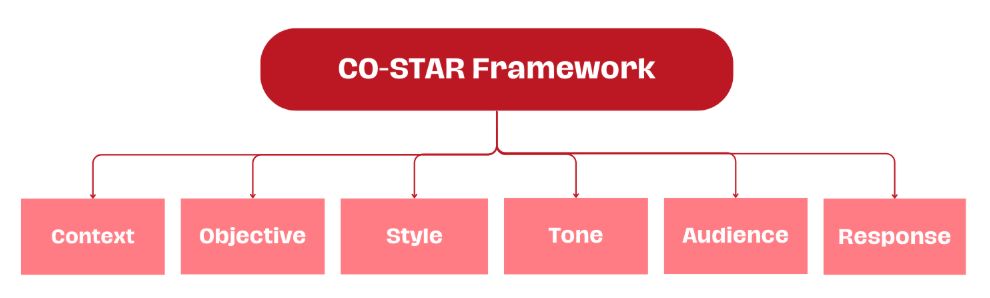
This involves learning about the varying capabilities of AI tools, as well as skills like GovTech’s CO-STAR framework.
Lee adds the new skill he has picked up means that he can now use AI for more complex tasks, some of which he would not have attempted before.
In September, the Singapore government announced that all public servants will have to attend a mandatory AI course.
In the opening address, Minister of State for Digital Development and Information, Jasmin Lau, who is also the Minister-in-Charge of GovTech shared that the permanent secretaries have undergone the training, and the ministers will be going through training this month.
How literacy is applied back to different public domains
The finalists highlight that they have gained some “soft” skills in the process, including critical thinking, public speaking when it comes to pitching to the audience and judges, as well as taking a user-centric approach when developing products.
Empathising with the user’s needs, MOE’s Chua says “different people will access the AI product at a different level depending on their needs and profiles.
“So, for me, it’s thinking about the person who uses it and it’s a key skill I have been trying to sharpen.”
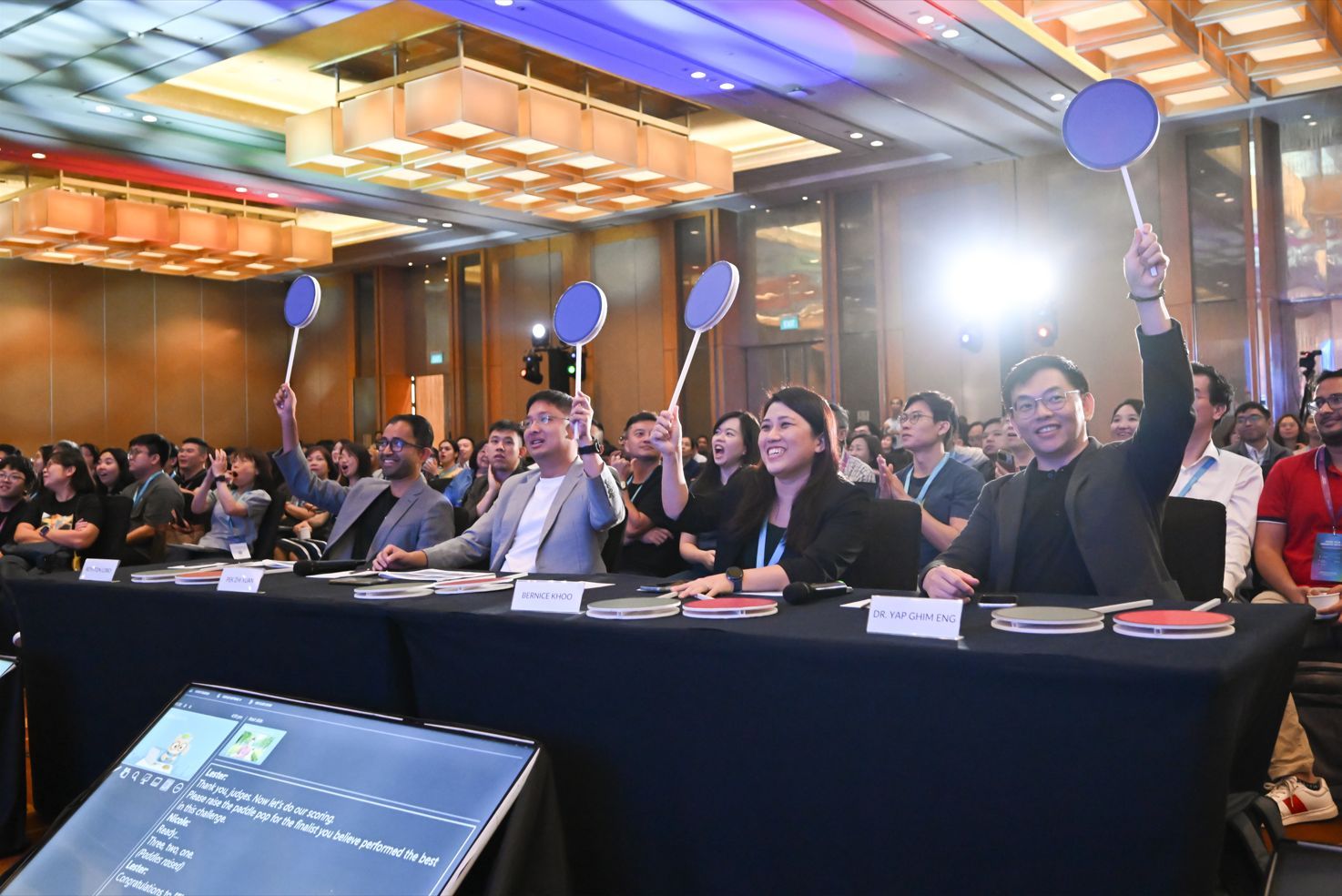
At the live competition, the finalists competed on four prompts. The AI-generated outputs were then evaluated by judges as well as audience voting. The judging criteria ranged from the quality of prompts and outputs, creativity, engagement, and overall impression.
HDB’s Lee secured the most points, which made him the winner of this year’s Prompt Royale.
Moving forward, Lee shares that he is already starting to build an AI bot for easier reference of building code requirements.
SCDF’s Azman highlights that his colleagues are also developing an AI bot for internal training materials.
“It’s also made simpler because it’s right on our phones, so everyone has access to the bot, and you can ask it anytime whenever they are unsure of a certain process,” he explains.
MOE’s Chua is experimenting with AI to enhance education and career guidance in his school.
“Schools have now one educational and career guidance (ECG) counsellor, and some form teachers are doing a little bit of that guidance. But it’s never enough, right?
“How can we multiply these capabilities with technology? And that’s what AI affords us the possibilities to do so,” he adds.