
Collaborative approach the way forward for Indonesia’s DPI journey
The country has been advancing its digital public infrastructure (DPI) strategy by building trust and aligning central and local governments under a shared vision.

Indonesia's story is one of those featured in the GovMesh Digest special report
Indonesia’s story is one of those featured in the GovMesh Digest special report. ou can find the individual stories on the other participating governments at GovMesh 4.0 here.
Indonesia’s digital government ambitions were not vague aspirations without a clear vision.
Over the past decade, the country has laid down the groundwork through a range of policies including comprehensive digital government frameworks.
However, delivering this vision across thousands of islands, hundreds of millions of people, through hundreds of institutions, while tackling a legacy bureaucratic system was used to operating in silos has presented a unique challenge.
Untangling this complexity – and how digital public infrastructure (DPI) can bind whole-of-government efforts – was the central theme of a presentation by Indonesia’s Ministry of National Development Planning (Bappenas) Senior Planner, Lisa Shaumanissa, during the GovMesh 4.0 event, organised by GovInsider and interweave.gov in Singapore, March 2 in conjunction with GovInsider’s Festival of Innovation 2026.
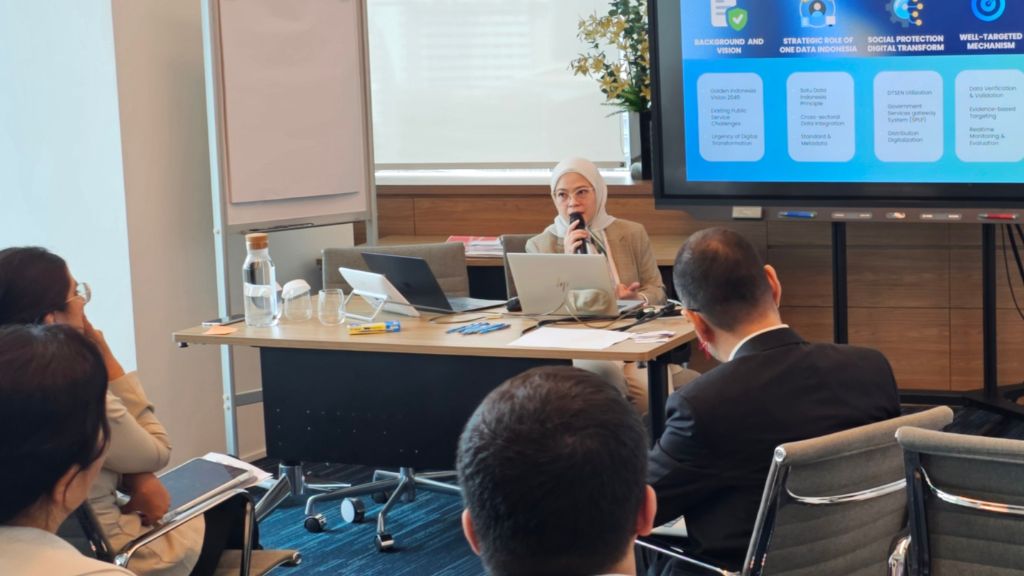
“Indonesia is in the process of transitioning towards a fully digital government, and we are trying to use DPI as a one tool to combine all the ministries and sectors to support our public services.”
Shaumanissa started her presentation by talking about Satu Data Indonesia, an initiative designed to unify fragmented government data systems, anchored on principles of data standardisation, interoperability, and shared metadata.
The initiative was mandatory for both central and local governments.
The challenge, however, lies in its scale.
Indonesia’s decentralised governance structure has meant that provinces, regencies, and cities have historically developed their own systems in silos.
To address this, the Satu Data Indonesia Agency has been actively engaging stakeholders through virtual and in-person outrech, helping them align with Satu Data Indonesia’s standards.
“Despite the complexity, we are happy because they are encouraged to learn,” she said.
DPI as the integration layer
Shaumanissa went on to explain how DPI acts as the glue binding cross-sectoral ministerial efforts to overcome fragmented systems.
This architecture spans multiple layers, from foundational infrastructure such as connectivity and computing to data governance through Satu Data Indonesia, and application layers including digital identity, digital payments, and data exchange.
One key component was Sistem Penghubung Layanan Pemerintah (SPLP), a government Application Programming Interface (API) layer developed by Ministry of Communication and Digital that connected systems across ministries.
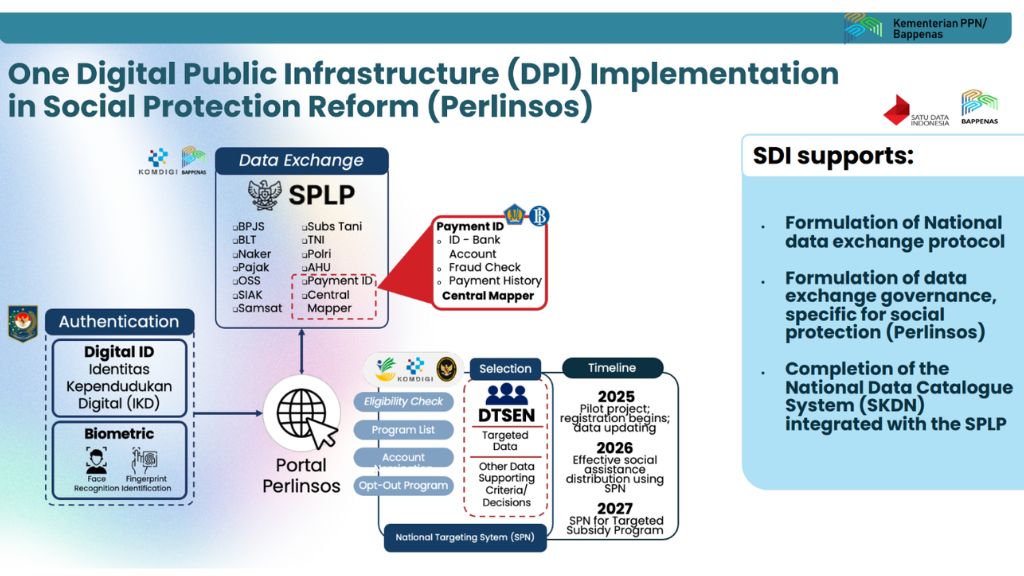
“They developed it as a gateway to connect one system to another across ministries,” Shaumanissa said.
She also highlighted the importance of reducing bureaucratic layers by simplifying inter-ministerial business processes. With trusted systems in place, data exchange would no longer require paperwork or memorandum of understanding (MoUs).
According to Shaumanissa, Indonesia’s DPI strategy was not only about system integration, but also about redesigning services from a citizen-centric perspective.
She described the “life journey” approach, where services were structured around citizens’ life events from birth and immunisation to social assistance delivery.
All processes were supported by integrated data and digital identity.
She pointed to one ongoing DPI use case: the social protection programme (perlinsos).
Through an integrated portal, citizens can apply for assistance, which is then verified and processed through interconnected data systems.
“All citizens can use the portal to apply for social assistance programme. Looking ahead, this portal will continue to be developed to support other government assistance services,” she explained.
The system then assesses eligibility, matches applicants with master data across assistance programmes, and the government disburses support through digital payments.
With fully integrated DPI, policymakers also benefit from more targeted assistance programmes and more efficient, inclusive economic growth.
Continuous learning
Despite progress, Indonesia’s DPI journey remained a work in progress, characterised by ongoing experimentation and continuous learning.
“We are still learning by doing. Not everybody is happy,” said Shaumanissa, noting that trust and resistance within government were the biggest hurdles.
She cited data sharing as a continuing sensitive issue. While Indonesia has made progress in data governance, privacy concerns still influenced institutional behaviour.
“Indonesia has enacted a Personal Data Protection Law, which sometimes makes ministries overly cautious to share data,” noted Shaumanissa.
As a result, data often remains concentrated within certain agencies, limiting its broader use for policymaking and public service delivery.
A similar paradox existed in technology management. Some ministries were reluctant to integrate, believing their existing systems were sufficient.
To address this, Bappenas has adopted a collaborative rather than a top-down approach.
“We always try to engage and hug them and continuously explain the importance of integrated DPI,” she said.
Shaumanissa outlined Indonesia’s five-year plan to strengthen the foundations of its digital government ecosystem, with digital identity as a key pillar.
The journey required sustained coordination, trust between institutions, and the willingness to break down long-standing silos that have shaped how the government operated.
“This journey is still ongoing. But the direction is clear. We are working hard to ensure everyone understands”, she added.