
Design thinking as a shared language of innovation
By Sol Gonzalez
Empathy, collaboration, and imagination are some of the skills that can contribute to “getting to innovation faster” by experimenting and solving problems, shares Ngee Ann Polytechnic’s Allen Lee.
-1771916122951.jpg)
Implementing design thinking across an organisation is about fostering a culture of experimentation, resulting in taking a different approach to create better experiences, products, or services based on the situation or problem addressed. Image: Canva.
Perfection stops innovation, says Ngee Ann Polytechnic's Strategy Lead & Senior Manager of the Human-Centred Design Institute (HCDI), Allen Lee.
When it comes to finding new and better ways to serve citizens, a mindset focussed on perfection can be costly.
Lee explains that both human centred design and design thinking deal with “developing solutions in the service of people, placing the user in the middle of all that we do”.
“All government agencies are in the business of experiences. With that, human centred design is a key component in making those experiences better, a discipline of developing solutions in the service of people,” says Lee.
He explains that design thinking does not end in a single workshop or training programme – it is a discipline that encompasses methods and mindsets that can help people and organisations innovate with confidence.
Empathy, collaboration, and imagination are some of the skills that can contribute to “getting to innovation faster” by experimenting and solving problems.
Lee shares how leveraging design thinking among teams can result in sharing a language of innovation where everyone contributes ideas and proactively gather perspectives to reach solutions that ultimately benefit citizens at large.
Recipes of innovation
At Ngee Ann Polytechnic, a public tertiary education, Lee explains that design thinking methods are taught based on the LUMA Institute which identifies 36 methods under four pillars: Looking, Understanding, Making, and Alignment.
The Harvard Business Review calls this a "taxonomy of innovation".
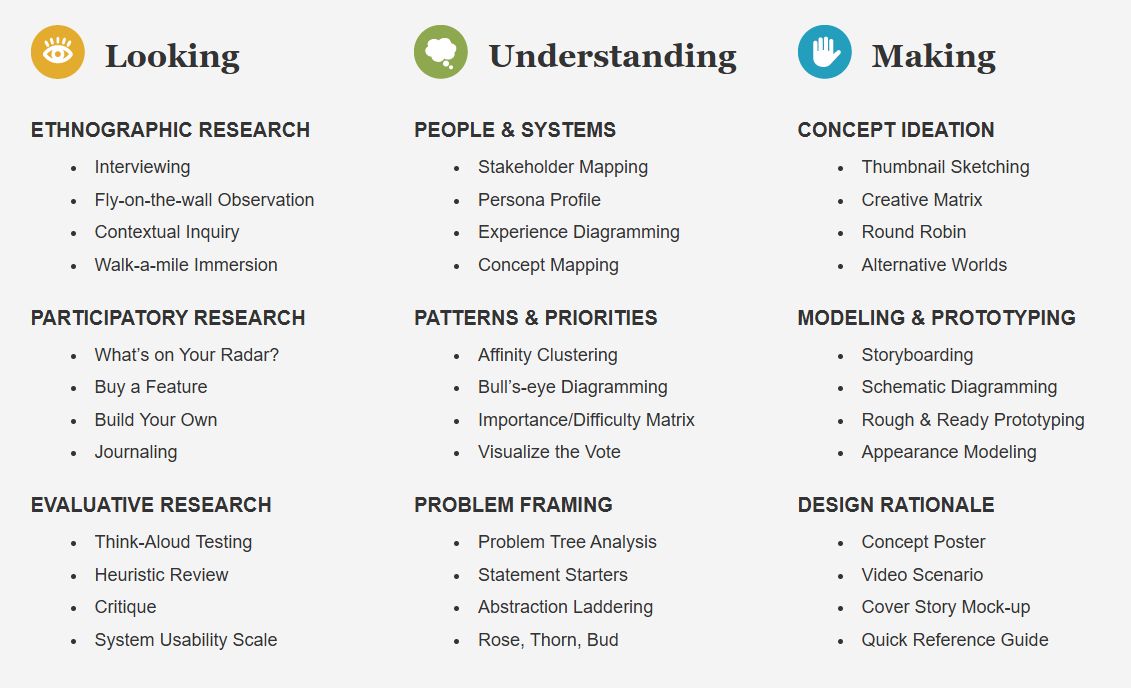
Lee explains that looking at these methods helps to reduce the decision paralysis of having too many ideas and provides a shared language for everyone involved to understand how a problem can be addressed.
“The whole idea is that when you’re talking about equipping a workforce, you want to ensure that the methods are easily grasped even by the last person all the way from the top to down the line,” says Lee.
The 36 methods can be combined differently to get “recipes” and fit many use cases and different scenarios.
This shared language of innovation, where methods are easily understood by everyone regardless of organisational level, helps to execute design thinking as a strategy and ultimately achieve transformation more effectively and faster.
“The ability to have a simple language for people to operate innovation is vital. You don’t want people to get bogged down in different definitions, so the quicker you get people to doing, the faster you innovate,” says Lee.
Walking the talk: design doing
On walking the talk, he says that instead of just talking about design thinking as a theory, the discipline is a more proactive attitude of implementing its methods.
Implementing design thinking across an organisation may manifest in taking a different approach to create better experiences, products, or services based on the situation or problem addressed.
Most importantly, human centred design is a culture of experimentation, notes Lee.
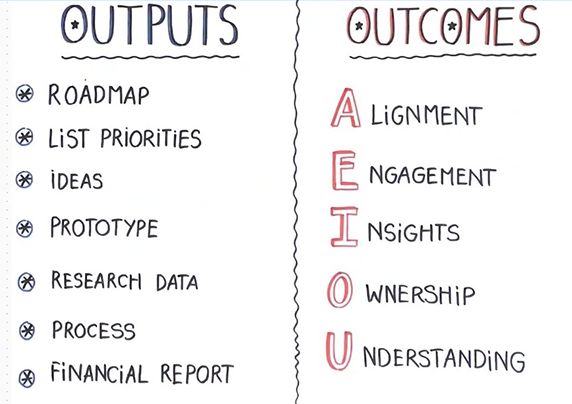
He reframes “win and lose” to “win and learn”, emphasising the importance of prototyping and iteration.
“We get a culture of failing fast and learning fast. Ultimately, the citizens benefit because you reduce the cost of failure, you get products that are more suited to different target audiences,” he says.
“The point is to do it in service of what we call organisational outcomes. Are we more aligned? Are we better engaged? Do we have better insights? Human centred design allows us to get these outcomes faster and better.”
Across the world, the Brazilian government adopted human centred design to enable ‘psychologically safe spaces’ where public servants can experiment, fail, and try again with confidence.
Previously, GovInsider covered how Singapore has been developing design thinking capabilities across different areas, from education to public sector.
Lee highlights design thinking as a lifelong skill, which SkillsFuture Singapore also emphasised in its Critical Core Skills (CCS) Framework which covers skills that enhance human adaptability and employability for now and the future.
Design thinking is included in the CCS category of “Thinking Critically” across abilities such as problem solving, decision making, and creative thinking.
Done is better than perfect
Public sector agencies often deal with “wicked problems”— problems with many different stakeholders involved, where each has a different definition of what success looks like.
Solutions for wicked problems “will likely never be perfect, [they] just get closer and closer to better,” says Lee.
He adds that this is where design thinking can help, with approaches such as the Double Diamond Framework.
Instead of jumping to a solution, the diamond shape represents a process where one expands to get as many different options and perspectives as possible and then converge, explains Lee.
“We do that process for both the problem and the solution. We want to spend enough time to really define the issue, and once we’ve invested sufficient time, we move to the solutioning to develop and deliver [the solution]”.
This approach also helps agencies to move away from the idea that solutions will be perfect, something essential for a thriving innovation culture.
“The idea is to build a culture that reassures that it’s okay to not be perfect. Done is better than perfect,” says Lee.
Allen Lee is one of the speakers at the Festival of Innovation 2026, happening in Singapore on 3 & 4 March. You may register here.