
Indonesia's digital transformation must move from apps to impact and value
By Yuniar A.
The new measure of digitalisation is shifting from simply encouraging adoption towards integrating public services and building shared infrastructure, says Minister for Administrative and Bureaucratic Reform Rini Widyantini.
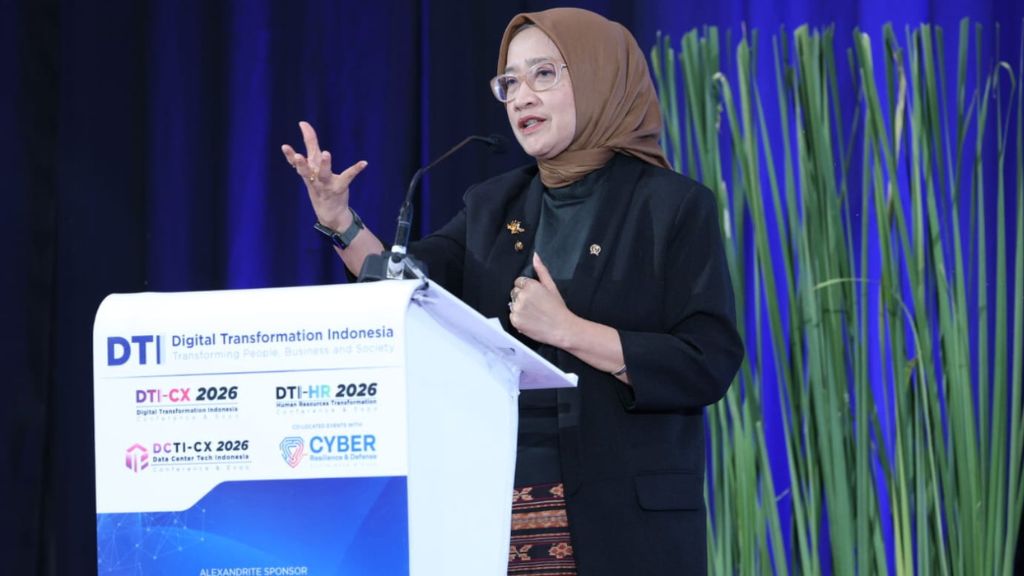
At the Digital Transformation Indonesia Conference and Expo (DTI-CX) 2026, government leaders highlighted the importance of digital transformation that creates impact and economic value for citizens. Image: DTI-CX
The new challenge for Indonesia's digital transformation is no longer just building more apps or pushing citizens to use digital services, but ensuring technology genuinely simplifies services, boosts productivity, and creates economic value at home.
That was the central message of a government keynote session at the Digital Transformation Indonesia Conference and Expo, held on August 5-6 at the Jakarta International Convention Centre (JICC).
Minister for Administrative and Bureaucratic Reform (PANRB), Rini Widyantini, highlighted service fragmentation as the biggest challenge facing government digital transformation.
Indonesia has developed around 27,000 government applications. Yet a large number of apps have not automatically made public services simpler.
"With digital adoption rising, the government has to ensure integrated services and deliver an experience that shows government genuinely working as one," said Widyantini.
According to her, digitalisation without integration simply preserves old bureaucratic habits in a new form.
Citizens still find themselves moving from one platform to another, entering the same data repeatedly, or even carrying physical documents between different agencies.
The new measure of digitalisation
In recent years, the government has pushed forward developing its digital public infrastructure (DPI) as a shared foundation linking various government systems, said Widyantini.
This foundation covers digital identity, digital payments, data exchange, and the use of big data and artificial intelligence (AI) as layers built on top.
Through DPI, data can be exchanged securely, meaning citizens no longer need to repeat the form-filling process when accessing different services.
For Rini, DPI is reshaping how the bureaucracy thinks about technology.
“With shared infrastructure in place, the government no longer measures digitalisation's success by how many systems or apps have been built, but by its impact on citizens and how much time, cost and burden it removes.”
She pointed to the use of DPI in the social protection digitalisation programme.
Integrating digital identity, data exchange and payment systems has cut the process of verifying eligibility for social assistance recipients – once a matter of months – down somewhere between minutes and hours.
The number of steps involved has also dropped from seven to three.
"That's the real measure of success for digital transformation. So, it isn't measured by how many systems are built, but by the time saved in delivering a service," she added.
This approach also puts citizens at the centre of transformation.
She stressed that inclusivity in public services must be built in from the start, not bolted on after a system is already finished.
Government services need to be easy to reach and easy to access, offer guided support, and be developed through co-creation with citizens, particularly the groups facing the biggest barriers.
Digitalisation, she added, doesn't mean every service has to move online.
"The most important thing is simplifying the business process behind a service. We need to simplify the service first, before we even talk about digitalisation," she concluded.
From users to value creators
Ministry of Communication and Digital’s Director-General of the Digital Ecosystem, Edwin Hidayat Abdullah, underlined the importance of technological sovereignty in lifting productivity and creating economic value.
"To increase productivity, technological intervention is inevitable," he said, adding that such intervention should be aimed at ensuring growth spread evenly and generated prosperity.
He argued that Indonesia needs to drive digital value creation built on homegrown innovation.
"Domestic innovation needs to be strengthened, so we can move away from being users to creators of solutions," he added.
This is being pursued through government support for a competitive digital economy ecosystem, aimed at generating more innovation from local start-ups and technology companies.
The government is also investing in underlying infrastructure such as cloud, data centres and networks.
Even so, Abdullah flagged energy supply as one of the key challenges facing the digital economy ecosystem.
The pipeline for data centre development through 2030 could reach around 10 gigawatts, while available electricity capacity is considered insufficient to match it.
Indonesia also faces a shortage of digital talent. Edwin estimated the country needs around 9 to 12 million skilled workers by 2030.
Beyond that, there remains a need for greater access to capital for research, technology firms and MSMEs, as well as stronger regulatory frameworks and a more robust ICT manufacturing industry.
Digitalisation as a lever for industrial productivity
The need to generate value from technology is also felt strongly in the manufacturing sector.
Coordinating Ministry for Economic Affairs’ Deputy for Trade and Industry, Ali Murtopo Simbolon, highlighted digitalisation as one of the key levers of industrial productivity.
According to him, the implementation of the Making Indonesia 4.0 roadmap has pushed the manufacturing sector to technologies, including robotics, smart logistics and cloud computing to industrial Internet of Things, cybersecurity and digital platforms.
This momentum is being reinforced further by ASEAN's digital economic integration, which is opening up far larger market opportunities.
"The domestic market potential that can be optimised is estimated at around US$800 billion, while the growth of data centres and AI is opening up even bigger investment opportunities," said Murtopo.
Yet behind this acceleration lies a fundamental question: who controls the underlying technology foundations?
"Data is the primary foundation," he said.
He stressed that Indonesia needs to ensure data remains under national control and sovereignty before AI is optimised to boost productivity in either services or production.
Echoing Abdullah, Murtopo also called for faster development of national data centre capacity, with targets having grown to around 11.8 gigawatts today.
To get there, he believes more specific regulatory support is needed so that investment can move more quickly.
He hopes industry players will bring concrete proposals to economic policymakers on the regulatory support required.
Read also:
Energy, connectivity and cybersecurity as foundations of Indonesia's digital economy
Better data can build more connected cities