
Next leap of Indonesia’s digital government is simplifying state access for citizens
The government believed that the success of digital transformation could no longer be measured solely by tech sophistication, but by whether citizens felt the services they need were readily available.
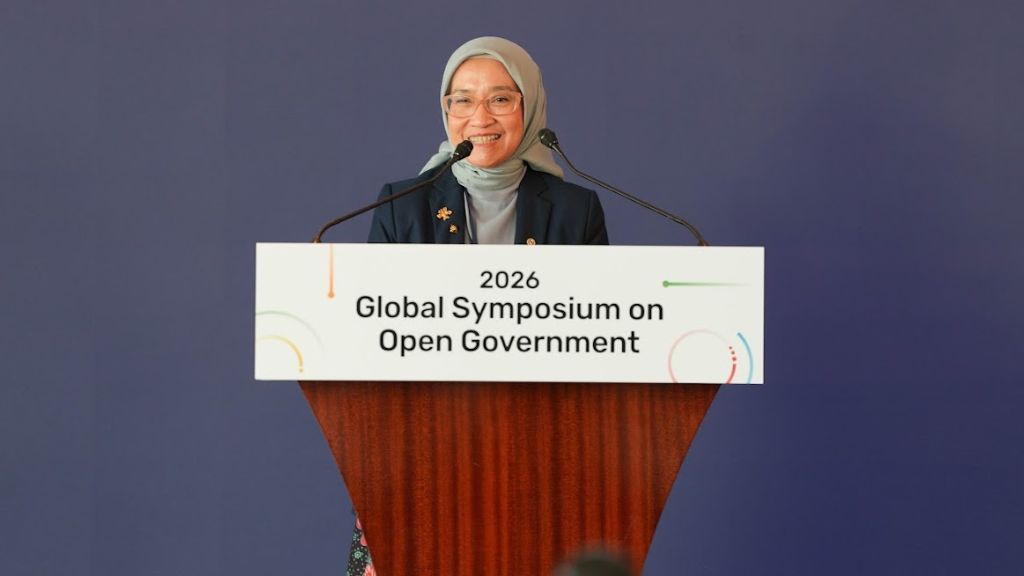
Indonesia's Minister of Administrative and Bureaucratic Reform Rini Widyantini emphasised that the government's digital transformation must deliver public services that are closer to citizens and have a meaningful impact on their lives. Image: Indonesia’s Ministry of Administrative and Bureaucratic Reform
Traditionally, government digital transformation has been discussed using technical jargons like interoperability, cloud infrastructure, and artificial intelligence (AI).
Indonesia’s Minister of Administrative and Bureaucratic Reform, Rini Widyantini, said this was not the correct approach as citizens do not experience government through technical terminology.
“People do not wake up in the morning thinking about interoperability. Nor do they automatically trust the state just because the government adopts AI,” she said.
Widyantini made her remarks at the OECD Global Symposium on Open Government 2026 event in Seoul, South Korea, on May 22.
Citizens experience the government through personal interactions, like when young job seekers were able to access opportunities more easily with connected databases, or when mothers in remote communities were able to access social services online without taking leave from work and sacrificing their incomes.
“These are the moments when the government finally feels reachable,” Widyantini said.
She added it was for this reason digital transformation shouldn’t merely be a technology modernisation project, but an effort to rebuild public trust in the state.
Indonesia’s challenge
Widyantini highlighted that building public trust in Indonesia was more complex given the enormous scale.
As an archipelagic country with more than 17,000 islands and a population exceeding 280 million people, geographical disparities often translate into unequal access to public services.
As a result, the Indonesian government increasingly saw digital transformation as an issue of social equity, not merely bureaucratic modernisation.
For years, the government has struggled with fragmented digitalisation. Thousands of applications and systems were developed independently across ministries and agencies.
As a result, citizens repeatedly had to go through the same processes, submit the same data, create dozens of accounts, move from one office to another, and navigate disconnected systems.
“Perhaps this is a paradox many countries face today. We are becoming far more digital, but are we becoming any simpler?”, she asked.
This was why the next phase of Indonesia’s digital transformation was no longer about building more applications but about simplifying how citizens access government services, Widyantini said.
Strengthening digital public infrastructure (DPI)
To this effect, Indonesia was currently strengthening its digital public infrastructure (DPI).
The government was building digital foundations through strong digital identity systems, integrated digital payments, secure data exchange, and responsible AI adoption.

“Most importantly, we are ensuring that these backend systems create a tangible, front-facing impact for ordinary citizens,” Widyantini noted.
She cited the transformation of Indonesia’s social protection delivery through a pilot programme in Banyuwangi, East Java (Perlinsos). The pilot has been successful and would be replicated across more than 40 cities and regencies nationwide.
Previously, vulnerable citizens had to endure lengthy verification processes to receive state assistance.
Some waited months simply to find out whether they qualified for social aid, while continuing to spend money on transportation just to submit documents.
By integrating DPI foundations such as digital identity and interoperable inter-agency data exchange, verification processes that previously took between 75 and 200 days could now reportedly be completed within minutes or hours.
Administrative costs for citizens have fallen significantly, while access to social assistance has become much faster, she added.
“For thousands of families, this means less stress, less uncertainty, and immediate access to a safety net when they need it most”.
One portal for all services
To unify citizen experience, Indonesia was developing INAku, an integrated portal designed to simplify public services into one connected journey, Widyantini said.
Indonesia was also accelerating the implementation of Digital Population Identity (IKD), Indonesian Digital ID, which had already connected millions of users to essential public services.
Concurrently, Indonesia was developing Government Service Connectivity System (SPLP) as a national interoperability infrastructure enabling secure cross-agency data exchange.
These initiatives provided an important foundation for a more integrated and citizen-centred digital government transformation.
Indonesia was also strengthening the development of GovTech Indonesia as part of a broader effort to bring together government services, data, and business processes, she said.
By adopting a more integrated approach, the government enabled citizens to access public services in ways that are simpler, faster, and more connected.
“We view GovTech not merely as a collection of digital platforms, but as an institutional enabler for whole-of-government transformation,” she said.
Ultimately, the goals of these initiatives are not merely public service convenience, but building a state that is more transparent, accountable, and trustworthy.
Building public trust
According to Widyantini, the world today was facing not only technological challenges, but also a crisis of public trust.
This is why the principles of open government were becoming increasingly important.
“Openness reminds us that citizens are not passive consumers of technology – they are active partners and co-creators,” she added.
This was especially important because no country possessed all the answers to the challenges of digital transformation, particularly as AI begins to reshape governance models around the world.
Widyantini also highlighted the importance of international collaboration, openness to mutual learning, and human-centred innovation to ensure digital transformation becomes truly meaningful.
Widyantini emphasised that the success of digital transformation was not measured by how sophisticated algorithms become, but by whether the systems can make governance smarter, fairer, faster, and kinder.
“True transformation was proven when citizens genuinely feel that their government is present in their lives, more responsive to their struggles, and entirely worthy of their trust,” she concluded.