
Singapore to set up 12 pilots and an observatory to put its skills-first push into practice
Moving beyond national frameworks and support systems, the Centre for Skills-First Practices (CSFP)'s new initiatives want to make skills-based practices easier to adopt and to deliver more visible results for individual employees and enterprises.
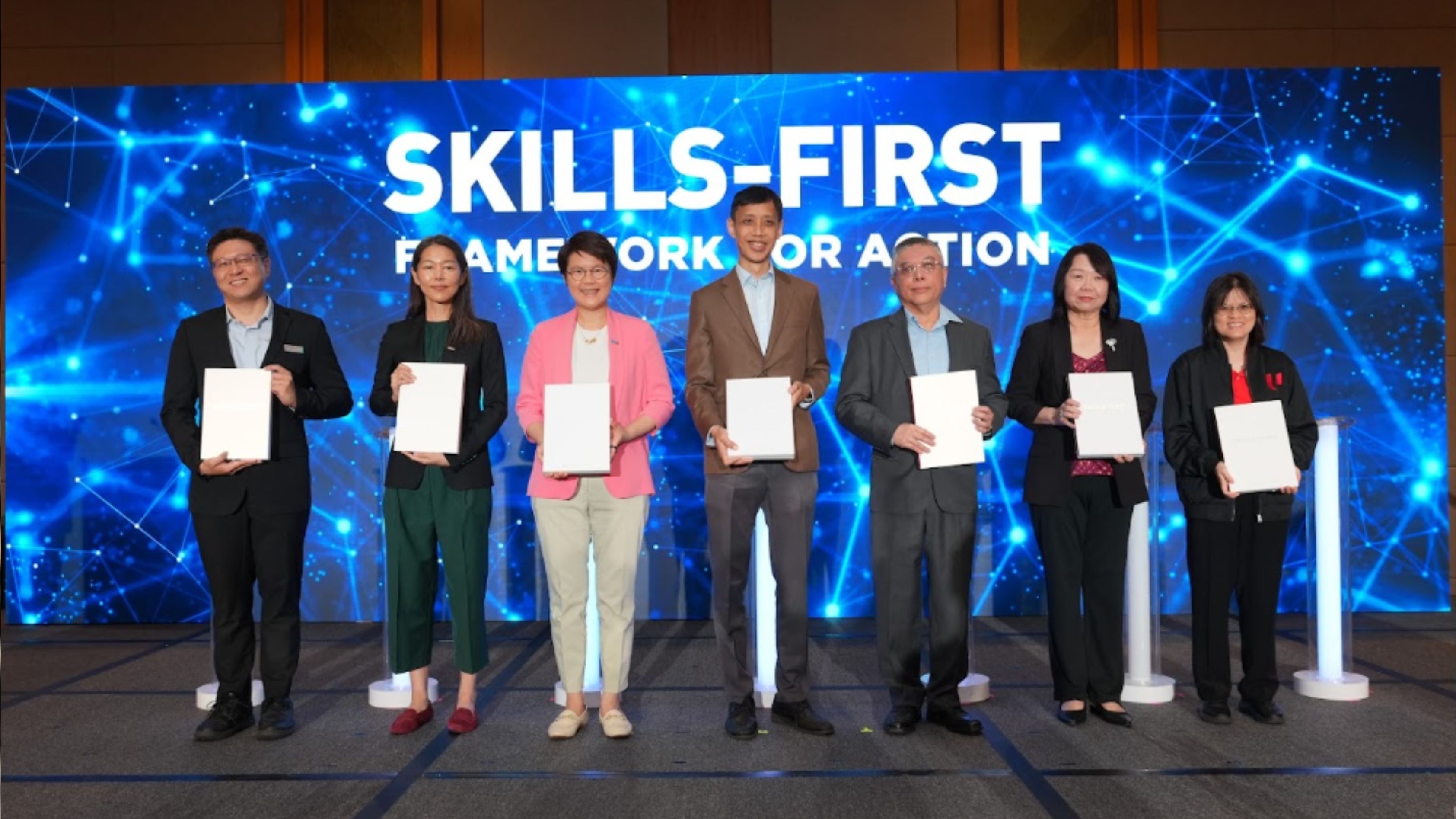
The Centre for Skills-First Practices (CSFP) has launched the skills-first framework for action, consisting of 12 pilot ideas and a national observatory to prototype and track the adoption and outcomes of skills-first practices in Singapore. Image: CSFP
The nature of work is quickly evolving, even more so with artificial intelligence (AI) and automation.
So today, it's no longer enough for individual employees to simply acquire more skills to keep up with these changes.
Singapore's shift towards a a skills-based approach, which values skills built through past experiences rather than qualifications alone, was meant to close this gap.
But many of these efforts have been piecemeal and remained conceptual.
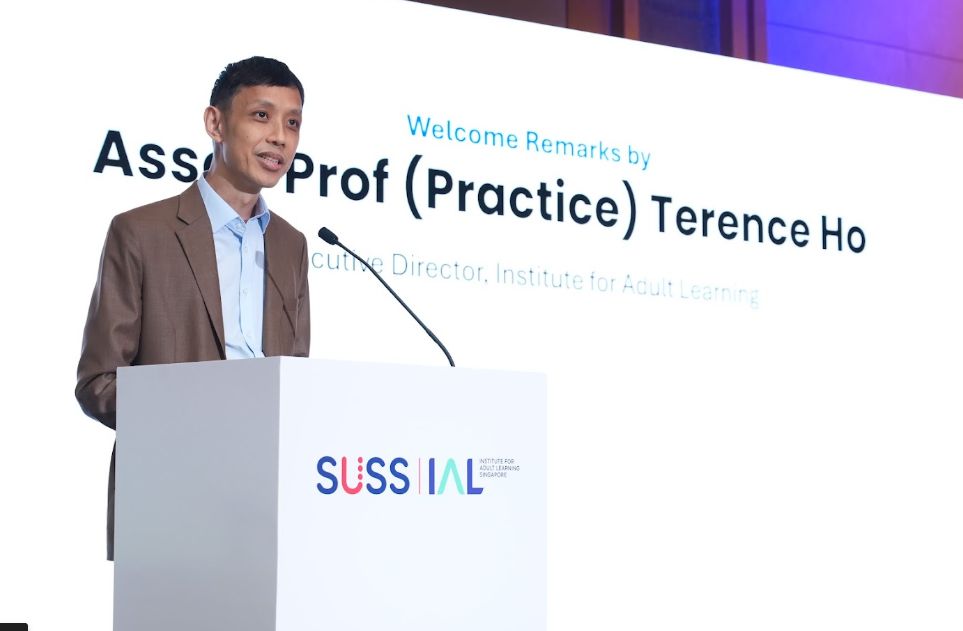
Delivering the opening remarks at the launch event of a new framework, Institute for Adult Learning (IAL)'s Executive Director, Associate Professor (Practice) Terence Ho, highlighted the skills-based approach as a key enabler for future career health.
In the age of AI, individuals and employers alike cannot predict with certainty what is required to adapt to the future workforce, "but we do know for sure that our workers must be nimble and adaptable, and continually adapt the skills in order to remain relevant."
To move beyond high-level frameworks and programmes, the Centre for Skills-First Practices (CSFP) has proposed 12 pilot ideas to build evidence of what works.
The centre would also set up a skills-first observatory to monitor adoption and track outcomes, as well as a community to convene employers, researchers and experts to focus on the translation work of this skills-first approach.
These initiatives are part of the skills-first framework for action launched by the centre on October 19.
The centre is parked under Singapore’s Institute for Adult Learning (IAL) launched the Centre for Skills-First Practices (CSFP) to leverage labour market data to design interventions around the national skills-first focus.
The framework was developed after two years of research and engagement involving more than 1,000 participants from across the government, industry, labour, education and the workforce, as well as and roundtables that explored different aspects of skills-first practices.
Led by the centre, the framework was co-developed alongside the Skills and Workforce Development Agency (SWDA), National Trades Union Congress (NTUC), Singapore Business Federation (SBF), Singapore National Employers Federation (SNEF) and Singapore University of Social Sciences (SUSS).
Foundations in place, prototypes needed to shift behaviors
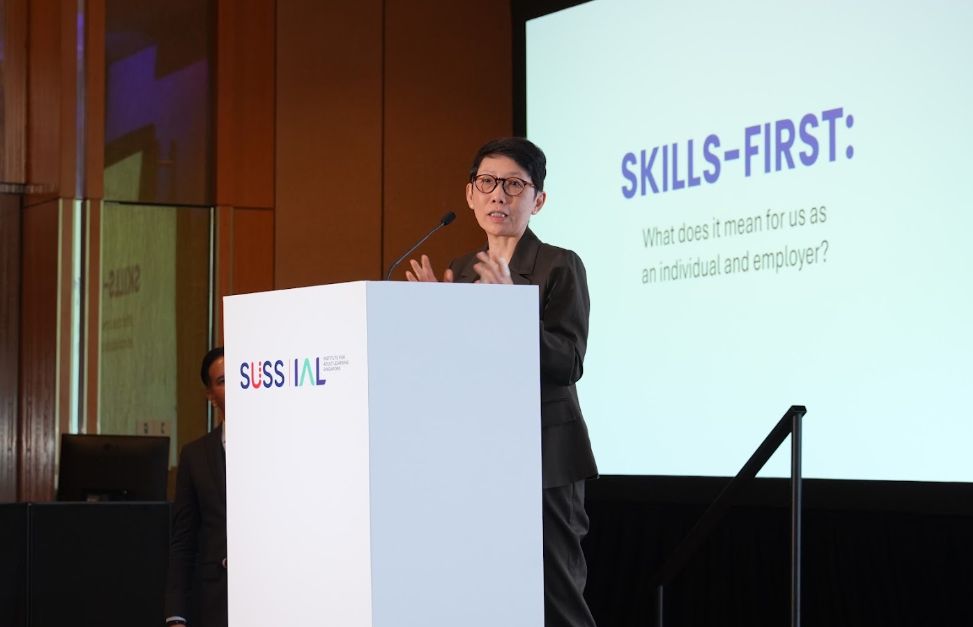
"Singapore has one of the best resource systems in the world for business transformation and workforce transition," said IAL's Senior Director (Special Projects), Dr Gog Soon-Joo, amid transformation, in a presentation at the launch event.
Her presentation highlighted a range of initiatives put forth by SWDA, across skills frameworks, transformation maps, course fee subsidies, transition and job seeker support programmes, to
enterprise workplace transformation.
The next step is to change how employees and businesses behave, by making skills-based practices routine, the default, and shared across organisations.
The 12 initial pilot ideas served as practical starting points for action to enable employers, individuals, and the system-wide infrastructure.
The website details the ideas, alongside who's working on them. It also has learning resources to support employers, education and training providers and sector agencies to enable a skills-first approach.
In a period of rapid changes, making skills-first work comes down to everyday decisions on who gets hired, how roles are designed, and who is chosen to work on projects.
Individuals also make decisions about learning, career development and skills signalling, she said.
GovInsider also recently covered the use of rapid prototyping in redesigning roles in Singapore's healthcare sector.
A national level observatory to measure skills-first adoption
This prototyping process is followed by plans to set up a national level observatory to monitor Singapore's progress towards a skills-first workforce ecosystem.
The observatory will be developed in phases.
In the first half of 2027, the centre expects to decide on measurement approaches, set up data-sharing agreements with relevant partners, and determine where new data collection is needed.
In the second half of 2027, it will test new research instruments, carry out the first measurement cycle, and establish a national baseline for skills-first adoption.
From 2028, the centre expects to run regular measurement cycles to track the direction and scale of change in skills-first adoption over time, as well as its impact on workforce and enterprise outcomes.
It plans to use the emerging findings to identify strengths and gaps, and to inform ongoing policy.
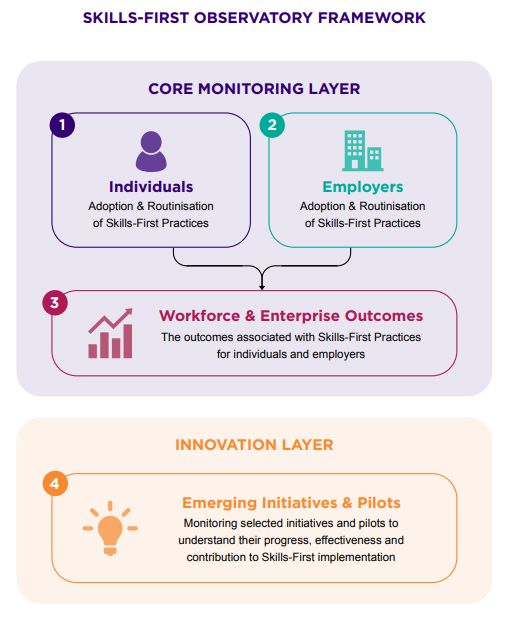
The centre plans to incorporate two layers into the observatory: a core monitoring layer and an innovation layer.
While the former tracks the impact of routine adoption of skills-first practices on workforce and enterprise outcomes among individuals and employers, the latter tracks the lessons gathered from emerging, ground-up pilot initiatives to advance these practices.
For individuals, these measurements might range from how regularly people review and articulate their skills, use skills information to guide career and learning decisions, and apply their skills at work.
For employers, they could include the use of skills in hiring, workforce development, deployment and progression decisions.
To support the innovation layer, the centre would also lead a community of stakeholders who are interested to embed a skills-based approach within their organisations and networks, and who can learn from one another along the way.