
Future-ready public sector workforce needs to ‘break the silence’ to innovate
By Sol Gonzalez
Speakers at the Festival of Innovation 2026 emphasised the importance of communication to foster action within a resilient workforce that enabled innovation, co-creation, and continuous learning.
-1773798415008.jpg)
The panel session, Building Future-Ready Talent Pipelines, explored how agencies could plan, recruit, and upskill workforces to remain agile in a rapidly changing environment. Image: GovInsider.
While silence in busy, high stakes environments could be a welcomed opportunity to re-centre oneself, some types of silence could be the enemy to innovation.
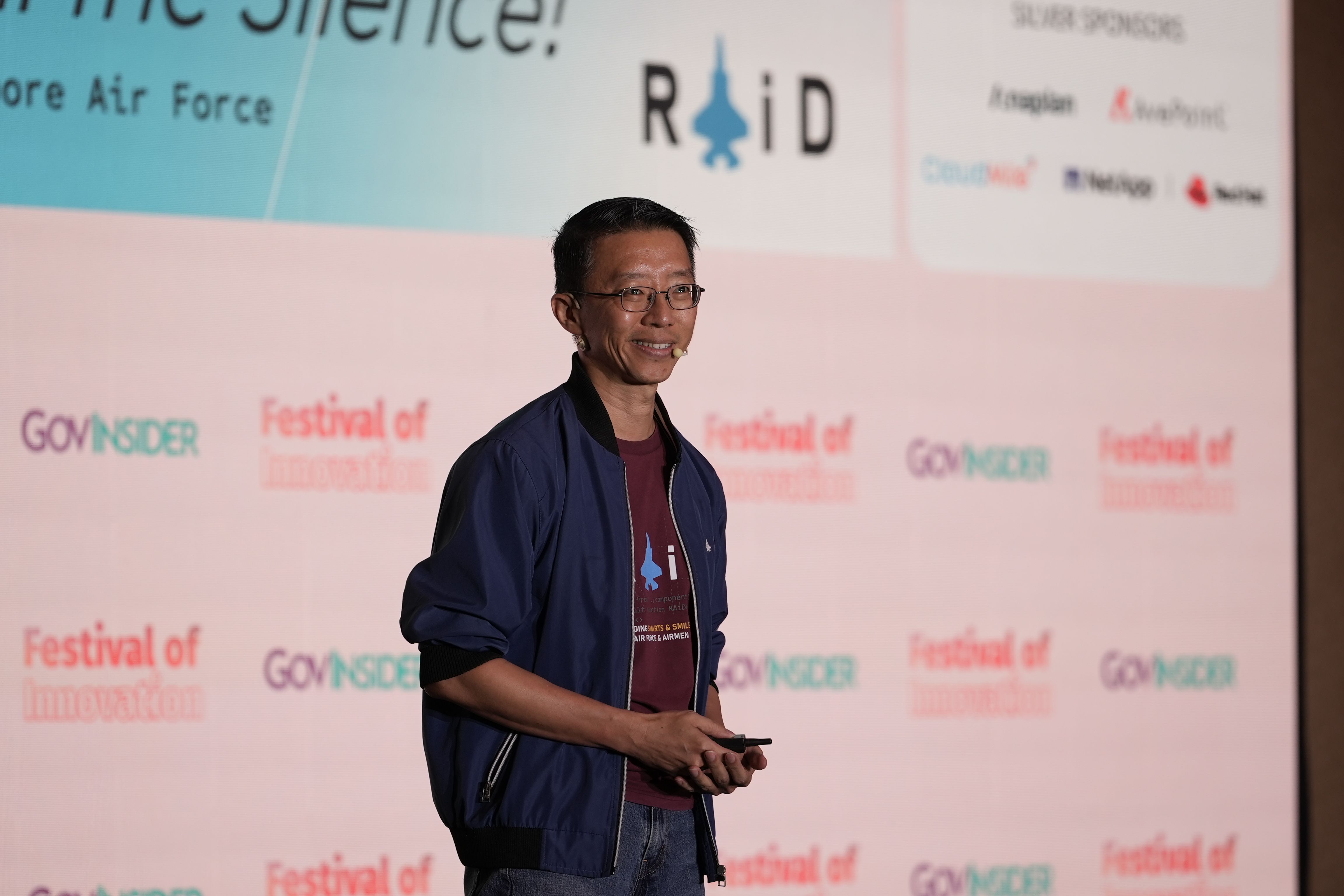
This was a point raised by Republic of Singapore Air Force (RSAF)’s Chief Data Officer, Gek-Peng Tay, who addressed the subject of detrimental impact of silence in workforce transformation.
“Silence can prevent unique perspectives from being heard, it can prevent the learning across disciplines and boundaries, and it can prevent new relevant skills from being applied,” said Tay during his presentation, Future-Ready Workforce: Aligning Talent with Long-Term Transformation Goals at the Festival of Innovation (FOI) 2026 on March 4.
Tay introduced the “bar fight” framework as a way of breaking silence, fostering action, and evaluating results.
It was key to provide space to be “comfortable to fail well and again”. Teams could then communicate what worked and what didn’t, so that learning and experimentation were continuous and failures came as lessons, he shared.
According to him, the key characteristics of being a future-ready workforce included adaptability, agility, and capability of navigating uncertainty.
Team of teams approach
Tay shared that his team broke the silence and acted through the Air Force’s ground-up innovation movement called SWiFT, which developed the SwiftMed app for contact tracing within the Air Force during the Covid-19 pandemic.
The movement proved the need for an in-house tech unit that was “always future-ready and thriving in disruptions” - and the result of this was RAiD founded in 2021 to drive digital solutions in the Air Force.
RAiD stands for RSAF Agile innovation Digital, and it embraced diversity by recruiting career switchers, interns, and non-uniform personnel, while partnering with institutions and industry players.
The unit adopted a "team of teams" approach, promoting autonomy and collaboration to maintain agility.
RAiD also realigned performance management to emphasise collaboration and shared success, adding considerations such as “how is an individual helping somebody else from a different team? Or how is he building on the solutions from others?”
Innovation was encouraged by providing an environment where teams felt secure to experiment on their own without having to ask for permission.
“There are many things that need you to go out there and go and search for yourself and then learn. And it also creates that safety net for them to fail fast,” shared Tay.
RAiD received a Special Mention for the Moon-Shot Award at the FOI Awards 2026, which recognised bold, transformative initiatives that drive extraordinary impact and innovation.
Versatility to remain adaptive
The panel session, Building Future-Ready Talent Pipelines, explored how agencies could plan, recruit, and upskill workforces to remain agile in a rapidly changing environment.
SkillsFuture SG’s Director of Jobs-Skills Insights Division, Kelvin Hee, noted that there was a growing demand for “bread-and-butter” skills, those that are relevant for daily operations such as customer relations and IT support, alongside fast-growing competencies in artificial intelligence (AI).
As the future becomes increasingly digital, the workforce would require more “bilingual AI” workers who combine sector-specific expertise with AI fluency, the speakers noted.
NUS-ISS' Digital Strategy & Leadership Practice, Principal Lecturer and Consultant, Sharon Lau, said this “bilingualism” was an example of versatility, which is a cornerstone of future readiness.
She added that there was a crucial need for public sector professionals to balance breadth and depth of knowledge.
“We have to understand each of these domains, how [they] interact with each other.
“So, when you make a decision, now or in the future, we must be able to see how this decision is going to affect not just within our area, but the bigger picture,” said Lau.
Underlying these sentiments was the need for continuous learning and upskilling.
The panellists highlighted intellectual humility as the key trait for navigating uncertainty and becoming future-ready.
“Acknowledging what you do not know and actively seeking out new skills, new knowledge, new competencies, to really be able to adapt and manage in this very uncertain world. Being future-ready is about being comfortable [with] uncertainty,” said Hee.
“Learning is not separate from work, it's actually part of work,” added Lau.
Speaking the same language on all levels
Speakers highlighted that having all levels of an organisation on board was important to foster a resilient workforce.
“When bosses take courses and speak the same language [of innovation], it creates a powerful signal throughout the organisation.
“The inverse is equally true; if bosses aren’t doing it, employees question why they should,” said Ngee Ann Polytechnic (NP)’s Human Centred Design Institute, Strategy Lead & Senior Manager, Allen Lee.
He shared that when NP began its innovation journey, training the bosses was an important first step to inculcate a mindset that is open to innovation.
Lee noted that over 30 per cent of NP’s workforce was now certified in human-centred design.
Achieving a resilient workforce
Speaking about job retention, Singapore Academy of Law ‘s Chief Legal Officer and Senior Director of Learning and Professional Development Division, Delphine Loo Tan, highlighted the importance of communicating the “why” of the job.
She noted that for younger workers who seek purposeful and impactful work, leaders must help employees visualise how their day-to-day tasks contribute to broader organisational mandates and societal outcomes.
This reminder of purpose also helped organisations to navigate multidisciplinary collaboration challenges.
While different stakeholders might have different or conflicting priorities, leadership could help to unite these differences to achieve broader objectives.
“We have to remind people that at the end of the day, yes, we all have our needs, our teams, goals, whatever, but we have to always bring people looking at the bigger picture.
“It takes conversation, communication, and leadership to really help people find that common ground or sweet spot to work together and achieve common goals together,” said Lau, also highlighting the importance of breaking the silence to foster a more collaborative workforce.
Wrapping up the session, moderator Dr Nuraini Muhammad Naim, Head of CRC at Hospital Sungai Buloh, Ministry of Health Malaysia, noted that building a future-ready talent pipeline was a team effort.
“It’s everyone’s job to maintain the resilience, the adaptability, the flexibility of the workforce. Everybody should play a role in adapting to this evolving ecosystem,” she concluded.
To revisit this panel session, click here!